First Seen
2023-05-10T21:03:40+00:00
simple-description (llama3.2-vision_11b)
The meme is a screenshot from the TV show Star Trek: The Next Generation, featuring Captain Jean-Luc Picard responding to a question from a diplomat. The image shows Picard with a serious expression, and the text "I find your lack of faith disturbing" appears in the corner. The meme is a humorous take on this iconic line, with the added text "I find your lack of grammar disturbing".
detailed-analysis (gemma3-27b-vision)
Okay, let's break down this image and its overlaid text through the lenses you've requested. It's a rich image to analyze due to the combination of the original "Star Trek: The Next Generation" setting and the strikingly blunt, contemporary text overlay.
Visual Description
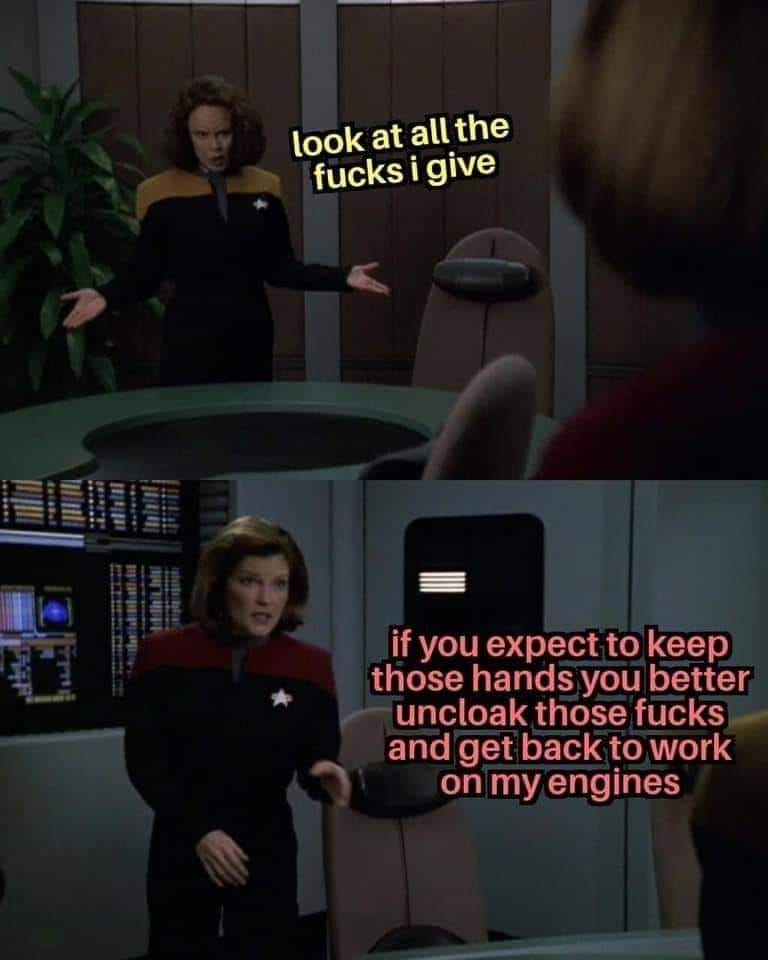
The image is a screen capture from a scene on the bridge of the USS Enterprise-D from Star Trek: The Next Generation. Two women, likely officers, are facing each other. The officer on the left, identifiable as Deanna Troi (Marina Sirtis), stands with her back to the camera, seemingly addressing the other woman, who is standing at a console. Troi’s posture is stiff and confrontational. The scene takes place in the distinctive teal and wood-paneled bridge setting of the Enterprise, with various control panels and monitor displays visible. The image quality suggests it's an older episode, likely from the late 1980s or early 1990s. The overlaid text appears in white, sans-serif font, placed strategically around the figures. The text is deliberately jarring in tone, clashing with the typically polite and measured dialogue of Star Trek.
Foucauldian Genealogical Discourse Analysis
This image and its text offer a fascinating example for a Foucauldian analysis.
- Power Dynamics: Foucault’s work emphasizes that power isn't simply top-down repression, but a diffuse network operating through discourse. In the original context of Star Trek, the command structure represents a defined power dynamic. However, the text disrupts this through a deliberately vulgar and aggressive tone. This isn't about hierarchical authority; it's about asserting dominance through language. The use of profanity is not about the content of the order, but about the performance of power, shocking and silencing through emotional force.
- Genealogy of "Fuck": The word "fuck" itself has a fascinating genealogy. It’s historically linked to ideas of transgression, rebellion, and the breakdown of social order. Its use here is not accidental; it's a way to disrupt the traditionally controlled discourse of the Enterprise and, perhaps, reveal the underlying tensions and frustrations within that seemingly utopian setting. It’s a reclaiming of agency through deliberately offensive language.
- Discursive Formation: The Star Trek universe is a "discursive formation" – a system of thought, language, and practices that construct a particular reality. The use of expletives and aggressive language here breaks that formation by interjecting a different set of social norms and ways of expressing authority.
Critical Theory
The image and its text engage with key themes in Critical Theory, particularly around alienation and the critique of idealized systems.
- Deconstruction of Utopia: Star Trek often presents a utopian vision of the future. However, this image suggests that even in a seemingly advanced and egalitarian society, tensions, frustrations, and power struggles still exist. The bluntness of the text exposes a rawness that's often hidden beneath the polite façade of Starfleet.
- Alienation: The officer's frustration (implied by the harsh language) could be seen as a form of alienation. Despite being part of a supposedly harmonious organization, she feels the need to express her authority in a deeply emotional and aggressive manner. This reveals a disconnect between the ideal of the organization and the reality of everyday interactions.
- Hegemony: The traditional Star Trek discourse (polite, reasoned) represents a kind of cultural hegemony – the dominance of a particular set of beliefs and values. The overlaid text is a direct challenge to this hegemony, a disruption of the accepted norms of communication.
Marxist Conflict Theory
While less directly applicable, a Marxist lens can be applied.
- Labor & Control: The directive to "get back to work on my engines" can be seen as a microcosm of capitalist labor relations. The officer is demanding the labor of another, enforcing a division of labor and exercising control over the means of production (the ship's engines). While the Star Trek universe is ostensibly post-scarcity, the image hints at the persistence of power imbalances within the organizational structure.
- Class/Status: Even within the seemingly egalitarian Starfleet, there are hierarchies of status and responsibility. The officer giving the order likely holds a higher rank than the one receiving it. The language used can be seen as a manifestation of this power dynamic, reinforcing the existing class structure.
Postmodernism
This image strongly resonates with postmodern themes:
- Meta-Commentary: The text overlaid onto the image creates a meta-commentary on the original Star Trek series. It deliberately disrupts the established tone and aesthetic, forcing the viewer to question the authenticity and idealism of the original source material.
- Pastiche & Parody: The juxtaposition of the sophisticated, futuristic setting with the vulgar language is a form of pastiche – a blending of different styles and contexts. It’s also a parody of the typical Star Trek dialogue and character interactions.
- Deconstruction of Meaning: By subverting the expectations of the audience, the image challenges the idea that meaning is fixed or stable. The text forces us to re-evaluate the scene and consider its underlying tensions and complexities.
- Simulacra and Simulation: The image can be read as a "simulacrum" – a copy without an original. It borrows from the Star Trek universe, but distorts and exaggerates its elements, creating a hyperreal representation that’s more about commentary than authenticity.
Queer Feminist Intersectional Analysis
This is where the analysis becomes particularly rich and interesting:
- Reclaiming Aggression: Traditionally, aggression and directness have been seen as masculine traits. The image features two women officers, and the officer delivering the harsh language is claiming agency and power through this traditionally masculine expression. This can be seen as a rejection of gendered expectations.
- Interruption of Politeness as a Gendered Expectation: Politeness and deference are often expected of women. The aggressive language disrupts this expectation, challenging the notion that women must always be accommodating or diplomatic.
- Power Dynamics & Gender: The image highlights the ways in which power dynamics are shaped by gender. The officer is using her authority to assert herself, potentially challenging the patriarchal structures that may exist within Starfleet.
- Intersectionality: The image suggests that power dynamics aren’t simply about gender or authority. They are shaped by the intersection of multiple factors, including rank, gender, and potentially even sexual orientation (though this isn't explicitly stated).
Let me know if you’d like me to delve deeper into any of these analyses or explore a specific aspect in more detail.
simple-description (llama3.2-vision)
This meme is a humorous take on a common phrase. The image features a screenshot from a Star Trek: The Next Generation episode, where Captain Jean-Luc Picard is shown with a raised eyebrow and a speechless expression. The text "In a room full of people, you think you can just yell at me?" is overlaid on the image.
tesseract-ocr
Semen aes Seite ane has & Pp ita r F 4 t ed " aE © bk s if you expect,to keep . Re those hands you better, uncloak those fucks and get back.to work | on|my engines AR