First Seen
2023-05-10T21:03:40+00:00
simple-description (llama3.2-vision_11b)
The meme is a Star Trek reference that juxtaposes the Star Trek universe's optimistic and progressive values with the harsh realities of the real world. The image shows a Star Trek character saying "Fascism is bad" in a utopian setting, but then suddenly cuts to a real-world scenario where fascism is prevalent. The text "Fascism is bad" is juxtaposed with "Fascism is good" in the real-world scenario, highlighting the irony of the Star Trek universe's optimistic values being at odds with the harsh realities of the world.
detailed-analysis (gemma3-27b-vision)
Okay, let's break down this image, which appears to be a collage exploring the ways in which Star Trek, specifically the original series, engaged with various political and social issues. I'll address the sections you've requested where applicable, recognizing that some lenses might not be as prominent in the collage as others.
Overall Visual Description
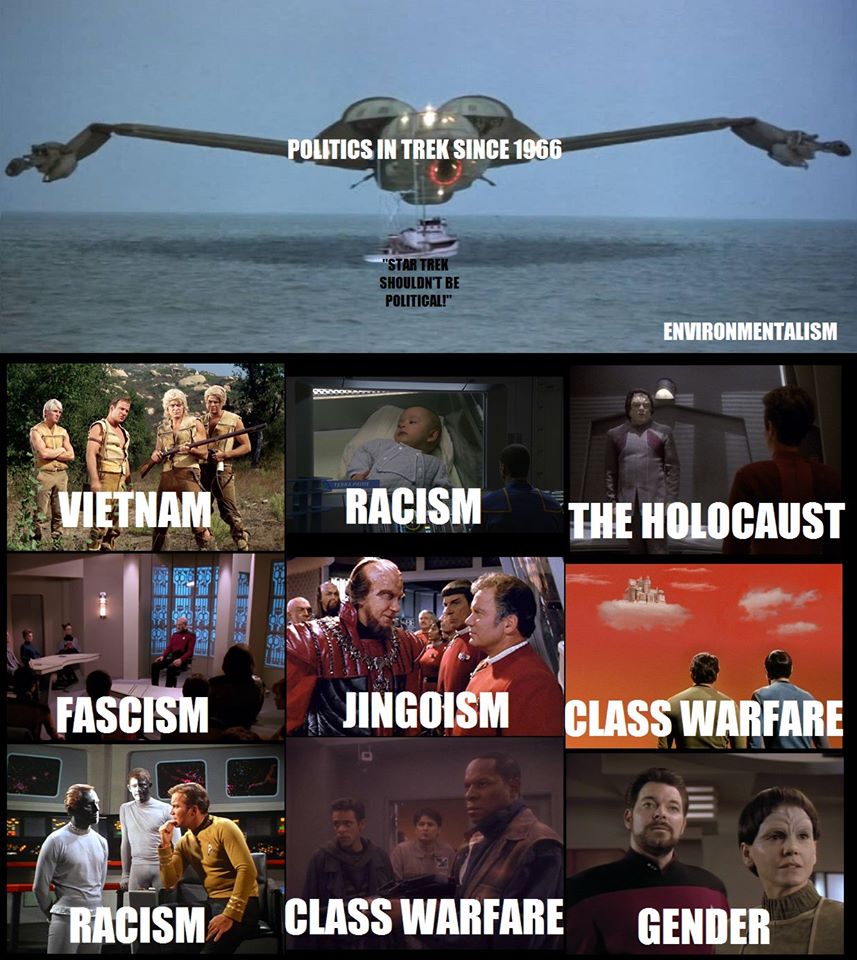
The image is a grid of stills taken from episodes of Star Trek (primarily the original series) and the movie Star Trek II: The Wrath of Khan. Each still is labeled with a keyword representing a political or social issue explored within the depicted scene. The overarching framing is the image of a Star Trek spaceship in the water, with text above it stating "Politics in Trek Since 1966" and a dismissive "Star Trek shouldn't be Political". The collage suggests an argument that Star Trek was and is deeply embedded in political commentary.
1. Foucauldian Genealogical Discourse Analysis
This lens is highly relevant. Foucault's work is about power/knowledge. Star Trek, as a cultural product, produces discourses around these issues. The collage highlights how Star Trek doesn't merely reflect existing ideologies but actively constructs understandings of them.
- Discursive Formation: Each image represents a specific "discursive formation" (a set of rules, assumptions, and practices that govern how we talk about a topic). For instance, the image labeled "Racism" establishes a way of seeing racism through the lens of the Star Trek universe, which, while often idealized, sets up a specific discourse (e.g., using alien differences to explore human prejudice).
- Power/Knowledge: The Star Trek narrative holds power because it creates knowledge. It positions certain ways of thinking about these issues as "correct" or "progressive" (even if imperfect). The scenes chosen present particular narratives, and thus, exercise power over how audiences understand these concepts.
- Genealogy: If we were to trace the "genealogy" (the historical development) of these concepts within the context of Star Trek, we’d see how the show evolved its portrayals of these issues over time, often responding to (and shaping) contemporary societal shifts.
2. Critical Theory
Critical Theory is also strongly applicable here.
- Ideology Critique: The collage is, implicitly, an exercise in ideology critique. The show often deconstructs dominant ideologies. The scenes labeled “Fascism”, “Jingoism”, and “Class Warfare” directly represent ideologies being critiqued within the fictional narrative.
- Domination & Resistance: Star Trek consistently presents power structures (Federation, Klingon Empire, etc.) and explores how individuals and groups resist those structures. This is at the heart of many episodes.
- The Enlightenment Project: Star Trek's optimistic vision of the future (at least initially) is tied to the Enlightenment project—the belief in reason, progress, and human potential. The collage subtly suggests that the show’s engagement with political issues is a continuation of this project—a striving for a more just and equitable future.
3. Marxist Conflict Theory
Marxist conflict theory is present, but perhaps not as central as the previous two.
- Class Struggle: The "Class Warfare" image (from Wrath of Khan) directly addresses this. It frames the conflict between Kirk and Khan as rooted in power dynamics and the consequences of social inequality.
- Resource Control: The conflict in Wrath of Khan also touches on control of resources (the Genesis device). This aligns with the Marxist focus on economic factors as driving conflict.
- Critique of Capitalism (Implicit): Star Trek frequently presents a post-scarcity society. This is an implicit critique of capitalism, suggesting that abundance is possible and that inequality isn’t inevitable.
4. Postmodernism
Postmodernism is less explicit but still relevant.
- Deconstruction of Grand Narratives: The collage itself deconstructs the idea that Star Trek is simply entertainment. It presents it as a complex text embedded in political discourse.
- Relativity of Truth: Some episodes explored different cultural perspectives and questioned universal truths. This aligns with the postmodern emphasis on the subjectivity of knowledge.
- Simulation & Hyperreality: The holographic depictions, simulations, and constructed realities within Star Trek (though not directly represented in these images) hint at a blurring of lines between reality and representation—a key concern of postmodern thought.
5. Queer Feminist Intersectional Analysis
This lens is the weakest in terms of direct representation, but relevant.
- Gender Roles: While the original series was quite heteronormative, the inclusion of strong female characters like Uhura and Nurse Chapel, even within limited roles, challenged traditional gender roles. The collage doesn't directly showcase this, but it is part of the show's legacy.
- Intersectionality: Star Trek began to explore how different forms of oppression (racism, sexism, speciesism) intersect. The depiction of alien cultures and the show’s exploration of prejudice offers some opportunities for intersectional analysis.
- Queer Representation (Evolving): While the original series didn't explicitly address LGBTQ+ issues, later iterations of Star Trek have become more inclusive. This collage is focused on the original series, so this aspect isn’t prominent.
Overall Interpretation
The collage argues that Star Trek wasn't just escapist science fiction; it was a vehicle for exploring important political and social issues. The act of putting these images together and labeling them emphasizes the show’s engagement with critical ideas. It also invites the audience to consider the ways in which the show shaped—and was shaped by—the political landscape of its time. The dismissive text "Star Trek shouldn't be Political" ironically underscores the argument.
Let me know if you’d like me to elaborate on any of these points or explore a specific theoretical lens in more detail.
simple-description (llama3.2-vision)
This meme is a humorous comparison of the Star Trek franchise's portrayal of politics in different eras. The image features a Star Trek spaceship flying over a series of iconic scenes from the franchise, with the names of various -isms (e.g. racism, fascism, communism) superimposed over them. The text "Politics in Trek since 1966" appears above the spaceship.
tesseract-ocr
2 nin . ; a SRS ert ncn pipet SS ee = eee etter A Ee ) ra Aneta, = ei CL are oN a pas 1 < 7 ret ail Se, a = za PRACISM? - CLASSWARFARE GENDER ©