First Seen
2023-05-10T21:03:40+00:00
simple-description (llama3.2-vision_11b)
This meme is a play on the idea of a futuristic food replicator from the Star Trek franchise. The image shows a person holding a device that looks like a cross between a 3D printer and a food processor, with a caption that says "I can recreate any flavor I want... but not the one that's stuck in my teeth". The meme is poking fun at the idea of a futuristic food replicator that can create any flavor, but not the one that's a common problem for humans.
detailed-analysis (gemma3-27b-vision)
Okay, let's break down this image and its implications through the lenses you've provided. This is a complex image, ripe for multiple layers of analysis.
Please note: I'm providing interpretations based on the image itself and the text accompanying it. There's some inherent speculation as we don’t know the full context of the meme’s creation or reception.
Visual Description
The image is a diptych, a two-part visual composition.
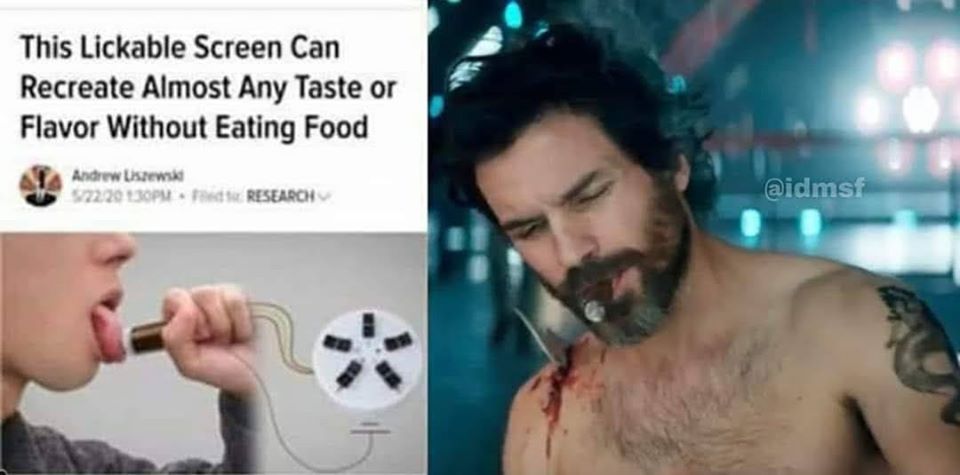
- Left Panel: A screenshot of a Twitter post by Andrew Liszewski from 5/22/20, stating "This Lickable Screen Can Recreate Almost Any Taste Or Flavor Without Eating Food." Beneath that is a photo of a person (presumably a man) licking a small, cylindrical device. The device appears to be a "digital taste simulator" or similar technology, with a spinning, multi-colored element visible near the licking point. The person is wearing a blue sweater.
- Right Panel: A dramatic, close-up photograph of a shirtless man with a full beard, dramatically lit. He is clutching a similar, cylindrical device (the same device from the left panel) to his mouth, and red liquid appears to be streaming from the device, around his mouth, and down his chin – resembling blood. He has a tattoo on his arm. The background is blurred and appears to be a neon-lit bar or club.
The juxtaposition of the two panels is striking and intentionally jarring. The left panel presents technology as a neutral advancement, while the right panel depicts a visceral, almost violent, interaction with the same technology.
Foucauldian Genealogical Discourse Analysis
This image provides a compelling entry point for a Foucauldian analysis focusing on the discourse of taste and consumption.
- Genealogy of Taste: Foucault traced how concepts like "madness" or "sexuality" were historically constructed through discourse. We can apply this to "taste." Historically, taste was linked to social class, refinement, and access to resources. This image disrupts that traditional link, suggesting taste can be simulated and decoupled from actual nourishment or origin.
- Power/Knowledge: The device represents a new form of power/knowledge. The "owners" of the technology control the creation of "taste" and can manipulate sensory experience. The image implies that this manipulation may not be benign. The 'blood' in the right panel can be seen as a visual metaphor for the potentially harmful or exploitative nature of such control.
- Disciplinary Power: The technology could also be viewed as a form of disciplinary power. By creating simulated experiences, it might serve to further control and normalize specific desires and cravings.
- The Body as Site of Control: The image centers the body – the tongue, the mouth – as the primary site where this power operates. The act of licking becomes a site of both pleasure and potential violation.
Critical Theory
A critical theory lens would examine the image as reflecting broader social anxieties and contradictions within late capitalism.
- Commodification of Experience: The device represents the ultimate commodification of experience. Not just food, but the sensation of taste itself is turned into a product. This aligns with the logic of late capitalism, where everything is potentially a marketable asset.
- Alienation: The simulated taste could be seen as a metaphor for alienation. We are increasingly disconnected from the sources of our sustenance and the natural world. The image suggests a disturbing move toward artificial satisfaction, rather than genuine fulfillment.
- Hyperreality and Simulation (Baudrillard): This image aligns strongly with Baudrillard's concepts of hyperreality and simulation. The simulated taste becomes more "real" than the original. It challenges the distinction between the real and the artificial. The blood in the right panel could be a signifier of that rupture—a sign that the simulation has gone wrong, or has become too intense.
- Spectacle and Consumption (Debord): The image also speaks to the concept of the "spectacle." We are bombarded with images of desired experiences (including taste), and the device offers a shortcut to those experiences, albeit an artificial one.
Marxist Conflict Theory
From a Marxist perspective, the image highlights the class dynamics inherent in technological advancement and the control of resources.
- Control of Means of Production: The company that produces this device controls the "means of production" of taste. They can dictate what tastes are available, potentially creating artificial scarcity or manipulating consumer desires.
- Commodification of Basic Needs: Even something as fundamental as taste, traditionally linked to sustenance, is turned into a commodity. This reinforces the capitalist logic of turning everything into a source of profit.
- Alienation of Labor: The device potentially displaces or devalues agricultural labor and the production of real food.
- Class Disparity: Access to this technology (and the simulated experiences it provides) would likely be unevenly distributed, exacerbating class disparities.
Postmodernism
The image is deeply imbued with postmodern characteristics.
- Deconstruction of Meaning: The image disrupts the traditional meaning of "taste" and "consumption." It challenges the idea that taste is inherently linked to food or natural sources.
- Blurring of Boundaries: The boundaries between the real and the artificial, the natural and the simulated, are blurred.
- Irony and Parody: The juxtaposition of the scientific, sterile image on the left with the dramatic, almost grotesque image on the right is inherently ironic. It parodies the idea of technological progress as inherently positive.
- Fragmentation and Pastiche: The image as a diptych is an example of fragmentation, while the mashup of technology and visceral imagery creates a pastiche of different styles and registers.
Queer Feminist Intersectional Analysis
This is potentially the most nuanced and complex area of analysis.
- The Body as Site of Control and Regulation: Feminist theory emphasizes how bodies, particularly female bodies, are historically controlled and regulated. The device can be seen as another form of this control – dictating what is deemed pleasurable or acceptable in terms of taste.
- Deconstructing Sensory Norms: Queer theory challenges heteronormative understandings of pleasure and desire. This image could be interpreted as a deconstruction of conventional sensory norms. The unsettling imagery might disrupt expectations of what is considered "good" or "desirable" taste.
- Intersectional Critique of Consumption: Intersectional feminism recognizes how race, class, gender, and sexuality intersect to shape experiences of oppression and privilege. Access to (and the consequences of) this technology would likely be unevenly distributed along these lines.
- The Grotesque and Abjection: The image on the right, with its blood-like substance, can be read through the lens of the "grotesque" (as theorized by Julia Kristeva). This image presents a body that is not clean or contained, challenging norms of beauty and control. This can be seen as a subversive act.
I hope this detailed analysis provides a helpful understanding of the image and its potential meanings. Let me know if you’d like me to elaborate on any of these points, or explore another angle of interpretation.
simple-description (llama3.2-vision)
This meme is a humorous commentary on the concept of a "lollipop that brings you back in time" from the movie "Back to the Future". The image shows a person licking a lollipop, but the lollipop is actually a device that looks like a miniature DeLorean, and the person is being pulled back in time. The text "This Lollipop brings you back in time" appears above the image, and the caption reads "I got my money's worth" in a playful reference to the movie's iconic time-traveling DeLorean.
tesseract-ocr
This Lickable Screen Can Recreate Almost Any Taste or Flavor Without Eating Food . a a ] > ~~ o ® 7 ‘ . — § ‘i Ae