First Seen
2023-05-10T21:03:40+00:00
simple-description (llama3.2-vision_11b)
The meme is a screenshot from Star Trek: The Next Generation, where Captain Jean-Luc Picard is quoted saying "I find your lack of faith disturbing" in a different context. The meme takes this quote and applies it to a scenario where Captain Jean-Luc Picard is being asked to explain the plot of Star Trek: The Next Generation, but he instead responds with the quote from Star Wars, saying "I find your lack of faith disturbing" in a context about explaining the plot of Star Trek: The Next Generation.
detailed-analysis (gemma3-27b-vision)
Okay, let's break down this meme featuring Captain Benjamin Sisko and Odo from Deep Space Nine using the frameworks you've requested. I'll go through each heading and assess whether it applies, and if so, provide an analysis.
Please note: These analyses are interpretations, and the applicability of certain frameworks to a meme can be subjective. I'll explain my reasoning.
Visual Description
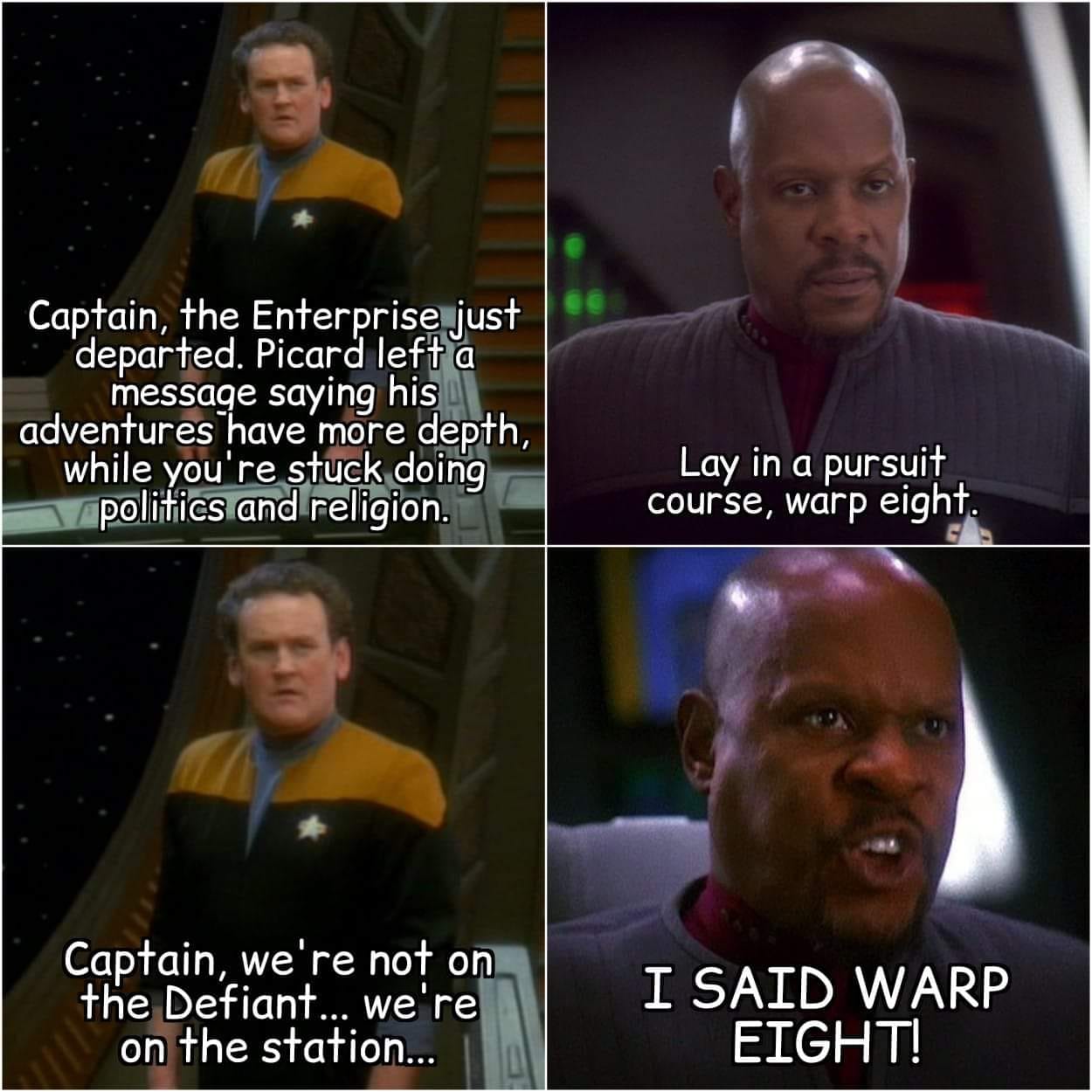
The image is a four-panel meme utilizing screencaps from Star Trek: Deep Space Nine. The dominant figures are Captain Benjamin Sisko (Avery Brooks) and Odo (René Auberjonois).
- Panel 1: Sisko is visible, looking slightly exasperated, and the text above him reads, "Captain, the Enterprise just departed. Picard left a message saying their adventures have more depth while you’re stuck doing politics and religion."
- Panel 2: A close-up of Odo with a stern and intensely focused expression. Text: “Lay in a pursuit course, warp eight.”
- Panel 3: Sisko, looking increasingly frustrated. Text: “Captain, we're not on the Defiant… we're on the station…”
- Panel 4: Another close-up of Odo, now visibly enraged, yelling. Text: “I SAID WARP EIGHT!”
The meme plays on a comedic contrast between Sisko’s more complex, bureaucratic, and politically fraught situation on Deep Space Nine versus the seemingly more exciting and action-oriented adventures of Captain Picard on the Enterprise. Odo’s repeated insistence on a specific technical order (“warp eight”) serves as a punchline, highlighting his rigidity and Sisko's increasing annoyance.
Foucauldian Genealogical Discourse Analysis
This framework is fairly relevant.
- Discourse & Power: The meme exposes the discourses of “adventure,” “exploration,” and “command” as constructed and inherently tied to power structures. Picard's adventures are framed as “having more depth,” which implies a value judgment about what constitutes worthwhile Starfleet activity. This subtly positions Picard’s command as “superior” because it embodies a certain (romanticized) ideal of Starfleet. Sisko’s command on DS9, being tied to politics and religion, is presented as less glamorous, less valued.
- Genealogy: Tracing the "genealogy" of "command" in Star Trek, we can see how the 'ideal' of a Captain shifts from Kirk’s swashbuckling adventurousness to Picard’s philosophical diplomacy and then to Sisko’s reluctant station commander dealing with messy terrestrial issues. Sisko's situation deconstructs the traditional heroic command archetype.
- Panopticism/Discipline: Although not as direct, the repetitive demand for "warp eight" can be read as a micro-level example of disciplinary power. Odo, as Head of Security, asserts control through meticulous adherence to protocol, a constant reminder of the rules and regulations that govern Deep Space Nine. It’s a demonstration of normalized control, even when it’s seemingly absurd in the context.
Critical Theory
Highly relevant. The meme is essentially a critique of how status, roles, and expectations are established and reinforced.
- Hegemony: The meme subtly challenges the "hegemony" of the Enterprise as the defining representation of Starfleet. By juxtaposing DS9 with the Enterprise, it highlights how the Enterprise’s brand of adventure has become the dominant cultural narrative of what Star Trek should be, even though DS9 offers a different, more complex, and arguably more realistic vision of interstellar diplomacy and conflict.
- Alienation: Sisko’s frustration can be interpreted as a symptom of alienation. He is alienated from the "pure" adventure narrative embodied by Picard, forced to deal with the mundane realities of political maneuvering, religious conflicts, and the constraints of being a station commander. He's trapped in a situation that doesn't align with the idealized image of Starfleet heroism.
- Deconstruction: The meme deconstructs the notion of the heroic captain. Sisko’s role on DS9 is messy, ambiguous, and often requires compromise. He’s not simply a bold explorer; he’s a bureaucrat, a negotiator, and a religious figure.
Marxist Conflict Theory
Somewhat applicable.
- Power Dynamics & Class: Deep Space Nine’s setting inherently involves conflict over resources, territory, and cultural control. The station is a point of intersection between various powers (the Federation, the Cardassians, Bajor). While this isn’t strictly a “class” conflict, it is a conflict over power and control, and Sisko is caught in the middle.
- Ideology: The emphasis on “adventure” versus “politics and religion” can be viewed as an ideological construction. The dominant ideology may valorize adventure and exploration while downplaying the importance of political and religious engagement, subtly reinforcing certain power structures.
- Commodification of Narrative: The meme itself commodifies narrative. It's a repackaging of existing content for entertainment, highlighting the commercial aspects of storytelling.
Postmodernism
Very relevant.
- Irony & Parody: The meme relies heavily on irony and parody. It’s a self-aware commentary on Star Trek tropes, and it plays with the expectations of the audience. It’s not taking the characters or situations at face value.
- Fragmentation of Grand Narratives: The meme undermines the "grand narrative" of Star Trek as a straightforward tale of exploration and progress. It suggests that reality is more complex, ambiguous, and fragmented. Sisko’s situation is messy, and there are no easy answers.
- Intertextuality: The meme is explicitly intertextual. It relies on the audience’s knowledge of both The Next Generation and Deep Space Nine to create meaning.
- Simulation & Hyperreality: The meme exists as a simulation of a conversation within the universe, divorced from its original context, becoming a separate layer of 'reality.'
Queer Feminist Intersectional Analysis
Less directly applicable, but some connections can be drawn.
- Challenging Heteronormative Structures: While Deep Space Nine isn't overtly focused on LGBTQ+ issues, the series does explore themes of difference, otherness, and challenging traditional norms. The depiction of Jadzia Dax, a Trill with a complex gender history, offers a space for exploring gender fluidity.
- Power Dynamics & Marginalization: Sisko, as a Black man in a position of authority, navigates complex power dynamics and racial tensions. This can be analyzed through an intersectional lens, considering how race, gender, and class intersect to shape his experiences.
- Reclaiming Narrative: The meme can be seen as a way of reclaiming narrative, subverting traditional Star Trek tropes and offering a different perspective on the characters and their motivations.
I hope this breakdown provides a useful analysis of the meme using these various theoretical frameworks! Let me know if you'd like me to expand on any of these points.
simple-description (llama3.2-vision)
The meme is a quote from the Star Trek: The Next Generation episode "The Enemy" featuring a conversation between Captain Jean-Luc Picard and his first officer Commander William Riker. The quote is "In a way, Commander, we're not where we used to be. We're not where we used to be. We're not where we used to be. Captain, we're not where we used to be. Captain, we're not where we used to be. Captain, we're not where we used to be. Captain, we're not where we used to be."
tesseract-ocr
i : € h eT Cel RL ™ departed. Picard lefitja tole ee ate aT | achein eres pop 1S ea ee a while you're stuck,doing, oe LU eel Cae icscudlaci-ans ¢ ee AL r - ee , Captain, we're not on ala DY sales I SAID WARP onthe station... | 17) EIGHT!