First Seen
2023-05-10T21:03:40+00:00
simple-description (llama3.2-vision_11b)
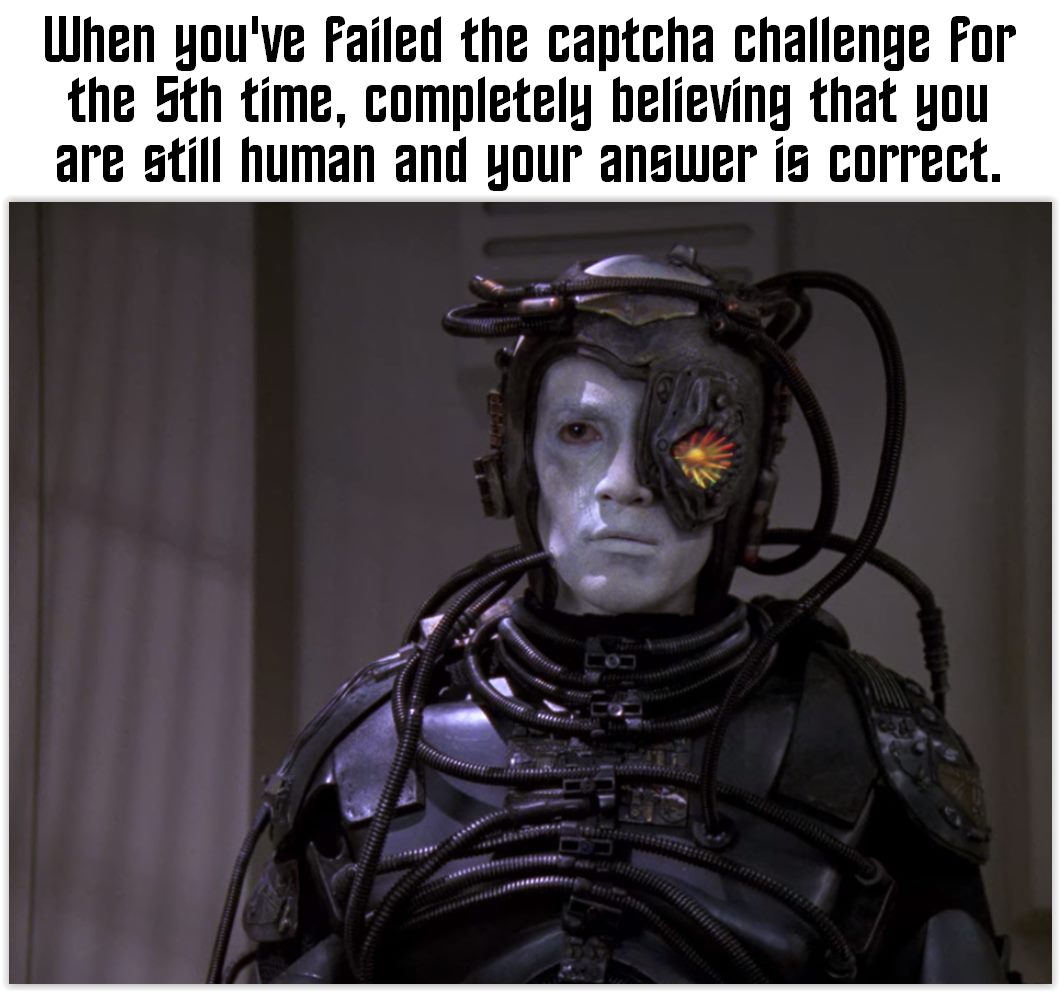
This meme is from the Star Trek category and is a play on the concept of a "captcha" - a type of challenge used to determine whether or not a user is a human. The meme is captioned "I'm not a bot, I'm a cyborg" and features a photo of the cyborg character from Star Trek: The Next Generation, Lieutenant Commander Data. The meme is poking fun at the idea that even a cyborg, a being with both human and machine components, can still fail at a captcha challenge.
detailed-analysis (gemma3-27b-vision)
Okay, here's an analysis of the image and its accompanying text, broken down into sections as requested. Not every section will apply, and I'll explain why where appropriate.
Visual Description
The image features a character heavily augmented with mechanical and cybernetic components. The character's face is pale and mostly human, but with a prominent cybernetic eye. A network of tubes, wires, and metallic plates covers a substantial portion of the torso, creating a visually striking contrast between organic and synthetic elements. The character's expression is somewhat melancholic, with a downturned mouth and a focused gaze. The lighting is dramatic, casting shadows that emphasize the mechanical details and the character's semi-human form. The background is dark and indistinct, which draws attention to the subject. The figure appears to be from a science fiction context, specifically Darmok and Jalad at Tanagra from Star Trek: The Next Generation.
Foucauldian Genealogical Discourse Analysis
This image and its caption lend themselves quite well to a Foucauldian reading. The core concern of Michel Foucault centers around the relationship between power, knowledge, and discourse.
- The "Human" as a Construct: The caption’s insistence on still being "human" despite repeated failure of the CAPTCHA test is telling. The CAPTCHA acts as a test of what defines being human in the digital age. Is it the ability to recognize patterns that an algorithm deems "human-like"? The CAPTCHA constructs a discourse around what is considered authentic human experience, and the character's resistance reveals the arbitrary nature of this construction.
- Disciplinary Power: CAPTCHAs can be understood as forms of disciplinary power. They are designed to separate "humans" from "bots" and regulate access to online resources. The character’s failure represents a breakdown in that disciplinary system. The test assumes a certain way of being human, and the failure of the test creates a "deviant" category.
- Genealogy of the "Human": A genealogical investigation might trace the evolution of the concept of "humanity" itself. The image, with its cyborg-like figure, challenges the historical boundaries between human, machine, and animal. The very act of having to prove one’s humanity suggests that this category is not fixed or natural, but rather historically contingent and constructed through discourse.
Critical Theory
The image speaks to central themes within Critical Theory, particularly relating to alienation, technological control, and the changing nature of identity.
- Alienation: The cyborg figure can be interpreted as a representation of alienation – the separation of the individual from themselves, from others, and from their own labor. The mechanical augmentations represent a loss of organic wholeness and a dependence on technology. The repeated CAPTCHA failures can be seen as a further alienation, denying the subject access to the digital world.
- Technological Control: The image reflects a concern about the increasing control of technology over human life. The CAPTCHA is a small example, but it highlights a broader trend of being subjected to algorithmic judgment and verification.
- Identity & The Body: The cyborg’s body is a site of contestation. The melding of flesh and machine raises questions about what constitutes the "self" and how identity is formed in a technologically mediated world. The insistence on remaining "human" is a desperate attempt to reaffirm a threatened sense of self.
Marxist Conflict Theory
A Marxist interpretation focuses on the potential for conflict and exploitation within a technologically advanced society.
- The Labor of Verification: The CAPTCHA itself can be seen as a form of digital labor. Users are required to perform this seemingly insignificant task to verify their own humanity, benefiting the corporations that use CAPTCHAs to protect their systems. This labor is often unpaid and invisible, mirroring the exploitative relationships of capitalist production.
- Technological Class Warfare: The image might be seen as foreshadowing a future where access to technology and digital resources is unequally distributed, creating new forms of class division. The cyborg’s inability to pass the CAPTCHA test could represent the marginalization of those who are deemed "other" by the algorithmic gatekeepers.
- Commodification of Humanity: The fact that proving one’s humanity has become a necessary step in accessing online resources suggests that humanity itself is being commodified – turned into something that can be bought, sold, and controlled.
Postmodernism
Postmodern thought emphasizes the breakdown of grand narratives, the rejection of universal truths, and the embrace of fragmentation and ambiguity.
- Blurring of Boundaries: The cyborg figure embodies the postmodern blurring of boundaries between human and machine, organic and inorganic, real and artificial. It challenges the traditional notion of a fixed, stable identity.
- Simulacra & Simulation: The CAPTCHA test can be seen as a simulacrum – a copy without an original. It is a test of recognition, but the images or puzzles it presents are often arbitrary and disconnected from any meaningful reality.
- Deconstruction of "Humanity": Postmodern thought often involves deconstructing essentialist categories, such as "humanity." The image, with its cyborg figure and the caption’s insistence on still being human, highlights the instability and constructedness of this category.
Queer Feminist Intersectional Analysis
While not the most immediate lens, a Queer Feminist Intersectional approach can reveal interesting aspects:
- Challenging Normative Bodies: The cyborg body inherently challenges the traditional, normative definition of the "human" body. It disrupts the binary opposition of male/female and expands the possibilities of embodiment. This can be aligned with queer and feminist struggles against oppressive body norms.
- Algorithmic Bias: Algorithms, including those used in CAPTCHAs, can perpetuate existing biases and inequalities. For example, if the training data used to develop the CAPTCHA is biased against certain demographics, it may be more difficult for members of those groups to pass the test.
- Access & Exclusion: The inability to pass the CAPTCHA test can be seen as a form of exclusion, denying the subject access to online resources and participation in the digital world. This exclusion can disproportionately affect marginalized communities who already face barriers to access.
Hopefully, this breakdown provides a comprehensive analysis of the image and its accompanying text through the requested theoretical lenses. Let me know if you'd like me to elaborate on any particular aspect.
simple-description (llama3.2-vision)
This meme is a humorous take on the frustration of repeatedly failing to pass a CAPTCHA (Completely Automated Public Turing Test to Tell Computers and Humans Apart) test. The image features a character from the Star Trek franchise, Lieutenant Worf, with a sarcastic expression and the text "I'm not a robot" (a common CAPTCHA response) displayed above him. The meme is captioned "When you've failed the CAPTCHA 5 times in a row".
tesseract-ocr
When you've Failed the captcha challenge For the 5th time, completely believing that you are Still human and your answer is correct. yo ABE "