First Seen
2023-05-10T21:03:40+00:00
simple-description (llama3.2-vision_11b)
The meme is a screenshot from the Star Trek: The Next Generation episode "The Outcast," where the character Jean-Luc Picard is seen holding a PADD (Personal Access Display Device) with a quote from Shakespeare's "The Tempest": "We are such stuff as dreams are made on, and our little life is rounded with a sleep." However, in the meme, the quote is replaced with a humorous phrase "We are such stuff as tacos are made on, and our little life is rounded with a burrito."
detailed-analysis (gemma3-27b-vision)
Okay, let's break down this iconic image through the lenses you've requested. It's a meme originating from the Zelda video game series, repurposed to represent a specific kind of social commentary. Here's an analysis, section by section, with acknowledgements that some categories will be more relevant than others.
Visual Description
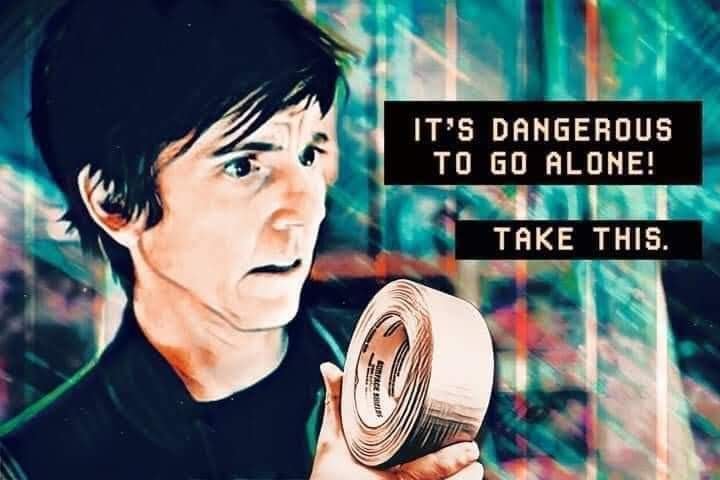
The image features a close-up of Link, the protagonist from the Legend of Zelda video game series. He has short, dark hair and intense, concerned eyes. He is wearing the tunic and clothing characteristic of his appearance in Ocarina of Time. He is holding a roll of duct tape. Overlaid on the image are two lines of white text in a bold, sans-serif font enclosed in a black box: "IT'S DANGEROUS TO GO ALONE!" and "TAKE THIS." The background is blurred but suggests the interior of a dungeon or cave, likely from the game. The image has a slightly desaturated, hazy quality. The overall composition creates a sense of urgency and a peculiar juxtaposition between the fantasy setting of the game and the mundane item of duct tape.
Foucauldian Genealogical Discourse Analysis
This image resonates strongly with Foucault's ideas about power/knowledge. The original phrase “It’s dangerous to go alone!” functions as a discourse—a system of thought, language, and practice that constructs reality. Within the game, it is a direct message about the necessity for tools and preparedness within the game's world.
The genealogical element comes into play with the reappropriation of the phrase and the substitution of duct tape for the traditional sword or shield. Duct tape is a tool of fixing, repairing, and making do. It’s a mundane, everyday object. By replacing a traditionally heroic item with duct tape, the image deconstructs the heroism of the original context. It suggests that navigating the dangers of modern life—whatever those dangers are—requires not brute force or valor, but resourcefulness, improvisation, and a willingness to patch things together.
The power dynamic shifts. The character isn't offering a weapon to dominate the dangers. Instead, he's offering a tool for coping with them. This speaks to a sense of disillusionment with traditional power structures and an embrace of practicality.
Critical Theory
From a critical theory perspective, this image can be seen as a commentary on the alienation and anxieties of contemporary life. The original game world presents a clearly defined set of challenges and a heroic path to overcome them. However, the addition of duct tape implies that the "dangers" of real life are less about epic quests and more about everyday struggles - broken systems, emotional vulnerability, and the need for self-reliance.
The image subverts the idealized notion of the heroic individual by offering a decidedly unglamorous "tool" for survival. This can be interpreted as a critique of consumer culture, which often presents superficial solutions to deep-seated problems. Duct tape is cheap, readily available, and embodies a "make do" mentality. It suggests that in a society that often fails to provide adequate support, individuals are forced to rely on their own ingenuity and resourcefulness to navigate difficult circumstances.
Marxist Conflict Theory
While not a primary lens, a Marxist reading can be applied. The "dangerous journey" can be interpreted as life under capitalism, filled with precarity and competition. The duct tape, rather than being a tool for overcoming the system, is a tool for surviving within it. It's about patching holes, fixing broken parts, and making the best of a flawed system.
The emphasis on self-reliance and improvisation suggests a lack of collective action or systemic change. The character isn't offering a weapon to revolutionize the world, but a tool to cope with it. This could be seen as a critique of the way capitalism individualizes problems and places the burden of responsibility on individuals rather than addressing systemic issues.
Postmodernism
The image is deeply rooted in postmodern aesthetics. It relies heavily on intertextuality—the relationship between texts. It takes a phrase and imagery from a video game and recontextualizes it in a new, often ironic, context. This remixing and reappropriation is a hallmark of postmodernism.
The image also reflects a loss of grand narratives. The original game presented a clear narrative of good versus evil. The duct tape version deconstructs this narrative, suggesting that the "dangers" of modern life are not so easily defined or overcome. It embraces ambiguity, irony, and a sense of fragmentation. The juxtaposition of the fantasy setting with the mundane object is inherently a postmodern gesture, challenging traditional notions of meaning and authenticity.
Queer Feminist Intersectional Analysis
This lens is perhaps the most potent application to understand the meme’s widespread usage. The meme gained particular traction within queer and feminist online spaces, specifically around the idea of emotional labor and navigating hostile or unsafe environments.
The "dangerous journey" can be read as the experience of being a marginalized person in a patriarchal, heteronormative society. The duct tape represents the coping mechanisms, boundary-setting tools, and self-protective strategies that marginalized people often develop to survive in a world that is not designed for them.
It speaks to the idea that safety is not a given, but something that must be actively created and maintained. Marginalized people often have to "fix" situations themselves, patch up emotional wounds, and create their own support systems in the absence of institutional support.
The emphasis on self-reliance can also be seen as a necessity for marginalized communities who have historically been excluded from mainstream power structures. It represents a defiant act of resilience and a refusal to be vulnerable in a world that often seeks to harm them. The meme therefore is an acknowledgement of the emotional labor marginalized folks perform, and a knowing offering of a tool for self-preservation.
I hope this detailed breakdown is helpful! Let me know if you'd like me to elaborate on any specific aspect or lens.
simple-description (llama3.2-vision)
This meme features a screenshot from the 2005 movie "The Hitchhiker's Guide to the Galaxy" with a character named Marvin, a paranoid android, holding a towel. The text overlayed on the image reads: "It's not just a towel, it's a metaphor for the absurdity of life."
tesseract-ocr
) | m Zt ag ‘ . ZR sae iY 2s, © TO GO ALONE! Cy oe ee AS MY er) a ; - ow ry . =) \G@ : tL .