First Seen
2023-05-10T21:03:40+00:00
simple-description (llama3.2-vision_11b)
This meme is a screenshot from the Star Trek: The Next Generation episode "The Outcast," where a character named Lt. Worf is asked to identify himself by the computer, and his response is "I am Worf, son of Mogi, of the House of Mogi." The meme is captioned "I am Worf, son of Mogi, of the House of Mogi" and "I am a Worf, son of Mogi, of the House of Mogi."
detailed-analysis (gemma3-27b-vision)
Okay, let's break down this incredibly layered image set, applying the requested theoretical frameworks where applicable. It's a rich and complex piece, leaning heavily into satire and absurdity.
Visual Description
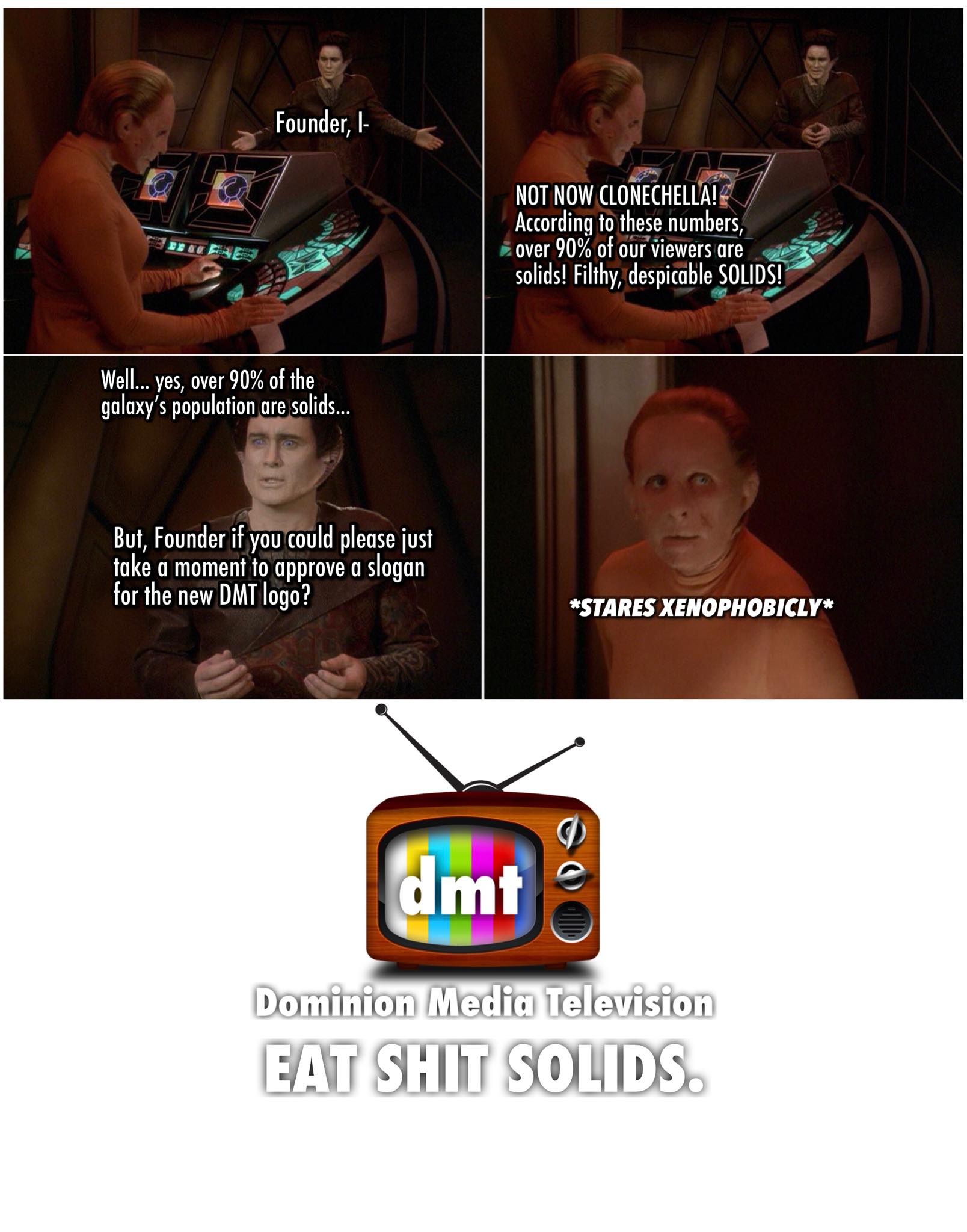
The image is a collage of four panels capturing a scene from the web series Dominion Media Television (DMT). The setting appears to be the interior of a spaceship or control room, bathed in a cool, blue light. The primary characters depicted are two alien figures. The one labeled “Founder” (clearly in a position of authority) is depicted seated before a complex console displaying charts and data. The other character, addressing the Founder, appears more subordinate, visibly pleading for approval.
The visuals emphasize the technologically advanced environment, but with a deliberately low-budget, slightly “cheesy” aesthetic. This is part of the series' deliberate style. The final panel presents the DMT logo—a simplistic television screen with the letters “dmt” in a retro font—accompanied by the slogan "EAT SHIT SOLIDS." The logo also includes a subtle design featuring a mushroom and a brain.
Foucauldian Genealogical Discourse Analysis
This imagery is ripe for a Foucauldian reading. The entire scenario revolves around power dynamics and the construction of knowledge.
- Discourse & Power: The dialogue highlights a discourse of quantifiable data (“90% of the galaxy are solids”). The “Founder” wields power by legitimizing this data as truth, even though it's absurd. The request for slogan approval is a demonstration of the Founder’s control over the meaning-making process within DMT. The subordinate character must ask permission to define what DMT represents.
- Genealogy of ‘Solids’: The insistence on “solids” isn’t about geometry; it’s a constructed categorization. It implies an ‘other’ – liquids, gases, perhaps things that don't conform to the Founder’s preferred categorization. This categorization isn't natural; it's a product of historical and cultural forces (within the fictional universe of DMT, and, in a meta-sense, a comment on how categorization operates in real life).
- The Panopticon: While not directly visualized, the control room setting evokes the panoptic principle. The Founder, surrounded by data, sees and potentially controls the entire operation. The focus on “viewers” and their classification further reinforces this idea of surveillance and control.
- Xenophobia as Discourse: The "Stares Xenophobically" annotation on the second image points to the discourse of "othering" – a core component of power dynamics. The emphasis on "solids" serves to dehumanize or devalue anything not conforming to this standard.
Critical Theory
This image can be approached through a critical theory lens focused on media and power.
- Media as Ideology: DMT, presented as a television network, serves as a vehicle for the transmission of ideology. The seemingly nonsensical emphasis on “solids” isn't accidental. It represents a deliberate attempt to construct a specific worldview.
- The Spectacle: The focus on viewership numbers and the performative request for slogan approval echo Guy Debord’s concept of the spectacle. The focus is on appearance and consumption rather than genuine meaning. DMT, as a fictional media entity, exemplifies the alienation and passivity inherent in the spectacle.
- Deconstruction: The absurdity of the scenario invites a deconstructive reading. The image challenges the notion of inherent meaning. The emphasis on “solids” reveals the arbitrary nature of categorization and the instability of language.
Marxist Conflict Theory
A Marxist reading focuses on the power dynamics and class (or species) struggle within the image.
- Alienation: The subordinate character's pleading demeanor suggests a clear power imbalance. This reinforces the idea of alienation—separation from the means of production (in this case, the means of media production and meaning-making) and from one's own creative agency.
- Hegemony: The “Founder” embodies the ruling class—those who control the narrative and impose their ideology. The acceptance of “solids” as the dominant paradigm demonstrates the establishment of cultural hegemony.
- False Consciousness: The emphasis on quantifiable viewership numbers could be seen as a distraction—a way to keep the “viewers” (the masses) focused on superficial metrics rather than questioning the underlying power structures.
Postmodernism
This image is deeply postmodern in its self-referentiality and embrace of absurdity.
- Meta-commentary: DMT explicitly comments on itself as a media entity. The dialogue about slogans and viewership numbers isn’t organic to the narrative; it’s a self-aware acknowledgment of the constructed nature of media.
- Pastiche & Irony: The low-budget aesthetic and the deliberately nonsensical dialogue are hallmarks of postmodern pastiche—a blending of styles and a playful deconstruction of conventions.
- Fragmentation & Loss of Grand Narratives: The absurdity of the scenario and the rejection of coherent meaning reflect the postmodern distrust of grand narratives and the embrace of fragmentation.
- Simulation & Hyperreality: The fabricated world of DMT and the manufactured emphasis on “solids” contribute to a sense of hyperreality—a world in which simulations have become more real than reality.
Queer Feminist Intersectional Analysis
While not as immediately central as the other frameworks, an intersectional analysis can reveal further layers.
- The Subordinate Character as "Other": The pleading alien character, as the subordinate figure, can be read as representing marginalized groups. Their request for approval (to define a slogan) can be seen as a metaphor for the struggle for representation and agency.
- Deconstructing Norms: The bizarre setting and the nonsensical emphasis on "solids" can be seen as a disruption of established norms. This disruption can be interpreted as a queer act of resistance—a rejection of conventional categories and expectations.
- Power Dynamics & Gender/Species: The Founder's authority and the subordinate's position highlight unequal power dynamics. These dynamics can be extrapolated to real-world issues of gender, race, and speciesism.
In Conclusion:
This image is a multi-layered, incredibly dense piece that offers a fertile ground for theoretical analysis. Its deliberately absurd and satirical nature invites us to question power structures, the nature of reality, and the role of media in shaping our perceptions. Its strength lies in its ability to combine seemingly disparate elements into a cohesive, thought-provoking work.
simple-description (llama3.2-vision)
This meme is a screenshot from a Star Trek: The Next Generation episode where the character Data is trying to understand human humor. The image shows Data's confusion as he reads a humorous article about the TV show "Star Trek: Deep Space Nine" and the show's "Dil" character. The text "Dil: I am Dil, I am Dil, I am Dil" is written on the screen.
tesseract-ocr
Lea ~ a j OO CRON Sea STE j ee Bs earn a CKO M UL RS > A FS Tig Ce NTL AC HCTA TCLS LC = <a : a Va RTCA ATLL ACCS ICCD eat a tA e PA | Rea CSMC aL AC LL galaxy’s population are solids... PM ATU Lan A UOC tinea (TRS CLR OM TUCO) TONERS OCT for the new DMT logo? *STARES XENOPHOBICLY* © —4 nen Wiech WAT we], \ i ey JN Sal H SOLIDS