First Seen
2023-05-10T21:03:40+00:00
simple-description (llama3.2-vision_11b)
The meme is a humorous comparison between two fictional characters from the Star Trek universe. The image shows a split-screen with Captain Jean-Luc Picard on the left, and a more rugged and aggressive-looking character, likely a Klingon, on the right. The text "Who would win in a fight?" appears above the split-screen, with the answer "Jean-Luc Picard" on the left and "Worf" on the right.
detailed-analysis (gemma3-27b-vision)
Okay, let's break down this meme image with the requested theoretical frameworks. It's a fascinating example of how internet culture can pull in surprisingly complex levels of meaning.
Visual Description
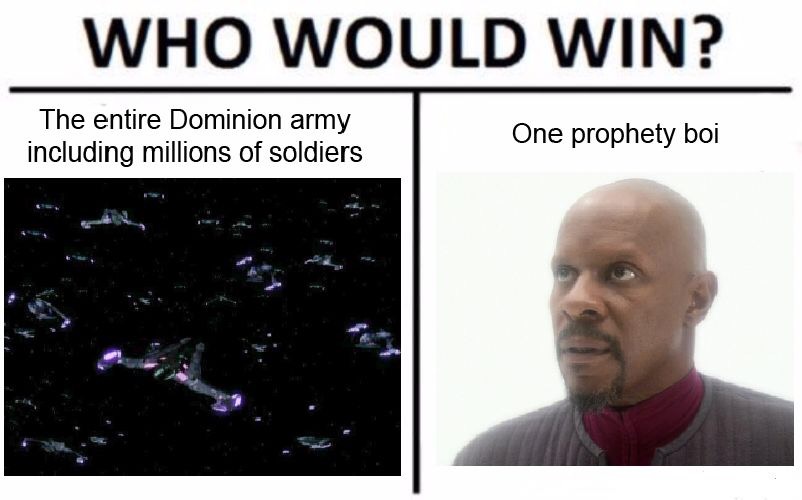
The image is a starkly contrasted "versus" meme format. On the left, we see a chaotic swarm of purple and white objects against a black background. These appear to be computer-generated imagery (CGI) representing an army of ships, possibly those from the science fiction franchise Halo, labelled as "The entire Dominion army including millions of soldiers." On the right, is a portrait of a bald man wearing a maroon turtleneck and a dark jacket. He is identified as “One prophecy boi.” The meme's title asks, "WHO WOULD WIN?". The high contrast of the imagery immediately establishes a binary opposition – overwhelming, technologically advanced military force versus an individual, framed as possessing unique (potentially mystical) power.
Foucauldian Genealogical Discourse Analysis
This meme plays with the discourse of power and the construction of the “hero” archetype. Foucault would be interested in how the concept of “winning” is constructed through the positioning of these two forces.
- Power/Knowledge: The visual immediately frames the Dominion army as the embodiment of disciplinary power – a massive, organized, and technologically sophisticated force that seeks to control space through overwhelming force. “Prophecy boi” represents an alternative form of power – not control through domination, but power derived from knowledge (prophecy), potentially representing a challenge to established norms and authorities.
- Genealogy of the "Hero": The meme taps into a deep genealogy of the "lone hero" trope. This trope, historically, has been used to legitimize certain forms of leadership and control. "Prophecy boi", as the lone individual, is positioned as a potential figure that disrupts the traditional understanding of power dynamics in conflict.
- Discursive formation: The meme is an example of a formation of discourse – it draws on common understandings of science fiction warfare, individual versus collective strength, and the role of prophecy. It operates within those existing frameworks to offer a commentary that may be subversive or critical of them.
Critical Theory
The meme, viewed through a critical theory lens (especially echoing elements of the Frankfurt School), highlights the commodification of conflict and the spectacle of power.
- Culture Industry: The meme itself is a product of the "culture industry." It takes elements from established franchises (Halo) and recontextualizes them into a new, easily shareable form. This process of repurposing and remixing is characteristic of the way culture is consumed and produced in late capitalism.
- Ideology: The implicit question "Who would win?" is itself an ideological one. It encourages a simplistic view of conflict (who is stronger?) while obscuring the complex social, political, and economic forces that often drive actual conflicts. The meme subtly reinforces the idea that "winning" is the ultimate goal, rather than questioning the basis of the conflict itself.
- Spectacle: The chaotic swarm of the Dominion army visualises the spectacle of war. It focuses on the overwhelming display of power, potentially obscuring the human cost of such conflict. By pitting this spectacle against a single individual, the meme draws attention to the absurdity of such displays.
Marxist Conflict Theory
From a Marxist perspective, this meme can be seen as representing a class struggle on a fantastical level.
- Dominion as the Bourgeoisie: The Dominion army, as a massive, technologically advanced military force, can be read as a metaphor for the ruling class (bourgeoisie). They control the means of production (the ships, weapons, etc.) and seek to maintain their dominance through force.
- "Prophecy boi" as the Proletariat: The single individual, “Prophecy boi”, potentially represents the oppressed or the proletariat. He has no material power, but possesses a unique form of “knowledge” (prophecy) which could be interpreted as an inherent power over the established system.
- Conflict & Revolution: The meme sets up an inherent conflict between these two forces. The question of "who would win" implicitly poses the question of whether a single individual, armed with revolutionary knowledge or insight, can overcome a powerful, oppressive system.
Postmodernism
A postmodern interpretation would focus on the deconstruction of grand narratives and the embrace of simulacra.
- Hyperreality: The image exists within a sphere of hyperreality. The Dominion army is a fictional force from a video game, and "Prophecy boi" is a character pulled from an unrelated online culture. The meme creates a new layer of reality by combining these elements, blurring the lines between the real and the simulated.
- Deconstruction of Hero Narratives: The meme subtly challenges the traditional "hero" narrative. It doesn't present a clear-cut case for either side. By contrasting an overwhelming military force with a lone individual, it forces the viewer to question the traditional metrics of power and success.
- Playfulness and Intertextuality: The meme embraces playfulness and intertextuality. It draws on multiple cultural references and remixes them into a new, self-aware form. It doesn't take itself too seriously, and it encourages the viewer to do the same.
Queer Feminist Intersectional Analysis
This one is a bit of a stretch, but possible.
- Deconstructing Power Dynamics: A queer feminist lens examines the power dynamics at play. The Dominion army, with its rigid hierarchy and militaristic structure, can be seen as embodying patriarchal systems of control. "Prophecy boi", as an individual challenging that system, could be read as representing a rejection of those norms.
- Subversion of Expectations: The meme subverts expectations by positioning a lone individual against a massive force. This challenges the traditional notion of "strength" and power.
- Intersectionality: While the meme itself doesn’t explicitly address issues of intersectionality, it's possible to interpret it as a commentary on the ways in which different forms of oppression intersect. The Dominion army could represent multiple forms of oppression (e.g., militarism, colonialism, patriarchy), while “Prophecy boi” represents a resistance to all of them.
In conclusion:
This meme, while seemingly simple, can be analyzed through a variety of theoretical frameworks, revealing layers of meaning that go beyond its surface appearance. It taps into themes of power, conflict, resistance, and the construction of reality, making it a fascinating example of how internet culture can reflect and engage with complex social and philosophical ideas.
simple-description (llama3.2-vision)
This meme is a humorous comparison between two fictional characters, one from the TV show "Game of Thrones" (Daenerys Targaryen) and the other from the TV show "The 100" (Clarke Griffin). The meme is a "who would win" scenario, with the text "The entire Dominion army including millions of soldiers" on one side, and "one" on the other. The implication is that even a single person (Clarke) could potentially defeat the entire Dominion army, a massive and powerful force, due to her strategic thinking and leadership skills.
tesseract-ocr
WHO WOULD WIN? including milion of solders One prophety bo ~~ a -.