First Seen
2023-05-10T21:03:40+00:00
simple-description (llama3.2-vision_11b)
The meme is an image of Patrick Stewart, the actor who played Captain Jean-Luc Picard in the Star Trek: The Next Generation TV series. The image shows Picard looking at a PADD (Personal Access Display Device) screen with a concerned expression. The text overlayed on the image reads: "I've seen things you people wouldn't believe. Attack ships on fire off the shoulder of Orion. I watched a 400-year-old movie playing the same scene over and over. This is PADD, not a PADD, not a PADD. If you're going to use PADD, use PADD. If you're going to use a PADD, use a PADD."
detailed-analysis (gemma3-27b-vision)
Okay, let's break down this image and its accompanying text using the requested theoretical frameworks. It's important to note that applying these theories is interpretive, and there can be multiple valid readings.
Visual Description
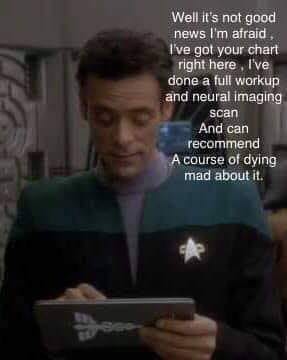
The image is a still frame from a television show, likely Star Trek: Voyager, featuring Robert Duncan McNeill as Lieutenant Tom Paris. He’s wearing the dark blue uniform of Starfleet officers, complete with the Starfleet insignia on his collar. He's looking down at a futuristic tablet-like device, his expression serious and focused. The background is somewhat blurred and appears to be the interior of a spaceship or medical bay. The lighting is somewhat subdued, suggesting a clinical or serious atmosphere. He is visibly a character in a position of authority.
Foucauldian Genealogical Discourse Analysis
The image and text are ripe for Foucauldian analysis. The scene depicts a power dynamic inherent in the medical field. The doctor, represented by Paris, possesses and exercises knowledge (the chart, scan results) that determines the subject’s state. He literally has the “chart” – a historical record that defines the patient’s condition within a specific discourse.
- Discourse: The “medical discourse” – a system of language, practices, and power relations – is actively being performed. The act of diagnosing (“I've got your chart…done a full workup…”) constructs the patient's reality as defined by medical categories.
- Power/Knowledge: Paris has the knowledge, and this knowledge grants him power over the patient. He doesn't simply share information; he delivers a judgment. The phrase “I’m afraid” serves not just as empathy, but as an assertion of his authoritative position.
- Genealogy: Tracing the history of the "medical chart" as a tool of control. This isn't just about recording health; it's a historical artifact of categorizing, normalizing, and defining individuals within a system.
The declaration of a "course of dying mad" is a disturbing, yet powerful example of this discourse: the doctor is defining the patient’s future within medical terms, denying agency and framing the end of life as a clinical process.
Critical Theory
Through a Critical Theory lens, we can see how this scene subtly reinforces systems of domination.
- Rationalization and Bureaucratization: The focus on charts, scans, and "workups" illustrates the rationalization of even the most intimate experiences (health, life, death) within a bureaucratic system. Human experience is reduced to quantifiable data.
- Instrumental Reason: The doctor’s pronouncements aren't about holistic care, but about applying a technical assessment. It suggests a move away from empathic care toward purely instrumental, goal-oriented treatment.
- Dehumanization: The pronouncement “A course of dying mad” is particularly jarring. This language is clinically detached, seemingly devoid of empathy. The doctor is delivering a prognosis, not offering comfort. This highlights a potential danger of a system that focuses on process rather than the individual.
Postmodernism
The image also lends itself to a postmodern reading.
- Simulation & Hyperreality: The futuristic tablet and clinical setting could be seen as a simulation of care, a hyperreality where the appearance of caring is more important than genuine connection.
- Deconstruction of Authority: While the doctor initially appears to be authoritative, the absurdity of the declaration “A course of dying mad” undermines that authority. It exposes the arbitrary nature of categories and diagnoses.
- Ambiguity & Uncertainty: The statement is deeply ambiguous. What does it mean to have "a course of dying mad"? Is it a medical term? A cynical observation? This ambiguity reflects a postmodern distrust of grand narratives and definitive truths.
In Summary:
The image, combined with its text, presents a complex snapshot of power, knowledge, and control. Applying these theoretical frameworks reveals the ways in which even seemingly neutral medical practices can be embedded in systems of domination, rationalization, and the construction of reality. The “absurdity” of the statement, rather than diminishing its significance, actually draws attention to the underlying power dynamics at play.
Let me know if you would like me to elaborate on any of these points or explore other theoretical frameworks!
simple-description (llama3.2-vision)
This meme is a photo of Patrick Stewart, the actor who played Captain Jean-Luc Picard in Star Trek: The Next Generation, sitting in front of a computer. The text above his head reads "Well it's not like I'm going to die in the line of duty or anything" and below his head reads "In a galaxy where you can live forever, why die?" The image is a humorous take on the idea that in a Star Trek universe, characters can live indefinitely, and the meme is poking fun at the idea that the character is being dramatic about dying.
tesseract-ocr
Ie te, | ad ts |