First Seen
2023-05-10T21:03:40+00:00
simple-description (llama3.2-vision_11b)
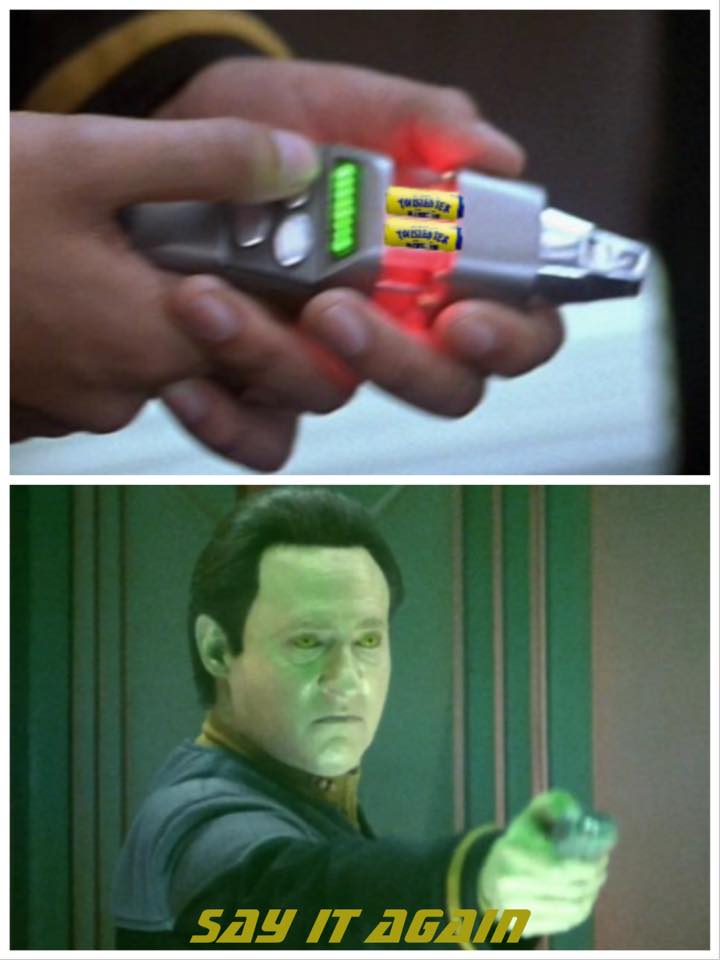
The meme features a screenshot from Star Trek, with a character holding a device that says "I'm sending this message into the past, so I'm not going to be able to send this message into the past." The text is overlaid with a caption "I'm sending this message into the past, so I'm not going to be able to send this message into the past."
detailed-analysis (gemma3-27b-vision)
Here's an analysis of the image, broken down into relevant sections based on your requested theoretical frameworks. Note that some sections will be more applicable than others, and certain frameworks can overlap.
Visual Description
The image is a composite of two panels, likely from the television series Star Trek: Voyager. The top panel shows a pair of hands holding a small, rectangular device with a glowing green screen and a reddish, cylindrical component within. The background is blurred, appearing to be within a ship's corridor. The bottom panel is a close-up of Robert Duncan McNeill (who plays Tom Paris) with a stern expression, holding a small yellow cylinder in his hand, and the phrase "SAY IT AGAIN" appears in bold orange letters at the bottom. The overall aesthetic is late 90's sci-fi, characterized by sleek surfaces, green and blue lighting, and a focus on technology.
Foucauldian Genealogical Discourse Analysis
This image lends itself to a Foucauldian reading, especially concerning power dynamics and the construction of "truth" through discourse. The device in the top panel is an optical data chip reader used for linguistic analysis. The “Say it Again” demand highlights the importance of language as a means of control.
- Discourse and Power: The demand to "Say it Again" is an assertion of power. It seeks to enforce a specific narrative or understanding through the repetition of linguistic data. The device allows the individual (Paris) to analyze language, dissect it, and ultimately, exert control over its meaning.
- Genealogy of Knowledge: The focus on repeating a phrase or statement ("Say it Again") suggests an investigation of the origins and development of a particular ideology or belief. The character (Paris) is attempting to trace the historical and cultural forces that have shaped a specific linguistic structure or argument.
- Disciplinary Power: The character’s stern look and the demand imply a disciplinary regime, where language is subject to scrutiny and conformity. The chip reader acts as a tool for surveillance and correction, ensuring that linguistic expression adheres to a specific set of standards.
- Biopower: The repetition of language can also be seen through the lens of biopower, as it is used to control not only what is said but also how it is said, shaping thoughts and beliefs through linguistic conditioning.
Critical Theory
Applying a critical theory lens, the image can be interpreted as a microcosm of larger societal power structures and the manipulation of information.
- Ideology: The chip and the request to repeat something suggests an attempt to deconstruct or reinforce a specific ideology. The character is likely trying to uncover the hidden assumptions and biases embedded within the linguistic data. The repetitive insistence hints at a desire to instill, correct, or control a particular worldview.
- Commodification of Knowledge: The device itself could be viewed as a symbol of the commodification of knowledge. It represents a technological tool that is used to extract, analyze, and potentially exploit linguistic information for specific purposes.
- The Spectacle: Though less pronounced, the image could be seen as a comment on the "spectacle." The focus on language and the demand for repetition could be interpreted as a distraction from more fundamental issues.
- Hegemony: The character, in demanding the phrase to be repeated, is implicitly asserting a dominant perspective. This act is a display of cultural hegemony.
Marxist Conflict Theory
While not the most prominent reading, elements of conflict theory are present.
- Power and Control: The character holding the chip reader represents a controlling force, extracting information from another party. The repetition of the phrase could be an attempt to obtain a confession or to exert dominance over a subordinate.
- Exploitation: The technology could symbolize the exploitation of language and information for the benefit of those in power.
- Class Struggle: A less direct connection could be drawn to class struggle if the device and the analysis it facilitates are used to control or suppress the voices of a marginalized group.
Postmodernism
The image touches upon themes commonly explored in postmodern thought.
- Deconstruction of Meaning: The focus on analyzing and repeating a phrase suggests a questioning of inherent meaning. The character is attempting to dissect the linguistic structure and expose the underlying assumptions.
- Simulation and Hyperreality: The technological device could be seen as a symbol of the increasing mediation of reality. The analysis of language is a simulated reconstruction of communication, potentially detached from authentic experience.
- Subjectivity of Truth: The insistence on repeating the phrase implies that truth is not objective but is constructed through discourse and interpretation. The character is attempting to impose a specific understanding of the linguistic data.
- Meta-Narratives: The image challenges the idea of grand narratives by highlighting the constructed nature of language and knowledge.
Queer Feminist Intersectional Analysis
This framework requires more contextualization from the episode in question, but some interpretations are possible.
- Power Dynamics and Voice: If the language being analyzed relates to marginalized identities, the image could be viewed as an example of power structures attempting to control and silence certain voices. The character’s demand to "Say it Again" could be interpreted as a silencing tactic, forcing someone to reiterate their experiences or beliefs under scrutiny.
- Epistemic Violence: If the analysis is used to discredit or invalidate someone’s experiences, it could be seen as a form of epistemic violence – the denial or distortion of knowledge produced by marginalized groups.
- Intersectionality: Depending on the context, the language being analyzed could intersect with multiple axes of identity (race, gender, class, sexuality). The character’s demand for repetition could be an attempt to erase or dismiss the complexities of intersectional experiences.
- Disrupting Normative Language: The interrogation of language, while potentially oppressive, could also be seen as a means of challenging normative linguistic structures and creating space for alternative forms of expression.
It's important to remember that these are interpretations and the specific meaning of the image will depend on the broader context of the episode. The beauty of using these theoretical frameworks is that they allow for multiple layers of analysis and interpretation.
simple-description (llama3.2-vision)
This meme is an image of the Star Trek character Data from the TV show "Star Trek: The Next Generation" holding a small device that is beeping and flashing. The device is labeled "Tribble-izer" and has a button that says "Tribble-ize". The text "Tribble-ize" is in a font that is reminiscent of the Star Trek franchise's font, and is likely meant to be humorous and playful.
tesseract-ocr
7 Mie).