First Seen
2023-05-10T21:03:40+00:00
simple-description (llama3.2-vision_11b)
The meme is an image from the TV show Star Trek: The Next Generation, featuring a character named Data, an android who is trying to understand human emotions. In the image, Data is sitting at a table with other characters, and his face is contorted in a comically exaggerated expression of confusion or frustration, captioned "When you realize you're not as human as you thought".
detailed-analysis (gemma3-27b-vision)
Okay, let's break down the image provided, applying the requested theoretical lenses. Given the specific setting (likely Star Trek: Deep Space Nine), and the nature of the image, some lenses will be more fruitful than others.
Visual Description
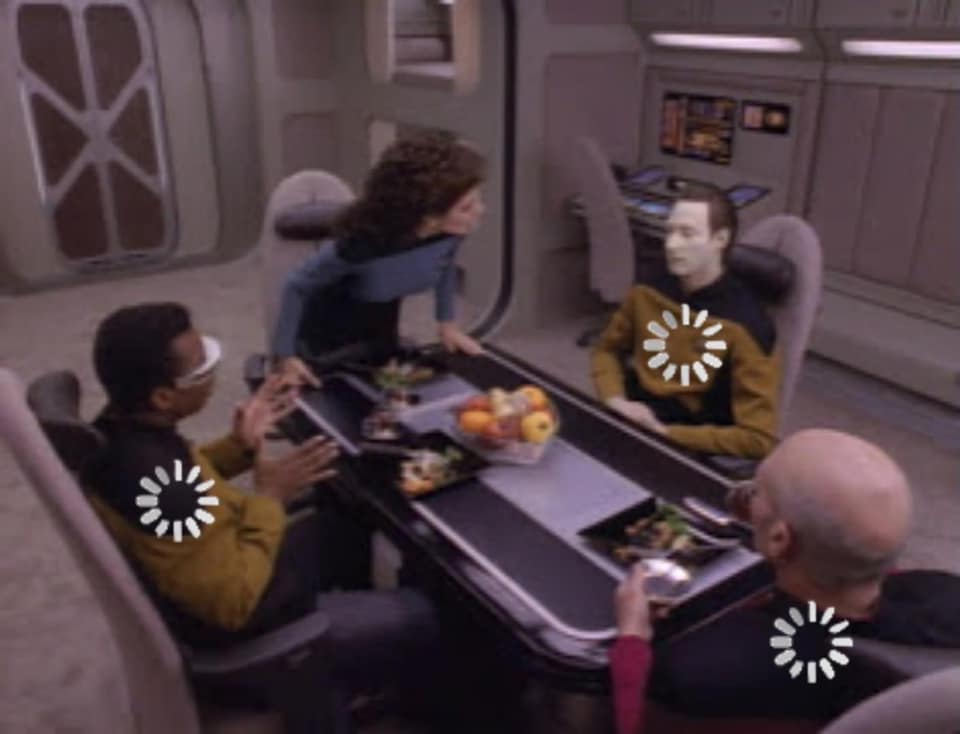
The image depicts a scene inside a spaceship or space station, most likely Deep Space Nine. Four individuals are seated around a dark-colored table. The table is covered in what appear to be plates, and a large bowl of fruit occupies a central position. The individuals wear what appear to be uniforms, predominately dark colors with golden-yellow accents. The backgrounds suggest metallic, industrial interiors of a technologically advanced ship. The lighting is relatively flat, with a slightly cool tone. The camera angle is a medium shot, focusing on the subjects and the table setting. The setting is clearly one for a meal, or some form of gathering.
Foucauldian Genealogical Discourse Analysis
This scene immediately brings to mind Foucault’s concepts of discipline and biopower. The setting itself is a highly controlled environment. The uniforms, the table arrangement, the very act of a structured meal - all contribute to normalizing and regulating behavior. The discourse embedded within this scene concerns Starfleet's emphasis on order, protocol, and shared experience. The communal meal is not simply about nourishment; it's a performance of unity and hierarchical structure.
A genealogical inquiry might ask: How has the practice of communal meals evolved within Starfleet? What rules or protocols govern who sits where, what is discussed, and how they interact? The fruit bowl, as a symbol of abundance, could be analyzed as a manifestation of control—providing nourishment but also setting limits on what is consumed. The seemingly innocuous act of eating is therefore inextricably linked to power relations.
Critical Theory
Using a Critical Theory lens, we can interpret this scene as a representation of the ideology of the Starfleet organization. The shared meal suggests a harmonious, cooperative structure. However, a critical analysis would question whose interests are served by this seemingly utopian image. Are dissenting voices allowed at this table? Is genuine equality practiced, or is it a facade concealing underlying power imbalances?
The setting – a technologically advanced spaceship – itself embodies the ideal of rationality and progress. However, this image also invites a critical interrogation of the potential for technology to reinforce existing power structures and to be used for control. Is the “progress” embodied by Starfleet a truly liberating force, or does it simply replicate patterns of domination in a new form?
Marxist Conflict Theory
From a Marxist perspective, the scene can be viewed through the lens of class and resource control. While seemingly egalitarian, the setting suggests a division of labor and a hierarchy of authority. Those at the table are likely officers or crew members with access to resources and decision-making power, while the labor that produces their sustenance (the food, the ship maintenance, the technology) is performed by others who are excluded from this scene.
The food itself, despite its abundance, represents a form of capital. The control over its production and distribution is a manifestation of power. The meal functions as a symbolic reaffirmation of the existing social order, reinforcing the privileges of those at the table.
Postmodernism
From a postmodern perspective, this scene challenges the notion of a singular, objective reality. The carefully constructed setting and the stylized uniforms suggest a manufactured experience, a simulation of community. The idea of a “utopian” future embodied by Starfleet can be seen as a grand narrative, an attempt to impose a fixed meaning on a complex and fragmented world.
The scene might also be interpreted as a commentary on the power of representation. The image itself is a construct, a selective portrayal of reality designed to evoke a certain emotional response. It is not a transparent window onto a "real" world, but rather a mediated experience shaped by the intentions of the creators.
Queer Feminist Intersectional Analysis
While the image doesn't immediately offer many strong gendered or queer cues, we can apply an intersectional lens. This requires asking who is absent from the table. Examining the composition of the crew, as a whole, we may find a lack of representation of certain marginalized groups. The performative nature of the meal – the adherence to protocols and expectations – can be seen as enforcing heteronormative and patriarchal norms. The lack of visible diversity on this particular table is relevant, as it suggests that even within a supposedly progressive organization like Starfleet, systems of power and exclusion persist.
It's also worth noting that the concept of “community” – as embodied by this shared meal – can be a site of both inclusion and exclusion. Who defines the boundaries of this community? What criteria are used to determine who is “in” and who is “out”?
Disclaimer: These analyses are interpretations based on the visual information provided. A more comprehensive understanding would require knowledge of the specific episode or story context.
simple-description (llama3.2-vision)
The meme is a screenshot from Star Trek: The Next Generation featuring a scene where Captain Jean-Luc Picard and his crew are enjoying a meal together. The image shows a shocked expression on Picard's face, and the text "I'm sorry" is displayed on the screen. The meme is captioned "When you finally understand the plot of Star Trek: The Next Generation".
tesseract-ocr
Q) | Se ee * \ | Te €5 ns ‘ y