First Seen
2023-05-10T21:03:40+00:00
simple-description (llama3.2-vision_11b)
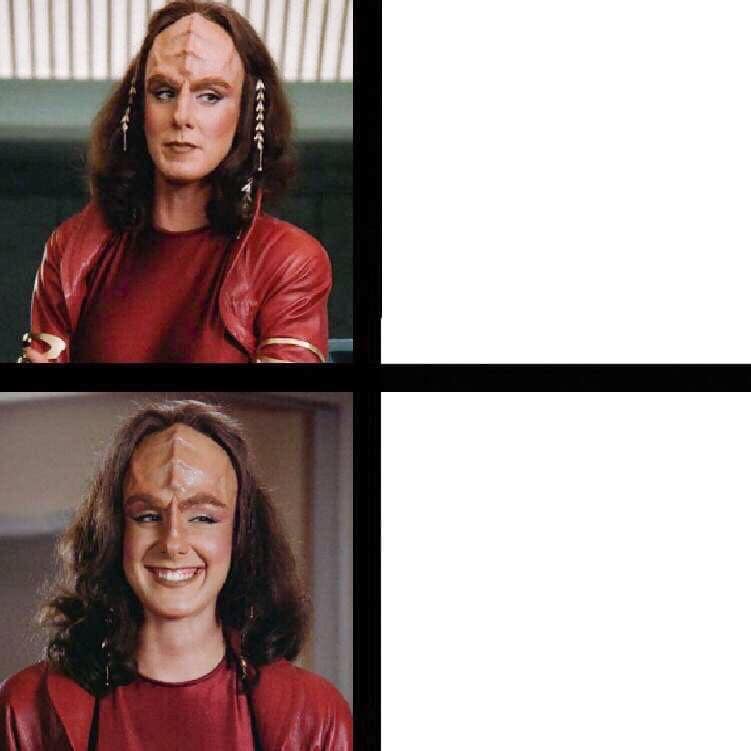
The meme features a still image of the Star Trek character Mr. Worf, a Klingon warrior, with a caption that reads "When you're trying to be professional but your coworkers keep asking for Friday updates".
detailed-analysis (gemma3-27b-vision)
Here's an analysis of the provided image of actor Mark Campbell in his role as the Borg Drone "Hugh" from Star Trek: Voyager, broken down into requested sections. Note that not every theoretical framework applies equally, and some are more relevant than others.
Visual Description
The image presents a two-panel meme format showing Mark Campbell as Hugh, a Borg drone who achieves individuality.
- Top Panel: Displays Hugh with a relatively neutral expression. His Borg implants (the forehead ridges and small head appendages) are visible. He's wearing the iconic, deep red, form-fitting uniform of the Borg. The lighting is somewhat cool and clinical.
- Bottom Panel: Depicts Hugh smiling warmly. The lighting is similar to the top, but his facial expression is markedly different. It communicates a sense of contentment and humanity. The contrast between the neutral/detached expression of the first panel and the warm smile of the second panel is the core visual joke.
The overall aesthetic suggests a duality: the mechanical, collective Borg versus an emergent individual personality.
Foucauldian Genealogical Discourse Analysis
A Foucauldian analysis could explore how the concept of "individuality" itself is constructed through discourse.
- Power/Knowledge: The Borg represent a system that suppresses individuality, operating on the principle that collective consciousness is superior. The "normal" human understanding of self, autonomy, and subjective experience are seen as inefficiencies by the Borg.
- Discipline & Normalization: The Borg's assimilation process is a form of disciplinary power. It eliminates variation, enforcing conformity and “normalizing” existence into a unified, collective form.
- Genealogy of Individuality: Tracing the historical development of the idea of the individual within Western thought reveals it's not a natural state, but a product of specific social, political, and philosophical forces. Hugh's emergence as an individual challenges the Borg's power because it draws upon, and activates, those historical discourses of selfhood. The contrast in the image between the two expressions can be read as a commentary on the way individuality performs itself and the conditions that allow it to do so.
Critical Theory
From a critical theory perspective (drawing on the Frankfurt School), Hugh’s development can be seen as a critique of mass society and the dangers of homogenization.
- The Culture Industry: The Borg, in their relentless pursuit of perfection through assimilation, can be seen as an analogy for the "culture industry" – the mass production of standardized culture that suppresses critical thought and individuality.
- Alienation: The drones represent the ultimate form of alienation, stripped of their unique identities and reduced to mere components of a collective. Hugh’s awakening is a rejection of this alienation and a reclaiming of subjective experience.
- Instrumental Reason: The Borg’s logic is purely instrumental – driven by efficiency and control, devoid of ethical considerations. Hugh’s emergence introduces a value system based on empathy and connection, challenging the Borg’s purely rational worldview.
Marxist Conflict Theory
A Marxist reading might view the Borg as a metaphor for a totalitarian, classless society that eliminates individual agency.
- Means of Production: The Borg Collective represents control over the “means of production” of identity. They produce drones by stripping away individual characteristics and replacing them with collective programming.
- Class Struggle (albeit unconventional): While the Borg seem classless, a struggle exists between the collective will (the Borg Queen, the collective consciousness) and the emerging individual consciousness of Hugh. His development represents a "rebellion" against the existing power structure.
- False Consciousness: The assimilated drones are in a state of "false consciousness," unaware of their lost individuality and accepting their role in the collective. Hugh’s awakening represents a breaking of that false consciousness.
Postmodernism
A postmodern approach would likely deconstruct the very notion of a stable, coherent "self."
- Fragmentation and Simulacra: The Borg can be seen as embodying the postmodern condition of fragmentation. Their assimilated drones are simulations of individuals, lacking genuine originality.
- Deconstruction of Identity: Hugh’s emergence challenges the idea of a fixed identity. His development suggests that the "self" is not inherent, but a fluid, constructed, and performative process.
- Hyperreality: The Borg’s pursuit of “perfection” represents a hyperreality – a simulation of reality that is more real than real. The difference between a truly individual, authentic self and a Borg drone becomes blurred.
Queer Feminist Intersectional Analysis
This is arguably the most complex but potentially richest lens.
- Assimilation as a Metaphor: The Borg’s process of assimilation can be read as a metaphor for societal pressures to conform, particularly for marginalized groups. For queer and feminist theorists, the suppression of individuality and the demand to fit into dominant norms can be a form of violence.
- The “Other” and Monstrous Feminine: The Borg, as a collective, can be seen as a monstrous “other” threatening the established order. Within that, Hugh’s individuality, and particularly his vulnerability and emotionality, could be interpreted through the lens of the “monstrous feminine” – the figure that challenges patriarchal norms.
- Intersectional Vulnerability: Hugh’s divergence from the collective makes him inherently vulnerable and a target for elimination. This vulnerability highlights the intersections of difference and power. He is not simply an individual but an individual who transgresses the boundaries of the collective and is therefore subjected to its disciplinary power.
- Reclaiming Agency: Hugh’s development can be read as an act of resistance and a reclamation of agency. His desire to understand his own individuality and to connect with others on a human level is a powerful statement about the importance of self-determination.
Regarding the Image’s Meme Format: The contrast between the two expressions, emphasized by the meme format, powerfully conveys the idea of transformation and the emergence of a subjective inner life. The meme structure itself invites audience participation and interpretation, further reinforcing the themes of selfhood and identity.
simple-description (llama3.2-vision)
This meme is a play on the infamous "Live Long and Prosper" gesture made famous by the character Mr. Spock from Star Trek. The image shows Mr. Spock with a raised eyebrow and a subtle, sarcastic tone, as if he's saying "Live Long and Prosper... to your misery". The text overlaying the image reads "When you finally get the job you've been applying for for years".
tesseract-ocr
1thd tit | | *?s' ME Bs we \ ee 4 iy)