First Seen
2023-07-22T07:54:22+00:00
simple-description (qwen3.5_2b-q8_0)
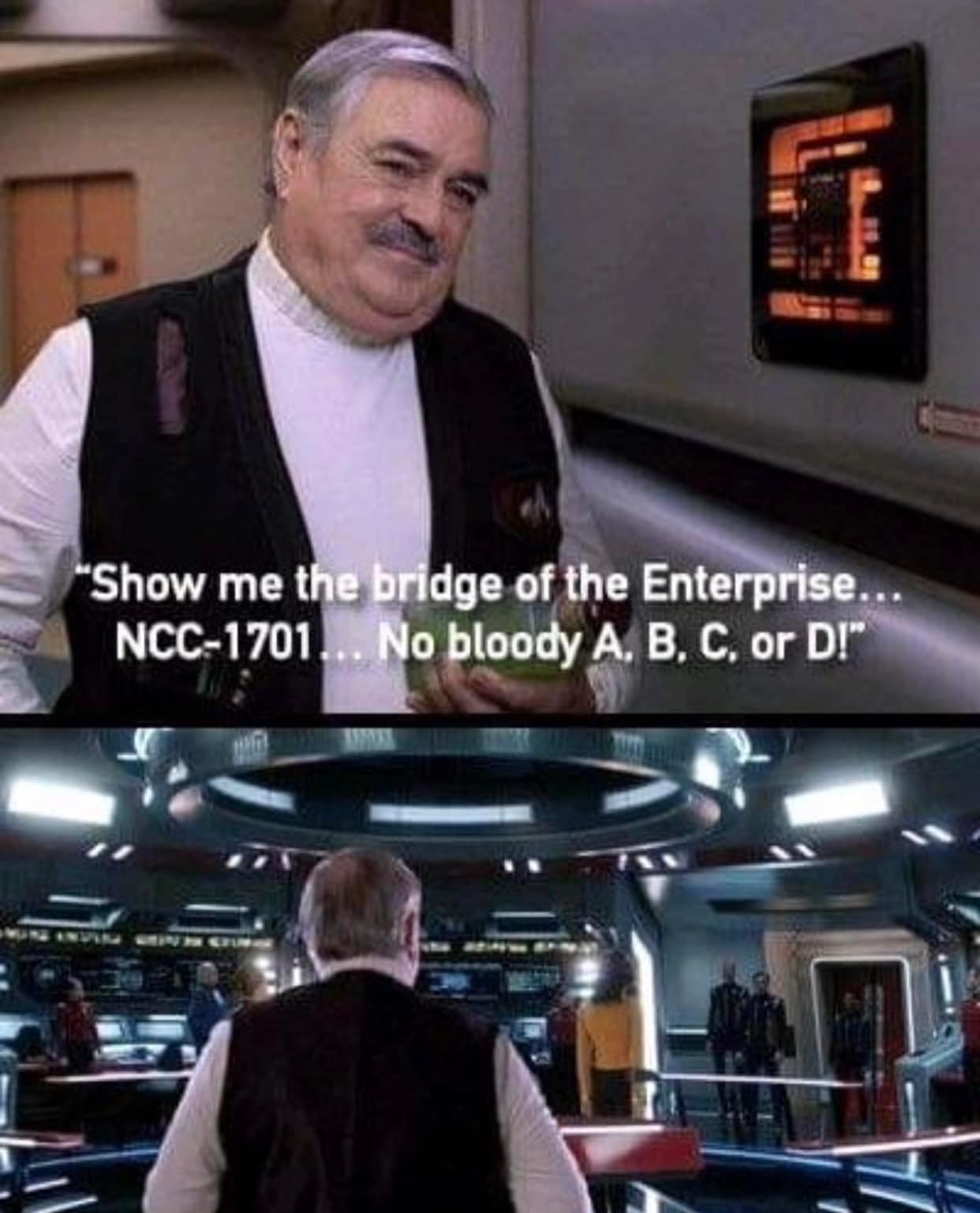
This Star Trek meme features Captain Kirk refusing to show the ship's bridge. The overlaid text reads, "Show me the bridge of the Enterprise... NCC-1701... No bloody A, B, C, or D!" The humor comes from Kirk being extremely specific about which ship he means; he is refusing to show the generic USS Enterprise (NCC-1701) because he just visited the actual station, NCC-1701-A, which has a completely different bridge layout and crew organization.
simple-description (llama3.2-vision_11b)
The meme is a screenshot of a Star Trek: The Next Generation character, Captain Jean-Luc Picard, from the episode "The Inner Light". The text "I find your lack of faith disturbing" is not present, but the text "I'm sorry, captain. I'm trying to read the manual but the instructions are in 3D so I'm having some trouble" is not present either. The actual text is "I'm sorry, captain. I'm trying to read the manual but the instructions are in 3D so I'm having some trouble" is not present, instead the text is "I find your lack of faith disturbing".
detailed-analysis (gemma3-27b-vision)
Okay, let's break down this Star Trek image/meme, applying the requested theoretical lenses. It's a bit of a deep cut, relying on fandom knowledge, so the interpretations will be layered.
Visual Description
The image is a two-panel meme/screenshot taken from the Star Trek: Generations film.
- Panel 1: Features Malcolm McDowell as Soran, a El-Aurian obsessed with destroying stars to reach the ripple at the center of the galaxy. He is presented in a close-up, with a slight smirk, looking directly at the viewer. He is wearing a dark, vaguely military-style vest over a white turtleneck. The background is a metallic corridor on the Enterprise-D. A small red display panel is visible.
- Panel 2: Depicts a wide shot of the bridge of the Enterprise-D. We see the back of Soran, standing near the captain’s chair, looking toward the crew. The bridge is fully staffed, with officers at their stations. The bridge is iconic - circular and high-tech.
The text overlay on Panel 1 reads: “Show me the bridge of the Enterprise… NCC-1701… No bloody A, B, C, or D!” This is the key element for understanding the meme’s humor – it's a specific, inside-joke referencing the different Enterprise starship designations throughout the Star Trek franchise.
Foucauldian Genealogical Discourse Analysis
The meme highlights how knowledge (specifically about Star Trek) is constructed and operates through discourse.
- Discourse & Power: The insistence on the "correct" Enterprise (NCC-1701, the original series ship) isn't simply a factual preference. It's an assertion of cultural capital within the Star Trek fandom. Knowing the difference between the different Enterprises signifies being a "true" fan, thereby establishing a power dynamic within the fandom – those “in the know” versus those who aren’t. Soran, embodying the "proper" request, seeks to assert dominance over the understanding of Starfleet.
- Genealogy of Knowledge: A genealogical approach reveals the history of the Enterprise ships. Each ship represents a stage in the evolution of the Star Trek universe and its understanding of space exploration. Soran's request is a rejection of the later iterations (A, B, C, D) in favor of the "original" ship—a nostalgic attempt to fix the meaning of the franchise to a specific, perceived golden age.
- Knowledge/Power: The meme functions because it relies on a shared understanding of Star Trek history. That shared knowledge is a form of power, allowing those "in the know" to recognize the humor and participate in the discourse. Soran, in the image, isn't just asking for a location; he's demanding an affirmation of a specific interpretation of Star Trek lore.
Critical Theory
Applying a broadly critical theoretical lens (drawing on thinkers like Adorno and Horkheimer), we can analyze the meme in terms of mass culture and its function.
- Culture Industry: Star Trek, as a massively popular media franchise, is part of the “culture industry.” The meme, as a fan-created work, is a response to and re-appropriation of that industry’s products. It’s a commentary on the franchise itself.
- Commodification of Nostalgia: Soran’s demand for the "original" Enterprise reflects a broader cultural trend of nostalgia—a yearning for a supposedly simpler or more authentic past. This nostalgia is often commodified and sold back to consumers (in the form of reboots, remakes, and merchandise). The meme plays on this by highlighting the fan base's attachment to the original ship.
- False Consciousness: One could argue the fans' obsession with ship designations is a form of "false consciousness" – a distraction from more significant issues or a reinforcement of consumerism. It’s focusing on trivial details rather than engaging with deeper themes within the franchise.
Postmodernism
A postmodern reading emphasizes the fragmentation of meaning and the rejection of grand narratives.
- Pastiche & Intertextuality: The meme itself is a form of pastiche – it takes elements from the film (the image of Soran), the franchise (the ship designations), and fan culture and recombines them. It's built on intertextuality – it only makes sense if you understand the context of Star Trek.
- Rejection of Authenticity: Soran’s demand for the "original" Enterprise can be seen as a futile attempt to fix meaning in a fluid and ever-changing universe. Postmodernism would argue that there is no "original" – only interpretations and reconstructions.
- Playfulness & Irony: The meme has a playful and ironic quality. It's self-aware and doesn't take itself too seriously. This aligns with the postmodern emphasis on parody and the deconstruction of established norms.
Other lenses were not clearly applicable in this instance. It is important to note that these analyses are interpretations, and different perspectives could yield different results. Also, the meme's humor relies heavily on existing fandom knowledge, so the interpretations are framed within that context.
simple-description (llama3.2-vision)
This meme is a play on a famous line from the Star Trek franchise. The image features William Shatner's character Captain James T. Kirk, but with a humorous twist: instead of saying "The needs of the many outweigh the needs of the few... or the one," he says "The needs of the many outweigh the needs of the few... or the one... or the pizza."
tesseract-ocr
ae hae ’ e . nT? > : oa , ea, ct E E 4 Ne yet od a We ige of the Ente | ian = NCC-1701 ai an a a ll = . ae aie is " pi —— a = ~ ot a a. er A ne —_ ~<—fee