First Seen
2024-04-07T03:02:43.669944+00:00
simple-description (qwen3.5_2b-q8_0)
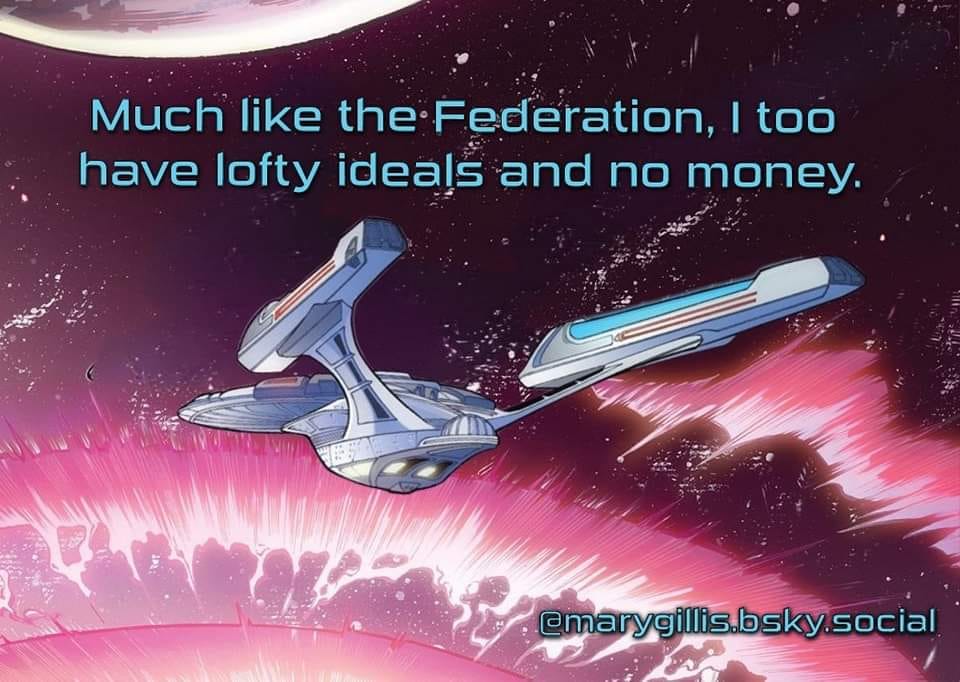
This meme features the USS Enterprise-D from the Star Trek franchise flying through space. The overlaid blue text reads, "Much like the Federation, I too have lofty ideals and no money," making a joke about the sci-fi crew's struggles.
simple-description (llama3.2-vision_11b)
This meme is from the Star Trek franchise, specifically from the TV show "Star Trek: The Next Generation". The meme features a quote from the character Jean-Luc Picard, who says "The needs of the many outweigh the needs of the few... or the one." However, in this meme, the quote is altered to "The needs of the many outweigh the needs of the few... or the one... who's a jerk."
detailed-analysis (gemma3-27b-vision)
Okay, let's break down this image with analyses according to the requested frameworks. It's a fascinating piece of internet ephemera that lends itself to multiple readings.
Visual Description
The image features a brightly colored, cartoon-style rendering of two starships, seemingly from the Star Trek universe. One is the USS Enterprise, specifically of the Enterprise-D (Next Generation) variety, depicted in profile. The other ship, alongside, is a similar vessel, but with different details. The background is a vibrant, nebulous space scene, with swirls of pink, purple, and white, speckled with stars. The composition positions the ships as if in flight within this cosmic backdrop.
Overlaid on the image is white text that reads: “Much like the Federation, I too have lofty ideals and no money.” At the bottom is a username/handle: @marygillis.bsky.social. The visual style is clearly meant to be meme-like – bright, expressive, and geared towards online dissemination. The rendering feels like it's from a fan art style or possibly a graphic created with tools like Procreate or Photoshop, and is definitely not screen capture from the show.
Foucauldian Genealogical Discourse Analysis
The meme constructs a discourse around the Star Trek Federation – an imagined utopian society. Foucault would be interested in how the concept of the Federation (and the ideals it represents – peace, exploration, post-scarcity, equality) functions within the social order, rather than if it's true or false. The text highlights a contradiction within this discourse. The Federation presents itself as a society that has transcended material concerns, but the creator positions their own lived experience (lack of funds) as analogous. This disruption creates a space for questioning the assumptions embedded within the utopian vision of the Federation.
Genealogically, this meme traces a line of thinking: utopian visions are often framed as possible but are always tethered to material conditions. The meme points to the reality that realizing 'lofty ideals' always requires resources. It implies that the Federation’s ideals, while aspirational, may be predicated on a concealed or ignored material base. The power dynamic is subtle; it's not a direct challenge to the Federation's ideals, but a self-deprecating comment that exposes a lack of power to realize similar ideals.
Critical Theory
From a critical theory perspective, the meme is a subtle commentary on the ideological function of utopian representations. The Federation, as a frequently cited example of a better society, can serve to naturalize existing inequalities by suggesting that ‘progress’ is simply a matter of better ideas, ignoring the material conditions that impede social change. The meme’s self-deprecating tone acknowledges those material conditions (lack of money) and implicitly critiques the way utopian narratives can obscure or downplay them.
The image is not simply about the Federation; it is about the relationship between ideals and reality, and the power dynamics inherent in that relationship. It's a small act of resistance, a refusal to accept the utopian narrative at face value.
Marxist Conflict Theory
The meme clearly aligns with a Marxist understanding of society. The core conflict inherent in the image is between aspiration and material conditions. The Federation represents a "post-scarcity" society, where economic hardship is supposedly absent. The creator, by contrasting this ideal with their own lack of funds, highlights the inherent conflict between the ruling ideology (utopian ideals) and the material realities of life under capitalism.
The image implies that the Federation's ideals, while admirable, are unattainable for those trapped within a system of economic inequality. The lack of money is not merely a personal problem, but a symptom of a broader systemic problem. The image doesn’t explicitly call for revolution, but it certainly raises awareness of the underlying conflicts inherent in the existing social order. The image is not advocating for violent revolution, but it subtly highlights the imbalance of power and the inherent contradictions within the system.
Postmodernism
The meme embodies several postmodern characteristics. First, it’s a pastiche – it takes a familiar cultural symbol (the Federation) and recontextualizes it in a personal, ironic way. It plays with the idea of authenticity and originality, remixing existing imagery and text to create a new meaning.
Second, it deconstructs the utopian narrative of the Federation, revealing its inherent contradictions. It’s not necessarily rejecting the ideals of the Federation, but it’s exposing the gap between those ideals and the realities of lived experience.
Third, it’s inherently subjective and fragmented. The meme is a personal expression of frustration and disillusionment, rather than a grand, universal statement. The meaning of the meme is open to interpretation, depending on the viewer's own experiences and perspectives.
Queer Feminist Intersectional Analysis
While not immediately obvious, an intersectional lens can illuminate the meme’s resonance. The experience of lacking resources disproportionately affects marginalized groups, including women, LGBTQ+ individuals, and people of color. The creator, likely identifying with one or more of these marginalized groups, is implicitly drawing attention to the systemic barriers that prevent them from realizing their own "lofty ideals."
The meme subtly challenges the dominant narratives of meritocracy and individual achievement, suggesting that success is not solely determined by hard work and talent, but also by access to resources and privilege. The self-deprecating humor can be read as a coping mechanism for navigating a world that is often hostile and exclusionary.
The image can also be seen as a commentary on the ways in which utopian visions often exclude marginalized voices and experiences. The Federation, while seemingly progressive, may not fully address the specific needs and concerns of all its citizens. The creator, by inserting their own personal experience into the utopian narrative, is challenging the dominant framework and demanding a more inclusive vision of the future.
Let me know if you’d like me to delve deeper into any of these analyses, or if you have other theoretical frameworks you'd like me to apply!
simple-description (llama3.2-vision)
This meme is a humorous take on the Star Trek franchise, specifically referencing the character Captain Jean-Luc Picard's famous quote "The needs of the many outweigh the needs of the few... or the one." The meme replaces "the needs of the many" with "the needs of the crew" and "the one" with "the captain" to poke fun at the idea that the captain is so self-absorbed that his needs are more important than everyone else's.
tesseract-ocr
(Ufo a=W tale t—to(=1e-1e(e a cele .. have lofty ideals‘and no money. {= ; e 3 Fie o : a: - CZAN' any = OS ees a CT era \ N= Bi aaa ee ae EE eae Wa s R “tare @marysillisbeteySeael een ea ew wage = = a /