First Seen
2024-04-13T05:55:58.644381+00:00
simple-description (qwen3.5_2b-q8_0)
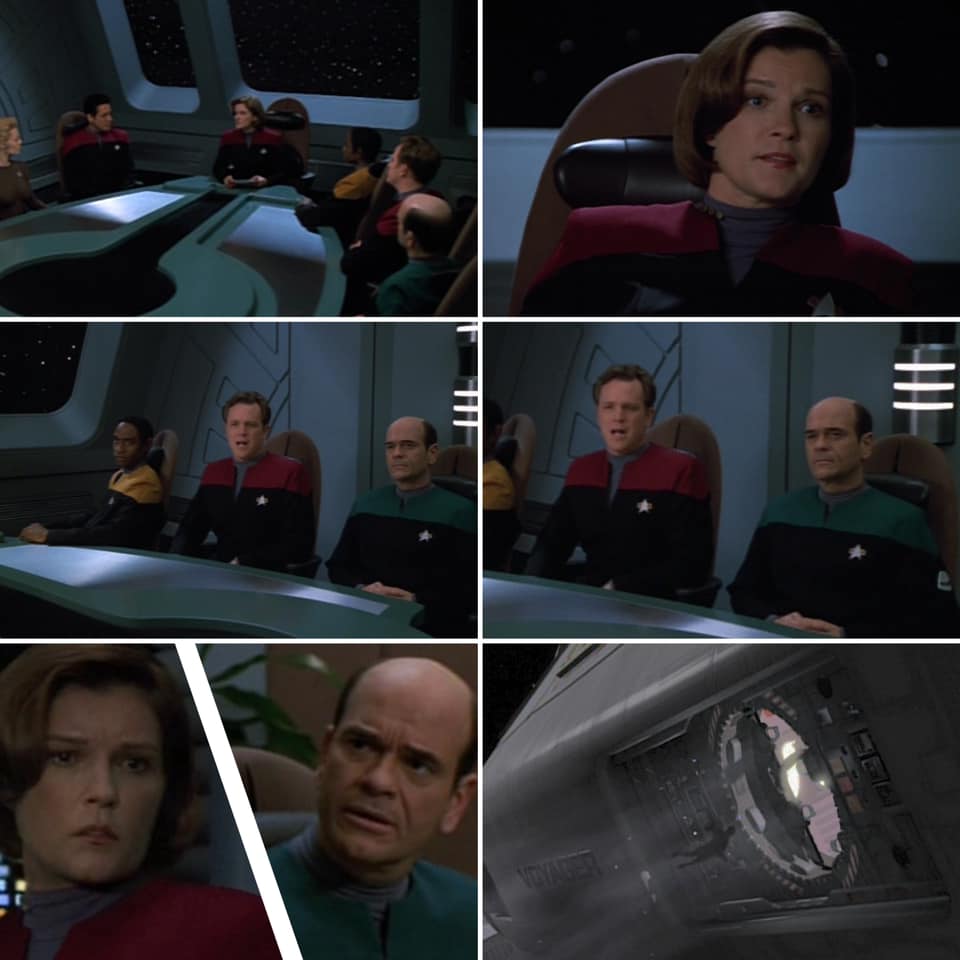
The image is a collage of scenes from the Star Trek franchise, featuring characters like Captain Kirk, Commander Riker, and Data reacting with confusion or surprise. The text "Widener" appears on a door in the bottom right panel, likely referencing the First Contact Coordinator from Star Trek: Voyager. This combination captures a moment of bafflement within the Star Trek universe, possibly blending clips from different eras or characters, and suggests a mystery or confusion about the scene.
simple-description (llama3.2-vision_11b)
The meme is a screenshot from the Star Trek: The Next Generation episode "The Outcast" where the character Deanna Troi's emotions are being suppressed by a device. The image shows a close-up of the device, with the text "I'm fine" appearing on the screen. The meme is often used to express that someone is trying to hide their true emotions or feelings.
detailed-analysis (gemma3-27b-vision)
Okay, let's break down this image set, utilizing the theoretical frameworks you've requested. Given the content and context of Star Trek: Voyager, I'll try to weave these together in a relevant manner.
Visual Description
The image is a collage of screengrabs from the Star Trek: Voyager episode "Scorpion." The setting is the bridge of the USS Voyager. The primary characters featured are Captain Kathryn Janeway (Kate Mulgrew), First Officer Chakotay (Robert Beltran), and Lieutenant Tom Paris (Robert Duncan McNeill).
The images depict a tense situation, clearly a moment of shock or revelation. The lighting is typical for the Voyager bridge—dim and focused on the characters, with a backdrop of the starfield. The framing emphasizes the reactions of the officers—Janeway’s direct gaze, Chakotay's stoicism, and Paris's visible alarm. The final image features an exterior shot of a Borg Cube, implying that the shock comes from a confrontation or revelation related to the Borg collective. The dramatic angles and lighting suggest high stakes and emotional investment.
Foucauldian Genealogical Discourse Analysis
This scene is ripe for Foucauldian analysis. The Borg represent a potent "discourse" of assimilation and control. The Voyager crew, representing a culture valuing individuality and exploration, is confronted by this opposing force.
- Power/Knowledge: The Borg's power stems not just from technological superiority but also from their knowledge – knowledge about other civilizations, their weaknesses, and how to integrate them. This is not simply objective knowledge, but power/knowledge intertwined, as Michel Foucault describes. Their knowledge is a tool of domination.
- Genealogy: The Borg's origins, while vaguely outlined in the series, trace a lineage of relentless efficiency and the eradication of individuality. Examining this "genealogy" of the Borg reveals how a particular logic of control evolved over time. The crew’s initial assumptions about the Borg are challenged, and they must re-evaluate their understanding.
- Disciplinary Power: The Borg’s collective structure can be seen as an extreme form of disciplinary power. Individuals are subsumed into a system designed to eliminate deviance and enforce conformity. Voyager's struggle against the Borg is a struggle against this type of power.
The image highlights the moment Voyager is forced to engage with this discourse – not merely to resist it, but to potentially understand it. The visual tension reflects the precarious balancing act of acknowledging the Borg’s power while simultaneously asserting the values of the Federation.
Critical Theory
Applying a critical theoretical lens, this scene can be interpreted as a commentary on themes of otherness, alienation, and the dangers of unchecked power.
- Frankfurt School Influence: The Borg can be seen as representing the forces of instrumental reason, as described by Max Horkheimer and Theodor Adorno. They reduce all beings to their function within the collective, eliminating any subjective experience or individual value.
- Alienation: The Borg's assimilation process represents the ultimate form of alienation. Individuals are stripped of their identity, their agency, and their connection to humanity, becoming mere drones within a larger system.
- Hegemony: The Borg attempt to establish a cultural hegemony, imposing their collective consciousness on others. The crew of Voyager is forced to confront the question of how to resist this imposition and preserve their own values.
The visual shock on the faces of the characters underscores the existential threat the Borg pose to their worldview. The image captures a moment where the crew is forced to acknowledge the fragility of their own assumptions and the potential for their values to be overwhelmed by a more powerful force.
Marxist Conflict Theory
From a Marxist perspective, this scene reveals a fundamental conflict between two distinct modes of social organization: the Federation's ostensibly egalitarian, exploratory model and the Borg’s rigid, hierarchical collective.
- Class Struggle: While not a traditional class conflict, the struggle against the Borg can be seen as a conflict between two opposing "classes" of civilizations. The Federation values individual agency and diversity, while the Borg represent a form of extreme collectivism that eliminates individual differences.
- Means of Production: The Borg’s technology can be interpreted as the “means of production” that allows them to exert control over other civilizations. They assimilate others into their collective, effectively exploiting their resources and knowledge.
- Ideology: The Borg’s ideology – the belief in perfection through assimilation – justifies their actions and serves to maintain their power. The crew of Voyager must challenge this ideology and defend their own values.
The shock on the characters' faces suggests the realization that the Federation's ideals may be insufficient to protect them from a force that prioritizes efficiency and control over individual freedom.
Postmodernism
The encounter with the Borg resonates with several postmodern themes.
- Deconstruction of Identity: The Borg dismantle the very notion of individual identity, reducing beings to their function within the collective. This challenges the postmodern emphasis on the constructed nature of identity and the fluidity of subjectivity.
- Simulacra and Simulation: The Borg's assimilation process can be seen as a form of simulation, creating copies of individuals without the original essence. This evokes Jean Baudrillard's concept of simulacra and the loss of the real.
- Rejection of Metanarratives: The Borg represent a totalizing system that seeks to impose its own logic on all of existence. This challenges the postmodern critique of metanarratives – overarching stories that claim to explain all of reality.
The crew’s disorientation reflects the breakdown of their established worldview. The encounter with the Borg forces them to question the very foundations of their beliefs and values.
Queer Feminist Intersectional Analysis
While not immediately apparent, the scene can be viewed through a Queer Feminist Intersectional lens by analyzing how the Borg’s assimilation threatens individuality and agency, particularly for marginalized groups.
- Loss of Subjectivity: The Borg's erasure of individual identity can be understood as a violation of queer and feminist critiques of essentialism. The Borg’s assimilation negates diverse experiences and suppresses individual expression.
- Control of Reproduction: While not explicitly reproductive, the Borg’s assimilation can be seen as a form of reproductive control, as they subsume others into their collective, effectively extinguishing individual lineage.
- Intersectionality: The impact of assimilation would disproportionately affect individuals already marginalized within the Federation. Those who identify outside of traditional norms would be more vulnerable to having their identities erased or suppressed.
The shock on the characters’ faces can be interpreted as a recognition of the existential threat the Borg pose to the values of diversity, inclusivity, and self-determination.
I hope this breakdown is helpful! Let me know if you’d like me to elaborate on any of these points or explore different theoretical angles.
simple-description (llama3.2-vision)
This meme is a screenshot from the TV show Star Trek: The Next Generation, featuring Captain Jean-Luc Picard looking at a Padd (a device that displays text and images) with a puzzled expression. The text on the Padd reads "It's a Padd, Jim, but not as we know it". The meme is likely referencing the classic Star Trek episode "The Padd" where the crew of the Enterprise discovers a strange device that displays text and images, but the text on the Padd is actually a joke about the Padd itself being a device that displays text and images.
tesseract-ocr
rr x9 7 a 7) ie | I ss rE ae —. : - SS “oq , : hres! a \* = - a AS