First Seen
2024-04-20T01:03:21.534120+00:00
simple-description (qwen3.5_2b-q8_0)
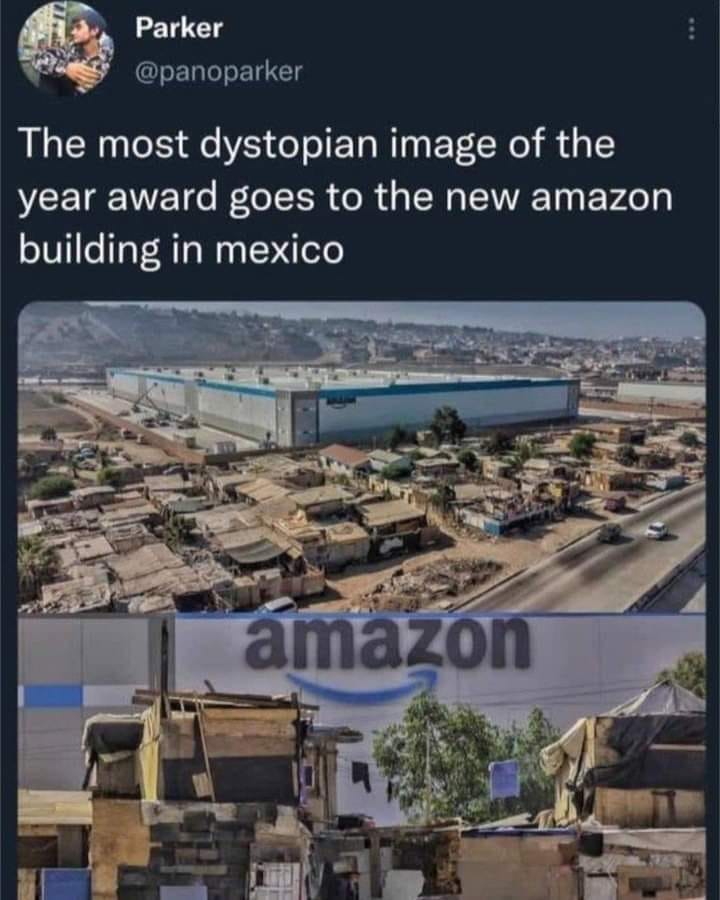
This meme references the Star Trek series The Borg and the annual "Dystopian Image of the Year" awards from major news outlets. The new Amazon warehouse is used as a metaphor for a hive mind that is replacing the diverse nature and culture of the Mexican landscape, much like the Borg assimilated all humanity. The caption reads: "The most dystopian image of the year award goes to the new amazon building in mexico"
simple-description (llama3.2-vision_11b)
The meme is a humorous comparison between the Star Trek: The Next Generation episode "The Inner Light" and the city of Ciudad Juárez, Mexico. The image shows a sprawling cityscape with a caption "The most dystopian city in the Federation" next to a photo of a Star Trek: The Next Generation episode where the crew of the Enterprise-D experiences a simulated life in the city of Cuatro Cienegas. The meme is poking fun at the idea that a futuristic city would be more appealing than the actual city of Ciudad Juárez.
detailed-analysis (gemma3-27b-vision)
Okay, here's a breakdown of the image, approaching it through the lenses you've requested. It's a complex image that readily invites several theoretical interpretations.
Visual Description
The image is a composite – two photos stacked vertically.
- Top Image: Shows a massive, modern, box-like Amazon fulfillment center. It's a sprawling, rectangular structure, light in color, set in a vast, arid landscape. A multi-lane highway runs alongside it, suggesting scale and logistical focus. The building dominates the horizon. The landscape appears brown, dry, and somewhat barren.
- Bottom Image: Presents a stark contrast. It depicts what appears to be a low-income residential neighborhood, with small, simple houses constructed of various materials like corrugated metal, concrete block, and perhaps some brick. These homes have flat roofs, some with rudimentary vegetation growing on them. They appear densely packed and lack the aesthetic polish of the fulfillment center.
The composition visually juxtaposes extreme wealth (symbolized by the vast, modern building) against apparent poverty or precarity. The contrast is striking, creating a strong visual statement.
Marxist Conflict Theory
This image is a potent visual illustration of Marxist principles, specifically the inherent class struggle embedded within capitalist systems.
- Means of Production: The Amazon fulfillment center represents the concentrated means of production – the capital, technology, and labor required to create goods. It signifies the ownership class controlling these resources.
- Proletariat & Exploitation: The tiny houses likely represent the living conditions of the workers within that fulfillment center (or within a similar system). This suggests a clear power imbalance. The vast scale of the building, coupled with the humble homes, highlights the exploitation of labor – a small number of owners reaping significant profit from the work of many.
- Alienation: The image evokes alienation – the separation of workers from the products of their labor, from each other, and from themselves. The dehumanizing scale of the building suggests that workers are treated as mere cogs in a machine.
- Superstructure: The Amazon facility can be seen as part of the “superstructure” – the institutions (economic, political, ideological) that maintain and reinforce the existing class structure. Its presence in this landscape actively perpetuates inequality.
- Imperialism/Neocolonialism The building’s presence in Mexico suggests a form of modern imperialism where a powerful multinational corporation (Amazon) is expanding its control over resources and labor in a developing nation, potentially perpetuating dependency and inequality.
Critical Theory
The image is ripe for Critical Theory analysis, particularly focusing on the idea of domination and the culture industry.
- Domination & Power: The image speaks to systemic domination – the ways in which power operates not just through overt force, but through structural inequalities. Amazon, as a global corporation, embodies concentrated power.
- Culture Industry: The Amazon logo is part of the "culture industry" – the mass production of cultural products (brands, images, lifestyles) that shape our values and beliefs. The ubiquity of the logo reinforces the normalization of consumerism and corporate power.
- Instrumental Rationality: The fulfillment center exemplifies "instrumental rationality" – the pursuit of efficiency and profit as the sole organizing principles. The image suggests that human needs and well-being are secondary.
- Hegemony Amazon’s logo and size demonstrate cultural hegemony - the dominance of one social group’s ideas and values over others, shaping perceptions and reinforcing existing power structures. The image suggests that this dominance is visually imposing and hard to ignore.
Foucauldian Genealogical Discourse Analysis
Foucault's concept of power/knowledge is very relevant here.
- Discipline & Surveillance: A fulfillment center is inherently a space of discipline and surveillance. It embodies the principles of panopticism – the idea that individuals can be controlled through the possibility of being watched. The layout of the building, with its vastness and potential for monitoring, reinforces this.
- Genealogy of Control: We can trace a genealogy of control through this image. From earlier forms of industrial labor to the modern, digitally-managed warehouse, we see the evolution of techniques used to maximize productivity and control workers.
- Normalizing Power: Amazon, as a corporation, exerts "normalizing power" – the ways in which it defines what is considered "normal" or "efficient," thereby shaping behavior and expectations. The scale and design of the building reinforce this idea of a standardized, optimized system.
- Discourse of Efficiency: The image contributes to a "discourse of efficiency" – a set of ideas and practices that prioritize speed, productivity, and cost-cutting. This discourse often obscures the human cost of these goals.
Postmodernism
- Hyperreality & Simulacra: The image can be interpreted through the lens of Jean Baudrillard’s concepts of hyperreality and simulacra. The Amazon fulfillment center may represent a “simulacrum” – a copy without an original, a representation that has become more real than the reality it supposedly reflects. It's a symbol of consumer culture and logistical power that has become detached from the actual production of goods and the needs of people.
- Fragmentation & Deconstruction: The juxtaposition of the modern building and the older homes can be seen as a fragmentation of space and experience. It deconstructs the idea of a unified or coherent social fabric.
- Loss of Grand Narratives: The image suggests a loss of grand narratives – the overarching ideologies that once provided meaning and purpose. It’s a fragmented, localized view of power and inequality, challenging the idea of a single, unified story.
Queer Feminist Intersectional Analysis
This is where things get slightly more nuanced, but the lens is still relevant.
- Intersectional Vulnerability: The image points to the intersectional vulnerability of workers within the Amazon system. Labor within fulfillment centers is often filled by marginalized groups (women, people of color, immigrants) who face multiple forms of oppression.
- Labor and Care Work The image draws a stark contrast between the "productive" labor taking place within the fulfillment center and the under-valued "care work" that often supports that labor (childcare, housework, community work).
- Precarity The image conveys the precarity of life for those living in the small homes. Their lack of economic and social power exposes them to systemic risks and vulnerabilities.
- Spatial Justice: The image raises questions about spatial justice – the equitable distribution of resources and opportunities within space. The vastness of the fulfillment center, juxtaposed with the cramped living conditions, highlights the unequal distribution of power and wealth.
I hope this detailed analysis is what you were looking for! Let me know if you'd like me to elaborate on any particular aspect.
simple-description (llama3.2-vision)
This meme is a humorous comparison between two images. The top image shows a sprawling, modern city with sleek skyscrapers and bustling streets, but the caption "The most dystopian image of the year award goes to..." sets up a surprise. The bottom image is a shocking contrast: a crowded, impoverished, and ramshackle slum, with trash-filled streets and makeshift shelters. The text continues, "The most dystopian image of the year award goes to... the new Amazon warehouse in Mexico."
tesseract-ocr
lag 2 | @panoparker | The most dystopian image of the year award goes to the new amazon building in mexico —— — eR sale a" Se SS Sion Se eS eS pe eng ae ee ie re EE ey | amazon a + | mB: 4 ne ee | Oi kno Ad inl <P a, a See ie ek Yr