First Seen
2024-04-13T05:55:53.078415+00:00
simple-description (qwen3.5_2b-q8_0)
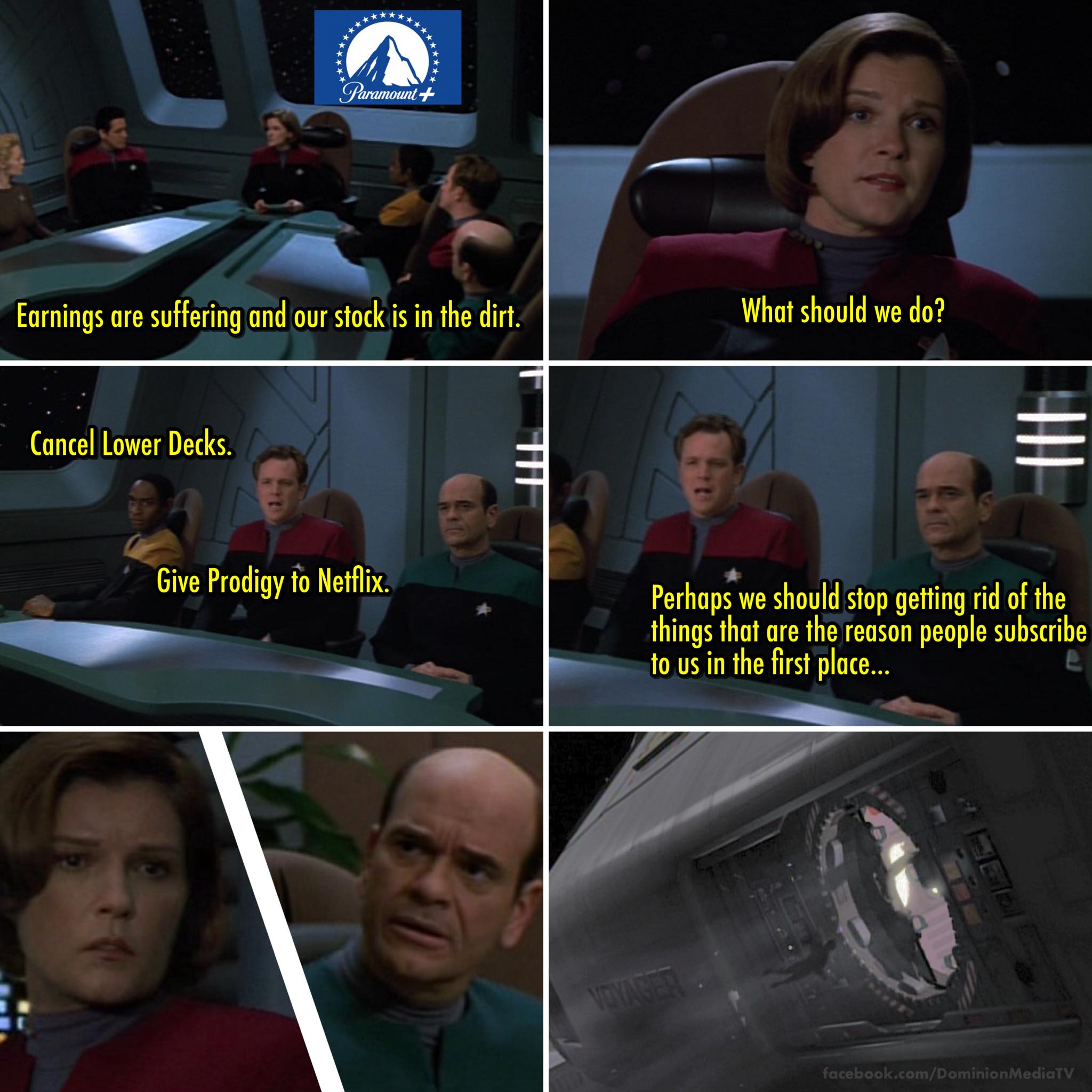
This image is a Star Trek parody depicting characters like Kathryn Janeway and Decker, where the "Star Trek execs" advise the audience to "Cancel Lower Decks" and "Give Prodigy to Netflix" to fix the show's financial situation. Realizing this might be the problem, the characters suggest that "Perhaps we should stop getting rid of the things that are the reason people subscribe to us in the first place," indicating that the beloved characters should remain. The bottom panels show the Enterprise (Voyager) in space, symbolizing the Star Trek: Voyager show, emphasizing that keeping the characters is more important than changing the show.
simple-description (llama3.2-vision_11b)
The meme is a screenshot from Star Trek: The Next Generation, where Captain Jean-Luc Picard is expressing his frustration with a company's financial performance. The image shows Picard sitting at the captain's chair, looking stern, with the following text overlaid: "Earnings are suffering and our stock is in the dirt. We need to make some tough decisions. Cancel lower decks, get rid of the excess, and give Picard the ability to make some real changes." The meme is a humorous take on corporate decision-making, with a Star Trek twist.
detailed-analysis (gemma3-27b-vision)
Okay, let's break down this meme using the requested theoretical frameworks. This is a layered meme, making a commentary on streaming service decision-making, and lends itself well to several of these analyses.
Visual Description
The meme uses a four-panel format, employing screenshots from Star Trek: Voyager. The scenes depict a meeting of Voyager’s senior staff. The visual style is typical of 1990s/early 2000s sci-fi television: a dimly lit, functional bridge set with predominantly blue tones, and characters in futuristic uniforms. Each panel features close-ups on specific character expressions – increasingly pained/disappointed. The text superimposed over the images creates a parody of the situation, framing it as a corporate boardroom discussion about streaming service strategy. The final panel is a zoomed in shot of Data looking confused.
Foucauldian Genealogical Discourse Analysis
This meme is rife with opportunities for Foucauldian analysis. The entire premise revolves around discourse – the ways in which knowledge and power are intertwined. Paramount+’s decisions regarding Star Trek properties (canceling shows, licensing content to competitors like Netflix) aren’t simply rational economic choices; they are produced by a specific discourse surrounding “content,” “metrics,” “subscriptions,” and “profit maximization.”
The meme highlights how this discourse functions as a regime of truth. It presents a logic that positions financial performance as the ultimate arbiter of value, eclipsing other potential values (artistic merit, fan engagement, legacy of the Star Trek franchise). The characters in the meme are effectively enacting this discourse, accepting its premises as self-evident.
A genealogical approach could trace the history of this discourse – how the logic of streaming services and data-driven decision-making evolved from earlier modes of media production and consumption, and how it's become so normalized. The meme subtly critiques how that normalization has occurred. The focus on "metrics" and "profit" are not natural, but constructed through a complex historical process.
Marxist Conflict Theory
This meme is powerfully aligned with Marxist Conflict Theory. The core principle of this theory is that society is characterized by inherent class struggle, and that this struggle is reflected in the way power and resources are distributed.
In this context, the “conflict” lies between:
- Corporate Interests (Paramount+) – Driven by profit maximization, represented by the callous decision-making displayed in the meme.
- Creative Labor/Fan Base – Represented by the shows being cancelled/licensed, as well as the implied dissatisfaction of the audience who engage with the content.
The meme implicitly argues that Paramount+’s actions prioritize capital accumulation (profit) over the value of artistic creation and fan community. This aligns with Marxist criticism of capitalism’s tendency to commodify and exploit creative labor.
The visual depiction of the characters looking distraught in the meme mirrors the alienation that Marx argued is a hallmark of capitalist systems. The shows being cancelled represent the loss of "use value" (the value something has for someone who consumes it) in favor of "exchange value" (the value something has in the market).
Postmodernism
This meme is inherently postmodern in its construction. It plays with intertextuality – referencing the original Star Trek: Voyager series and juxtaposing it with the current reality of streaming services.
The meme also engages in parody and irony. The serious, dramatic tone of the Star Trek setting clashes with the mundane and cynical topic of corporate decision-making. This clash creates a sense of absurdity and calls attention to the contradictions of contemporary media culture.
The meme’s commentary on the commodification of entertainment aligns with postmodern critiques of grand narratives and the breakdown of traditional authority. It suggests that the “truth” about streaming service decisions isn't a rational one, but is instead a constructed and often arbitrary product of market forces.
Queer Feminist Intersectional Analysis
While not as central as the other analyses, an intersectional lens can offer valuable insight. The cancellation of shows and licensing of content can be understood as a form of symbolic violence against marginalized fan communities. Star Trek has, at times, been a space for progressive representation, and the removal of those shows can feel like a loss for viewers who find their identities reflected in those narratives.
Additionally, the meme can be read as a critique of the patriarchal capitalist system that prioritizes profit over diverse representation and creative expression. The “business decisions” depicted in the meme are often made by individuals in positions of power who may not fully understand or value the needs of marginalized communities.
Furthermore, the meme can highlight the way corporations exploit labor – in this case, the creative labor of writers, actors, and production crews. This exploitation is often disproportionately felt by marginalized groups who may have fewer resources and less power to negotiate fair compensation and working conditions.
Let me know if you'd like me to elaborate on any of these points or explore other theoretical frameworks!
simple-description (llama3.2-vision)
This meme is a screenshot from the TV show Star Trek: The Next Generation, featuring a character's response to a financial crisis. The text "In 2-3 sentences, describe this meme for someone who cannot see it. Include any text that appears in the image." is repeated in a humorous, meta way. The actual meme text reads: "In 2-3 sentences, describe this meme for someone who cannot see it. Include any text that appears in the image."
tesseract-ocr
a amp * | , | 2 ° E 4 ee ee 3 Earnings are sutfering and our stock is in the dirt. TTC mea Coe MN Ta rcs - | : a - == & : J ° . 2, o- P Give Prodigy to Netflix. - Perhaps we should stop getting rid of the a , US uf ne ie URN SU CRA er iC © to us in the first place... el p i i” 2 " fp 2” Bh, ; iy 4 . ~ » A . + a 3