First Seen
2023-05-10T21:03:40+00:00
simple-description (llama3.2-vision_11b)
The meme is a screenshot from the Star Trek: The Next Generation episode "The Outcast," where the character Data is explaining the concept of humor to his captain, Jean-Luc Picard. The image shows Data saying "I do not understand the nature of this 'humor' you find... amusing" as he's trying to comprehend the concept of sarcasm and irony. The meme is often used to express confusion or frustration when someone doesn't understand a joke or a sarcastic comment.
detailed-analysis (gemma3-27b-vision)
Okay, let's analyze this series of screenshots from Star Trek: Deep Space Nine through the lenses you've requested. It's a fascinating little exchange, ripe for theoretical unpacking.
Visual Description
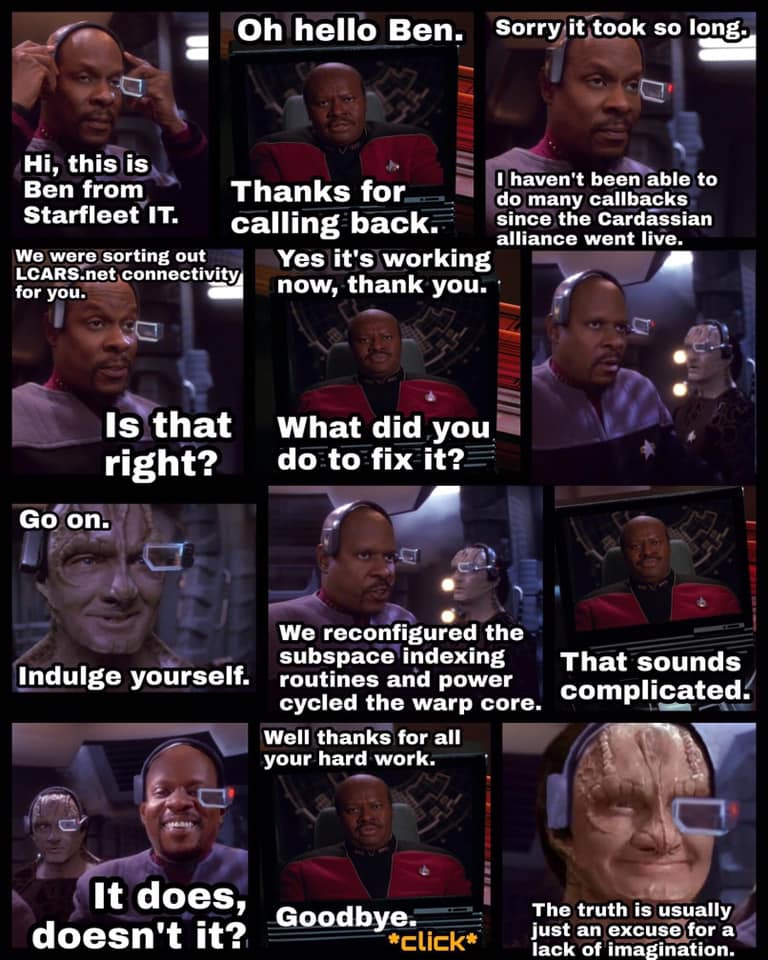
The images depict a series of close-up shots, primarily focusing on the face of Odo, a Changeling security chief, while he's on a video call with Ben, an IT technician from Starfleet. The setting is the Ops center of Deep Space Nine, characterized by its rounded walls and illuminated LCARS (Library Computer Access and Retrieval System) panels. The lighting is predominantly deep purple, casting dramatic shadows. Odo's expression is consistently thoughtful, bordering on pensive, while Ben is only seen briefly in shadow, mostly obscured. The visuals emphasize Odo's isolation and interiority, contrasting with the faceless, functional authority of Starfleet represented by Ben's unseen presence. The color scheme evokes a sense of mystery and technological complexity. The exchange is presented in nine panels, creating a deliberate rhythm and drawing attention to specific moments of dialogue.
Foucauldian Genealogical Discourse Analysis
This exchange provides a rich opportunity to apply Foucault's concepts. The very act of needing to "reconfigure subspace indexing routines" and cycle the "warp core" is a demonstration of power/knowledge. The technical jargon isn’t simply description; it constitutes the reality of the warp core and subspace itself. It establishes the terms by which these things exist within the universe and reinforces the authority of those who can manipulate them (like Ben, through his technical expertise).
The "fix" isn't merely a solution to a problem; it's an exercise of disciplinary power. Ben, from Starfleet IT, operates as a node in a broader network of control, ensuring the smooth functioning of the station. Odo, while a security officer, is dependent on this external authority for maintaining fundamental systems. This highlights how seemingly neutral technologies are always embedded in relations of power.
The exchange demonstrates the genealogy of knowledge—how specific technical concepts (subspace indexing, warp core cycling) have emerged through historical practices and are not universal truths. The fact that this fix is necessary after the Cardassian Alliance went live speaks to a shift in power dynamics and the necessity for technological adaptation to maintain control. The language used (indexing, routines) also embodies a particular way of understanding the universe—one that is ordered, categorized, and amenable to manipulation.
Critical Theory
From a Critical Theory perspective, this scene exposes the inherent contradictions within the Star Trek universe's seemingly utopian vision. The Federation prides itself on its ideals of cooperation and non-interference, yet Odo requires technical assistance from Starfleet IT – a clear demonstration of dependence and control. The technical language, while presented as objective, actually functions to obscure the underlying power relations.
The fact that Odo, representing the station’s security, relies on an external authority highlights a potential vulnerability. This echoes the Frankfurt School’s concern with the "instrumental reason" of technology, where systems are designed for efficiency and control at the expense of human agency.
Furthermore, the briefness of the interaction and the lack of personal connection between Odo and Ben suggest a dehumanizing aspect of the technologically mediated exchange. It’s about solving a technical problem, not about fostering genuine connection or understanding. This aligns with Adorno and Horkheimer’s concept of the “culture industry,” where even seemingly progressive narratives can reinforce existing power structures.
Marxist Conflict Theory
Applying a Marxist lens, we can see this scene as representative of the inherent class struggle within the Star Trek universe. Ben, the IT technician, represents the bourgeoisie – the owners of the means of production (in this case, the technical knowledge and infrastructure). Odo, the security officer, represents the proletariat – those who must rely on the bourgeoisie to maintain the fundamental systems that allow them to function.
The "fix" is not a benevolent act of assistance but rather a reinforcement of Ben’s power. Odo is dependent on Ben’s technical expertise, and this dependence creates a power imbalance. Ben can exert control by withholding or manipulating this expertise. The fact that this dependency arose after the Cardassian Alliance went live suggests that the shifting political landscape (the alliance) necessitates increased technological control to maintain the existing power structure. This is a classic example of how economic/technological power is used to solidify political dominance.
The seemingly neutral act of “reconfiguring subspace indexing” is, from a Marxist perspective, a tool of control, used to maintain the status quo and prevent any challenge to the Federation’s authority.
Postmodernism
From a postmodern perspective, this exchange challenges the notion of a coherent, unified reality. The technical jargon (“subspace indexing,” “warp core cycling”) functions as simulacra – signs that have become detached from any underlying reality. The terms themselves are more important than any actual process they describe. The "fix" is not about solving a problem but about maintaining the illusion of control.
The fact that Odo readily accepts Ben’s explanation, even though it is highly technical and potentially incomprehensible, highlights the acceptance of “grand narratives” (in this case, the narrative of technological progress and control) without critical questioning.
The scene also deconstructs the traditional heroic archetype. There is no dramatic rescue or confrontation, only a mundane technical exchange. This subversion of expectations is characteristic of postmodern art and literature. The lack of personal connection between Odo and Ben further emphasizes the fragmentation and alienation of modern life.
Queer Feminist Intersectional Analysis
While less immediately apparent, an intersectional analysis can be applied. Odo, as a Changeling, represents a non-normative identity within the Star Trek universe. He is often perceived as "other" and subject to prejudice. His dependence on Starfleet IT, a predominantly human institution, can be seen as a metaphor for the systemic disadvantages faced by marginalized groups. The lack of personal connection in the exchange reinforces the sense of alienation and exclusion that Odo experiences.
The emphasis on technological "fixes" and rational solutions can also be seen as a manifestation of patriarchal logic, prioritizing technical expertise over emotional intelligence and human connection.
Furthermore, the fact that Odo, as a security officer, requires assistance to maintain the station’s systems underscores the limitations of individual agency. Even those in positions of authority are subject to systemic constraints. The focus on maintaining a functional system at the expense of acknowledging the underlying power imbalances echoes feminist critiques of patriarchal institutions. While subtle, the scene subtly reinforces power structures that are at odds with intersectional justice.
Let me know if you'd like me to expand on any of these interpretations or explore other theoretical lenses!
simple-description (llama3.2-vision)
The meme is a screenshot from the TV show Star Trek: The Next Generation, featuring the character Data, a android who is trying to understand human humor. In the image, Data is watching a video of a comedian performing stand-up, and he's trying to understand why the comedian is laughing at a joke. The text overlayed on the image reads "I'm trying to understand this 'humor' thing. A comedian is saying 'I'm reading a book on the history of time. It's very short. It says in the first chapter: 'Man is a 3.33... 3.33...'".
tesseract-ocr
Oh hello Ben. Trays em itp 52 a " ns ee \ 5 a Q 4 PTS a eo. Cg LT Cok ol ee er er PCa iT) a calling back. BUCO ee een are working ETE Tet) AC To pee eae aT) atc “| , a J | ees - aw E SS ae. e = <a, —— te ee SCE UC hr right? do‘to fix it? \/ nT Ns _ COCs ad ! ih CT a ee a s “4 en ; eo a i . i We reconfigured the . ry etwas That sounds UT CUTE Ml Ct eeu tl iets P yy cycled the warp core. RT ASL a —— uu) oho ‘ ‘-" your hard work. ( & ee > oe | Has Ns os i F = 7 5 moe ‘= ] : . Ch 4 It does, U P x Goodbye: a amy Cer , doesn't it? eee