First Seen
2023-05-10T21:03:40+00:00
simple-description (llama3.2-vision_11b)
The meme is a screenshot from the TV show Star Trek: Discovery, featuring characters Saru and Michael Burnham in a tense conversation. The text overlay reads "I'm not going to sugarcoat it" and "I want to go to Mars" in a playful, sarcastic tone, implying that Michael is frustrated with Saru's lack of understanding about her desire to join the crew of the Discovery.
detailed-analysis (gemma3-27b-vision)
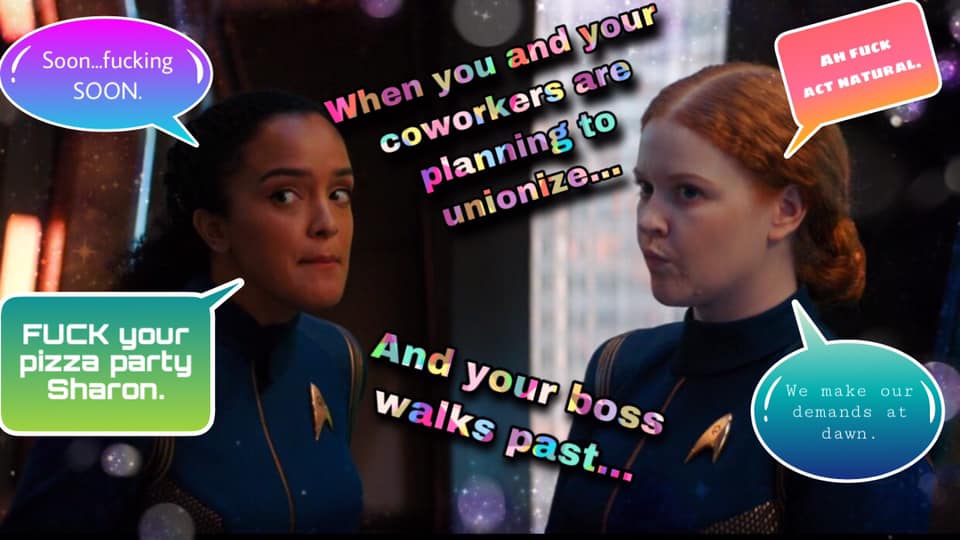
Okay, let's break down this image with the requested theoretical frameworks. It's a meme format featuring characters from Star Trek: Lower Decks, overlaid with text expressing rebellious workplace sentiment.
Visual Description
The image is a still from the animated series Star Trek: Lower Decks. It depicts two female characters, Beckett Mariner (on the left) and Tendi Shar (on the right), walking down a corridor. Mariner has a determined, almost mischievous expression. Tendi looks anxious and worried. The background is a blurred, brightly lit corridor, typical of a starship interior. The image is overlaid with text bubbles that convey a narrative of workplace resistance. The color palette is dominated by blues, purples and black.
Foucauldian Genealogical Discourse Analysis
This meme can be understood through a Foucauldian lens as a disruption of the discourse surrounding workplace power dynamics. The seemingly benign setting of a starship is undermined by the explicit, vulgar language. The text reveals a subaltern counter-discourse forming.
- Power/Knowledge: The text highlights the asymmetrical power relationship between workers and management. The anxiety displayed by Tendi, coupled with Mariner’s determination, demonstrates how power operates through surveillance and discipline. The fear of being caught (“And your boss walks past…”) illustrates the internalised discipline.
- Discipline & Punish: The threat of reprisal hangs over the workers’ talk of unionization. The subtext suggests that any attempt to organise would likely result in punishment, though not necessarily a physical one - more likely professional consequence.
- Genealogy: The meme points to a historical lineage of worker resistance. The demand for unionization isn’t a new phenomenon. This meme acts as an echo of historical efforts and struggles.
- Micro-powers: The simple act of whispering a plan and attempting to act “natural” speaks to the subtle ways power operates on a micro level.
Critical Theory
The image critiques the structure of power within the workplace, even in a fictional, futuristic setting.
- Ideology: The meme challenges the prevailing ideology that workers should be grateful for their positions and not question authority. The very act of planning to unionize is a rejection of this ideology.
- Hegemony: The meme represents a challenge to the hegemonic control of the management. The explicit language is a deliberate attempt to break the norms of polite workplace conversation.
- Domination & Subordination: The power dynamic between workers and management is central to the meme. The meme reveals the feelings of those in a subordinate position and their desire to challenge the existing order.
Marxist Conflict Theory
This meme is a clear example of Marxist conflict theory in action.
- Class Struggle: The image depicts a clear conflict between the working class (the characters plotting unionization) and the owning class (represented by "the boss").
- Alienation: While not explicitly stated, the meme implies that the workers feel alienated from their labour and/or their employers. The desire to unionize suggests a need to reclaim control over their working conditions.
- False Consciousness: The “act natural” directive suggests that workers are expected to accept their subordinate position without question, reflecting a state of false consciousness.
- Revolutionary Potential: The plot to unionize, even in a whispered conversation, hints at the potential for collective action and a challenge to the status quo.
Postmodernism
The meme embraces elements of postmodernism by challenging established narratives and conventions.
- Meta-commentary: The use of a Star Trek setting, a utopian vision of the future, to highlight a very contemporary issue of worker exploitation creates a layer of irony and meta-commentary.
- Deconstruction: The meme deconstructs the idea of a harmonious workplace. It reveals the underlying tensions and power struggles that exist even in seemingly ideal environments.
- Playfulness & Irony: The vulgar language and the juxtaposition of a serious political issue with a humorous image represent a playful and ironic approach to social critique.
Queer Feminist Intersectional Analysis
While the image doesn’t explicitly address gender or sexuality, a Queer Feminist Intersectional lens can still offer valuable insights.
- Power Imbalance: This meme speaks to the ways in which power structures impact marginalized groups. The anxieties of the characters can be seen as reflective of a wider pattern in which women and other marginalized groups face greater obstacles when challenging authority.
- Emotional Labour: The “act natural” directive can be understood as a demand for emotional labour. Workers are expected to suppress their true feelings and project an image of contentment, even when they are unhappy.
- Challenging Norms: The explicit language breaks with the expectation of polite workplace communication. It represents a defiant act of self-expression that can be seen as part of a broader effort to dismantle oppressive norms.
Hopefully, this breakdown provides a comprehensive analysis of the image through the requested theoretical frameworks. Let me know if you'd like me to elaborate on any particular aspect.
simple-description (llama3.2-vision)
The meme is a screenshot of a scene from Star Trek: Discovery, with a character (Sarek) saying "Fascinating" in a calm, stoic tone. The meme is captioned "When you and your coworkers are trying to unionize, but your boss is just...".
tesseract-ocr
ms Poe i > = ee a : sansa < | nr rv eee D--la4! ) | re aia \ “he! AZ tia ate? (ye) | ar) é “fs 7A