First Seen
2023-05-10T21:03:40+00:00
simple-description (llama3.2-vision_11b)
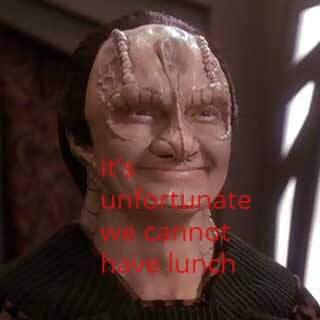
The meme features a screenshot from the Star Trek: The Next Generation episode "The Outcast," where a character with a severe facial deformity is referred to as "the outcast." The image has the text "It's...fascinating" overlaid on it, but the actual meme says "It's...unfortunate we cannot have lunch." The meme is a play on the character's quote, replacing the original phrase with a humorous and ironic statement.
detailed-analysis (gemma3-27b-vision)
Okay, here's an analysis of the image, broken down into the requested sections, applying those critical lenses as appropriate. Given the context of the image (Gul Dukat from Star Trek: Deep Space Nine and the text "it’s unfortunate we cannot have lunch"), certain lenses will be more relevant than others.
1. Visual Description
The image is a close-up portrait of Gul Dukat, a Cardassian officer from the Star Trek universe. He is a middle-aged man with a striking, somewhat unsettling appearance. His skin is a pale, grayish-brown, and his forehead is marked with prominent, raised ridges. He has a thin, cruel mouth and piercing dark eyes. The lighting in the image is stark and dramatic, creating strong shadows and emphasizing the textures of his skin. The overall impression is one of power, menace, and a certain deceptive charm. The image captures a moment where Dukat appears to be speaking, his lips slightly parted in a disturbing half-smile. Overlaid on the image is red text, stating, "it’s unfortunate we cannot have lunch."
2. Foucauldian Genealogical Discourse Analysis
This image and the overlaid text strongly lend themselves to a Foucauldian analysis. Foucault would be interested in how power operates through discourse—language, images, and social practices.
- Discourse of Hospitality & Threat: The phrase "it’s unfortunate we cannot have lunch" presents a facade of polite social convention (inviting someone to lunch). However, given Dukat’s character within the Star Trek narrative, this politeness is always a mask for manipulative, calculating, and potentially violent intent. Lunch becomes a site where power dynamics could be subtly enacted, negotiations made, or control asserted. The "unfortunate" denial of that lunch isn’t simply a missed opportunity for a meal; it signifies a refusal of his attempt to establish a power relationship.
- Genealogy of Cardassian Power: A genealogical analysis would trace the historical development of Cardassian culture and the practices that allowed figures like Dukat to rise to power. We would examine how Cardassian social structures, values (honor, conquest, dominance), and even aesthetic norms (the harsh architecture, the emphasis on ornamentation) contributed to the creation of a leadership style characterized by both charisma and ruthlessness. The image itself is a historical artifact contributing to this discourse.
- Discipline & Control: Dukat’s gaze (evident in the photo) is a crucial element. It embodies the surveillance and control that are central to Foucault’s concept of “panopticism.” He appears courteous, but his eyes suggest an underlying watchfulness and the potential for punishment.
3. Critical Theory (Frankfurt School)
Dukat, as a figure, resonates with several themes within Critical Theory.
- Instrumental Reason: Critical theorists like Max Horkheimer and Theodor Adorno argued that modern society is dominated by "instrumental reason"—the application of rational thought solely to achieve practical ends, without regard for ethical or humanistic concerns. Dukat embodies this perfectly. He is a master of strategy, constantly calculating how to achieve his goals, even if it means exploiting or harming others. The polite phrasing of the message ("it's unfortunate") is merely a tool to further this instrumental reason.
- The Culture Industry: The Star Trek series itself, as a piece of popular culture, can be examined through the lens of the culture industry. Dukat is a carefully constructed character designed to evoke specific emotional responses (disgust, fascination, perhaps even sympathy). The series presents a simplified morality play, where Dukat represents a clear "villain" embodying the dangers of unchecked power.
- False Consciousness: The image and text could be seen as a form of manipulation. Dukat's attempt to appear amenable and regretful is an effort to mask his true intentions and maintain his position of authority.
4. Marxist Conflict Theory
Within a Marxist framework, the image can be analyzed in terms of class struggle and power dynamics.
- Dominant vs. Subordinate: Dukat clearly represents a figure of authority and power within the Cardassian Union. The "lunch" invitation, while seemingly polite, is a demonstration of this power – a gesture that implies control and the ability to offer (or withhold) something. The person he’s addressing is likely in a subordinate position, and the denial of the lunch represents a rejection of his authority.
- Ideology & False Consciousness: The "unfortunate" denial could be seen as a subtle ideological statement. It reinforces the idea that Dukat is a reasonable, regretful figure, despite his history of brutality and oppression. This helps to legitimize his power and maintain the existing social order.
5. Queer Feminist Intersectional Analysis
While not the most immediately apparent lens, a Queer Feminist Intersectional analysis can offer some interesting insights.
- Performance of Masculinity: Dukat actively performs a hyper-masculine persona – charming, powerful, calculating. This performance is tied to his position of authority and his ability to exert control. It's a masculinity built on domination and exploitation.
- Power & Vulnerability: Even figures with immense power like Dukat are not immune to vulnerability. The denial of lunch suggests a disruption of his control and a resistance to his attempts to establish a relationship based on dominance.
- Intersectionality & Colonialism: Cardassia’s occupation of Bajor, central to the DS9 storyline, can be examined through an intersectional lens. Dukat embodies a colonial power structure that systematically oppresses and exploits an indigenous population. His "polite" demeanor masks a history of violence and control.
6. Postmodernism
- Meta-narratives: The image challenges the concept of a stable, overarching narrative. Dukat is a complex, multi-layered character who resists easy categorization as simply "good" or "evil." His politeness masks a history of cruelty, and the "unfortunate" denial of lunch throws the entire situation into question.
- Simulacra & Simulation: Dukat is, in a sense, a “simulation” of a leader – a carefully constructed persona designed to project power and authority. The polite phrasing ("it's unfortunate") is a "simulacrum" of genuine regret, masking his true intentions.
Let me know if you’d like me to expand on any of these sections or explore other critical lenses!
simple-description (llama3.2-vision)
This meme features a screenshot from the TV show Star Trek: The Next Generation, specifically a character known as the Borg Queen. The image shows her with a neutral expression, but the text overlaid on top of her face reads "It's not a good time for a picnic" and "It's not a good time for a picnic" is crossed out, replaced with "It's not a good time for lunch".
tesseract-ocr
be , ee > Y a