First Seen
2023-05-10T21:03:40+00:00
simple-description (llama3.2-vision_11b)
The meme is an image of Captain Jean-Luc Picard from the Star Trek: The Next Generation series, with a quote "I find your lack of faith disturbing" (from the Star Wars franchise) changed to "I find your lack of chocolate disturbing". This is a humorous example of a "meme" that combines two unrelated sources (Star Trek and Star Wars) to create a humorous and unexpected twist.
detailed-analysis (gemma3-27b-vision)
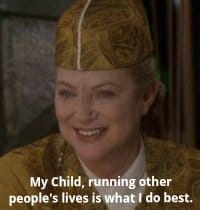
Okay, let's break down the image and its accompanying text ("My Child, running other people’s lives is what I do best") through the requested theoretical lenses.
Image Description
The image is a close-up of a woman, likely actress Julie Andrews, in costume. She's wearing a gold-toned outfit with intricate detailing (perhaps sequins or embroidery). Her hair is styled in a somewhat severe but elaborate updo, with a white stripe running through it. She has a subtly smug or condescending smile, with her eyes carrying an air of control or amusement. The lighting is dramatic, and the background appears blurred and dark green. Her facial expression is key—it conveys a sense of power, possibly even a hint of predatory intent.
Foucauldian Genealogical Discourse Analysis
This image and its text are ripe for a Foucauldian analysis. The statement “running other people’s lives is what I do best” is an explicit assertion of power/knowledge. Foucault argues that power isn't simply repressive, but productive. This woman isn’t just forbidding; she’s actively creating reality for others through her control.
- Discourse: The statement demonstrates a specific discourse—a way of talking about and understanding the world. This is the discourse of the controller, the manipulator, the one who defines the rules and imposes them on others. This discourse doesn't necessarily need to be overtly coercive (though it can be); it can be enacted through seemingly benign acts of guidance, influence, and expectation.
- Genealogy: A genealogical tracing of this discourse might reveal how the notion of ‘proper governance’ or ‘maternal/paternal guidance’ has historically been used to justify control over others. The phrase “My Child” is significant: it suggests an expectation of obedience rooted in familial hierarchy, which is then extended beyond the immediate family to encompass others. It implies that "running lives" is part of her prescribed role.
- Panopticism: The image itself evokes a sense of being watched. Even though we don't see the full scene, the woman’s direct gaze suggests surveillance, an important component of Foucault’s concept of panopticism. Her control is subtly enforced through the feeling that one is being observed and judged.
Critical Theory
Critical Theory (particularly in the Frankfurt School tradition) would focus on the underlying ideology and social structures being reinforced by this image and statement.
- Domination and Control: The image and text clearly demonstrate a power dynamic, with this woman positioned as the controller and others as the controlled. Critical Theory would ask: What social forces and structures enable this kind of domination? What purpose does it serve?
- Instrumental Reason: The woman's statement suggests a coldly calculated approach to life. She’s not motivated by compassion or empathy, but by the satisfaction of control itself. This aligns with Critical Theory’s critique of “instrumental reason” – a focus on efficiency and control at the expense of ethical considerations.
- Culture Industry: Depending on the source of the image (likely a film or TV show), Critical Theory might explore how this representation of power reinforces existing social norms and ideologies. It asks whether this representation is critiqued or normalized within the cultural context.
Marxist Conflict Theory
From a Marxist perspective, the image suggests class and power dynamics.
- Power as a Resource: Control over the lives of others is a form of power – a resource that this woman possesses. In a Marxist framework, power is derived from material ownership and control over the means of production. Though not explicitly shown, the woman's position (implied by her costume and demeanor) suggests that she possesses economic or social capital which enables her control.
- Exploitation and Alienation: Running other people’s lives could be interpreted as a form of exploitation. The woman benefits from the control, while those she controls may be denied agency and autonomy, leading to alienation.
- False Consciousness: The “My Child” framing could be seen as a way to disguise the power imbalance and legitimize control. This is similar to the concept of "false consciousness", where those being controlled accept the dominant ideology and believe it is in their best interest.
Postmodernism
Postmodern analysis would challenge the notion of a fixed or objective power structure, highlighting the constructed nature of reality and identity.
- Deconstruction: The statement “My Child, running other people’s lives is what I do best” can be “deconstructed.” The seemingly straightforward assertion actually relies on a series of unstated assumptions: what constitutes “running” a life, who has the right to do so, and what it means to be a “child”.
- Simulacra and Simulation: The image and statement could be seen as a “simulacrum” – a copy without an original. It is a performance of power, a constructed image designed to project authority.
- Fragmentation and Fluidity: Postmodernism emphasizes the fragmented and fluid nature of identity and reality. This woman’s control is not total or absolute; it is a constant negotiation and performance of power, always subject to challenge and resistance.
Queer Feminist Intersectional Analysis
This lens brings together considerations of gender, sexuality, and social power.
- Patriarchal Control: The image is potentially indicative of a patriarchal system where women are expected to control others, often under the guise of nurturing or guidance. This can manifest as micromanagement, emotional manipulation, or outright domination.
- Gender Performance: The elaborate costume and stern demeanor can be seen as a performance of gender—an exaggeration of feminine authority.
- Intersectionality: Depending on the context of the image (e.g., if the people whose lives are being "run" are of different races, classes, or sexual orientations), an intersectional analysis would examine how power operates differently based on these intersecting identities. The woman's control might be exercised differently towards those who are marginalized or vulnerable.
- Reclaiming Agency: A queer feminist perspective might ask: Who benefits from this woman’s control? Who is harmed? And how can those being controlled reclaim their agency and resist this power dynamic?
Disclaimer: These analyses are interpretations based on the image and the provided text. The specific meaning and relevance of these theories will depend on the larger context of the source material.
simple-description (llama3.2-vision)
This meme is an image of a character from the TV show "Parks and Recreation" (Leslie Knope) with a sarcastic expression. The text overlay on the image reads: "My mom's always telling me I'm a good kid. My dad's always telling me I'm a good kid. But my mom's always telling me I'm better than your kids."
tesseract-ocr
CCR rn ad Persea eet cores