First Seen
2023-05-10T20:59:59+00:00
simple-description (llama3.2-vision_11b)
This meme is a playful adaptation of a scene from the Star Trek: The Next Generation episode "The Last Out 1", where Captain Jean-Luc Picard and his crew are transported to ancient Egypt. The image shows the crew in ancient Egyptian attire, with the caption "They're not going to find it in the handbook" written above a drawing of a 3D printer. The meme is a humorous take on the crew's situation, implying that they're struggling to find a solution to a problem that's not in the handbook.
detailed-analysis (gemma3-27b-vision)
Okay, here's an analysis of the image, broken down into sections as requested. It's a fascinating piece, and offers a lot to unpack.
Visual Description
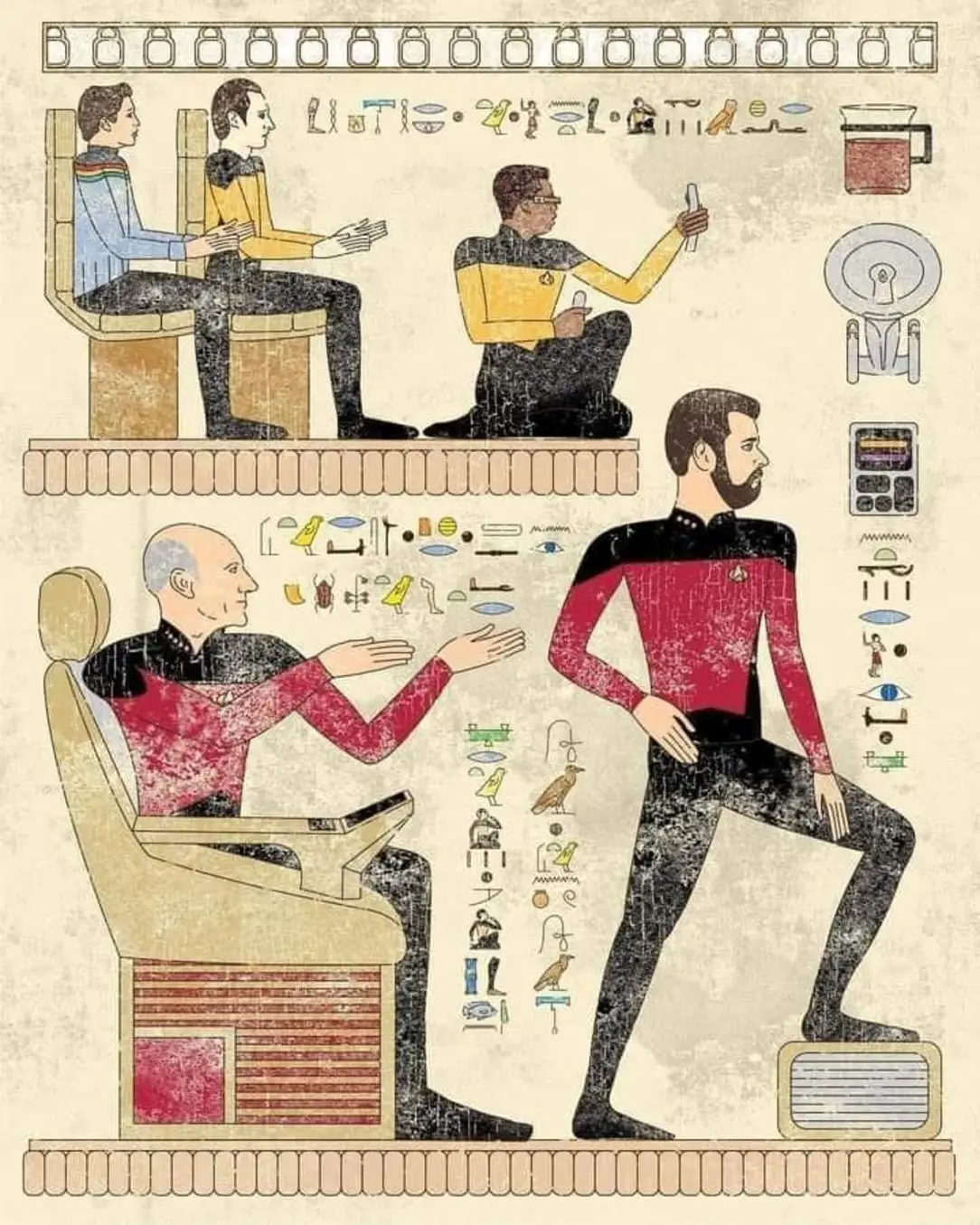
The image is a digitally rendered illustration mimicking the style of ancient Egyptian hieroglyphic reliefs. It depicts characters from the television series Star Trek: The Next Generation (TNG) situated within a scene that blends the aesthetics of the Enterprise bridge with an ancient Egyptian setting.
- Composition: The scene is divided into two primary registers (horizontal bands). The top register shows several Starfleet officers seated around a table, appearing to be in a meeting or a briefing. The bottom register focuses on Captain Picard seated on a throne-like chair, with Data and Geordi La Forge standing before him.
- Characters: Key characters from TNG are represented: Captain Picard, Data, Geordi La Forge, Counselor Troi, and Commander Riker.
- Symbolism & Style: Instead of typical Egyptian hieroglyphs, the symbols surrounding the characters are stylized representations of Star Trek technology and elements (PADD devices, the Enterprise itself, etc.). The aesthetic is deliberately flattened and two-dimensional, echoing the style of ancient Egyptian art. The color palette is limited and uses ochre/beige tones and reds. The texture appears distressed, adding a sense of age.
- Overall Impression: It playfully reimagines Star Trek as an ancient civilization, implying that their values, structures, and power dynamics are timeless or deserving of deification.
Foucauldian Genealogical Discourse Analysis
The image lends itself strongly to a Foucauldian analysis.
- Power/Knowledge: The depiction of Picard as a Pharaoh-like figure immediately positions him as a source of authority and knowledge. The ‘hieroglyphs’ around him don’t represent a sacred language, but Star Trek technology – signifying that knowledge (technology) is intrinsically linked to power. The arrangement of the characters, with some attending to Picard’s pronouncements, shows a clear power dynamic. The 'knowledge' of how to operate the technology is what legitimizes Picard's rule.
- Discourse and Practices: The image implies a discourse around leadership, authority, and technological advancement. The practice of representing this discourse through the visual language of ancient Egypt suggests a cyclical or repeated pattern of power structures. It asks: Is Star Trek's vision of the future simply a continuation of past hierarchies, repackaged with advanced technology?
- Archaeology of Knowledge: The artist "excavates" the power dynamics within Star Trek by presenting them through an ancient aesthetic. It's an attempt to reveal the underlying structures that may have been hidden within the show's utopian narrative. By framing it as archaeology, the artist asserts that these structures have a history and can be analyzed.
Critical Theory
The image critiques and deconstructs the seemingly progressive ideals of Star Trek.
- Myth and Ideology: Star Trek often presents a utopian vision of the future, free of poverty, prejudice, and war. This image, however, subverts that vision by placing it within the framework of ancient Egyptian civilization, which was decidedly hierarchical and often exploitative. It suggests that even the most advanced societies may simply replicate existing power structures under a new guise.
- Deconstruction of Utopia: By framing the Starfleet officers as figures in an ancient civilization, the image deconstructs the idea of a perfect, egalitarian future. It forces us to question whether Star Trek truly breaks from the past or merely reasserts traditional hierarchies through technological means.
- The Illusion of Progress: The image implicitly asks: Is technological advancement enough to achieve a truly just and equitable society? Does the “progress” of Star Trek simply mask underlying systems of control and domination?
Marxist Conflict Theory
A Marxist reading reveals the underlying class and power dynamics within the image.
- Ruling Class/Technological Control: Picard, as the Pharaoh-like figure, represents the ruling class – those who control the means of production (in this case, the advanced technology of the Enterprise). The other officers serve as administrators and enforcers of this power.
- Ideological Control: The depiction of the officers as revered figures, surrounded by symbols of technological power, suggests that ideology is used to maintain this control. By presenting technology as something sacred or divine, the ruling class legitimizes its authority.
- Potential for Exploitation: Though Star Trek doesn't explicitly depict exploitation, the image hints at the potential for it. The control of technology and the reverence for those who wield it could easily be used to suppress dissent and maintain the status quo.
Postmodernism
The image embodies several key elements of Postmodernism.
- Pastiche and Intertextuality: The image is a clear example of pastiche – it combines elements from two distinct cultural sources ( Star Trek and ancient Egypt) to create a new, hybrid work. It relies on the viewer's familiarity with both sources to create meaning. The image relies on intertextuality – the relationship between texts (in this case, the television show and ancient Egyptian art).
- Deconstruction of Grand Narratives: The image challenges the “grand narrative” of progress and utopianism often associated with Star Trek. It suggests that there is no single, linear path to a better future, and that even the most advanced societies are subject to the same flaws and power dynamics as those that came before them.
- Irony and Playfulness: The image is clearly ironic and playful. It takes a beloved science fiction series and reimagines it in a completely unexpected way, forcing us to question our assumptions about the future and the past.
Note: A Queer Feminist Intersectional Analysis isn't as readily apparent in the image. While it is possible to analyze power dynamics through a feminist lens (e.g., questioning the male-dominated command structure of the Enterprise), the image doesn’t explicitly address issues of gender, sexuality, or intersectionality. It’s more focused on broader themes of power, ideology, and social control.
I hope this comprehensive analysis is helpful. Let me know if you’d like me to elaborate on any particular point or delve deeper into a specific theoretical framework.
simple-description (llama3.2-vision)
The meme is a still image from the TV show Star Trek: The Next Generation, featuring the character Jean-Luc Picard in a humorous situation. The image shows Picard sitting in his captain's chair, but his head has been replaced with a cat's head. The text "I, Cthulhu, am the captain now" appears above the image.
tesseract-ocr
FPO OOooooooooboooo8 p@ of ustis- wr etamase = i ey | “a | \@ a \—_ EZ A. \ — == y Coe G; cert ai } 1 i 4 R A 2) Bam | 3 Se { ) ‘ 2 LTO oa, UT xe ~ (hf Hiy ic => os =— rd U Xt og = .. - = ey @ Pp UBER a= mK ir \ sz ec eS (BB a oy ee Be \ , Bes a Set L WY os >" ay ee ee ef ei @ {+ £ so | ees it a + ——- Ss =) TT # fa Bent {[ COO