First Seen
2023-05-10T21:03:40+00:00
simple-description (llama3.2-vision_11b)
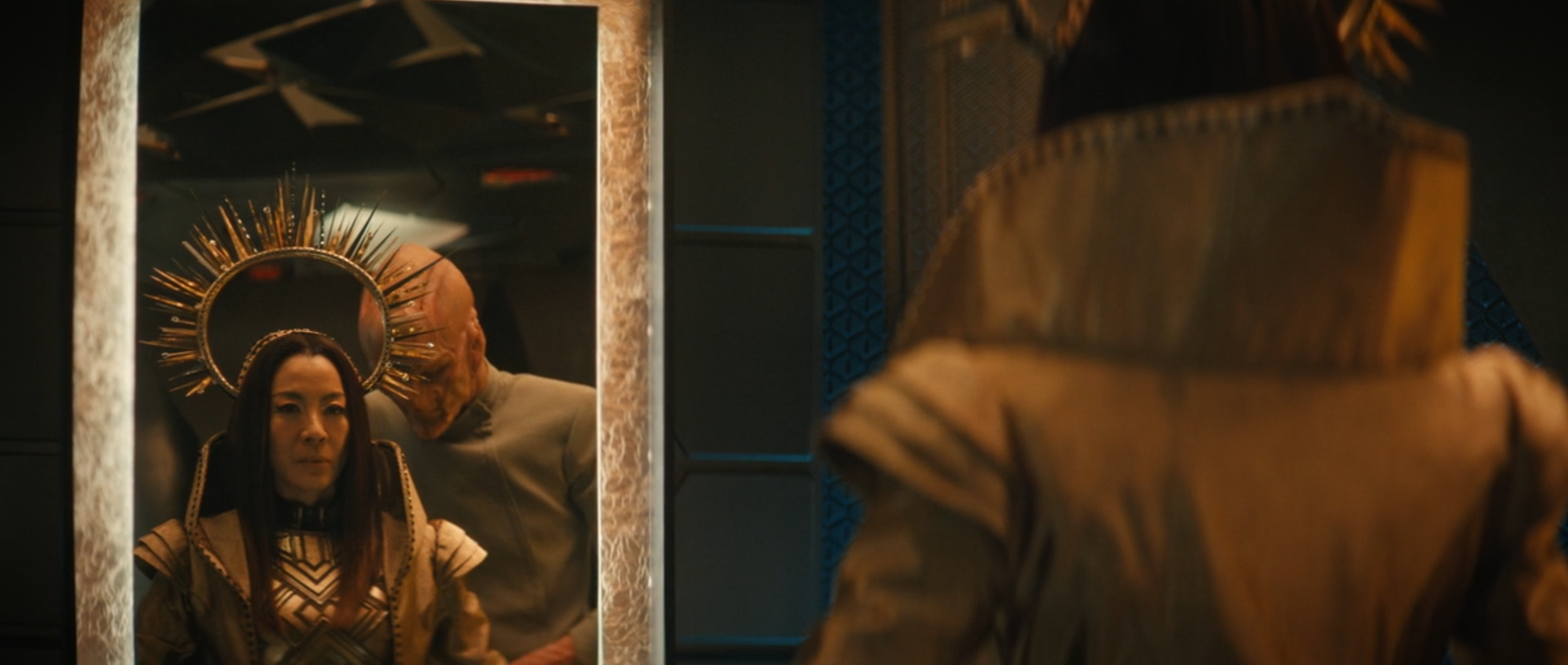
This meme features a still image from the Star Trek: Picard series, where a character is seen in a mirror, with a reflection that is not their own. The character is shown with a dark, distorted reflection, implying that they are not seeing themselves, but rather an alternate version of themselves. The text "I am not my reflection" appears in the image, highlighting the theme of identity and self-discovery.
detailed-analysis (gemma3-27b-vision)
Okay, let's break down this image using the requested theoretical lenses. It's important to note that these are interpretive approaches, and different readings are possible.
1. Visual Description
The image depicts a striking and somewhat unsettling scene. The focal point is a richly ornamented, antique-style mirror. Within the mirror's reflection, we see a woman with long, dark hair. She is adorned with elaborate golden headgear resembling radiating sunbeams or a halo, as well as golden detailing on her clothing/upper body. The figure’s expression is difficult to read, but appears somber.
Behind the woman in the mirror, faintly visible, is a figure with a mask or distorted face, wearing a drab, utilitarian outfit. This figure seems to be looming or observing. The mirror frame itself is ornate and aged, suggesting history, tradition, or perhaps even confinement.
To the right of the mirror is a blurred figure, seen from the back. This person is dressed in similarly toned clothing. The overall color palette is warm and moody, dominated by browns, golds, and oranges. The image is dramatically lit, and there's a strong sense of depth and contrast.
2. Foucauldian Genealogical Discourse Analysis
This image readily lends itself to a Foucaultian reading. The mirror is central, and Foucault was interested in how mirrors—and more broadly, practices of observation—are interwoven with power.
- Discipline and Panopticism: The reflection acts as a form of observation—the woman is always observed, by herself and potentially by the obscured figure behind her. This brings to mind the Panoptic structure—where the individual internalizes the gaze, policing their own behavior. The figure in the background could represent the force creating this internalized gaze.
- Genealogy of "Self": The elaborate ornamentation on the woman suggests a construction of identity. The "self" is not natural or inherent, but is formed through historical discourses—in this case, discourses around beauty, power, and perhaps even divinity (implied by the halo-like headgear). The image asks us to consider the history of how this particular "self" has been built up and what social forces have contributed.
- Power/Knowledge: The mirror reveals a constructed image—knowledge is generated about the woman through this image, and this knowledge is inherently linked to power. Who is controlling the creation of this image? Who benefits from it?
3. Critical Theory
From a Critical Theory perspective, the image can be interpreted as a commentary on societal constructions of the female subject and the pressures placed upon women to conform to certain ideals.
- Objectification: The woman is viewed as an image—reflected, framed, scrutinized. This highlights the tendency to treat women as objects of the gaze rather than as autonomous subjects.
- Alienation: The ornate headgear and clothing could symbolize the alienation of the woman from her own authentic self. She is adorned with symbols of power, but at what cost? Is this her true identity, or is it a performance demanded by external forces?
- Ideology: The image could be seen as exposing an underlying ideology—a set of beliefs and values that naturalize certain power structures. The image asks us to consider what these structures are, and how they are reinforced through the representation of women.
4. Postmodernism
The image resonates with several key themes of Postmodernism:
- Simulacra & Simulation: The mirror itself is a simulacrum—a copy without an original. The reflection is not "real" but a representation. This highlights the postmodern idea that our experiences are increasingly mediated by representations, and that the line between reality and simulation has blurred.
- Deconstruction of Identity: The image seems to question the very notion of a stable, coherent identity. The woman's identity is presented as fragmented and constructed, not inherent. The headgear and clothing add layers that complicate any simple understanding of who she is.
- Loss of Grand Narratives: The image suggests a rejection of traditional, unifying narratives about power and identity. There's no clear story here, just a fragmented and ambiguous scene that challenges the viewer to construct their own meaning.
Let me know if you’d like me to elaborate on any of these readings, or if you'd like me to explore other theoretical frameworks!
simple-description (llama3.2-vision)
The meme is a screenshot from the Star Trek: Strange New Worlds episode "The 100 Years of Storms" featuring a character (Sarek) from the Star Trek franchise. In the image, Sarek is shown with a look of shock and horror, with a caption that reads "When you realize you've been living with the wrong spouse for 50 years".
tesseract-ocr
— f ° hud iN ‘e. 7 Rat) | nag ‘t = f a by * . aa il A 2 , , ~ a P 4 a - | ‘ AS 4 a 3 iS - ‘ a