First Seen
2023-05-10T21:03:40+00:00
simple-description (llama3.2-vision_11b)
This meme is a still image from the Star Trek: The Next Generation TV series, featuring the character Data with a caption that pokes fun at the show's tendency to include overly elaborate and pretentious descriptions of simple concepts. The image shows Data looking thoughtful, with the caption "The needs of the many outweigh the needs of the few... or the one." The text is a play on the phrase from the Star Trek II: The Wrath of Khan movie, but it's used in a humorous way to describe a mundane situation, like a person being too proud of their cooking skills.
detailed-analysis (gemma3-27b-vision)
Okay, here's an analysis of the image, broken down into the sections you requested, focusing on how those theoretical frameworks apply (or don't) to the image and its associated text.
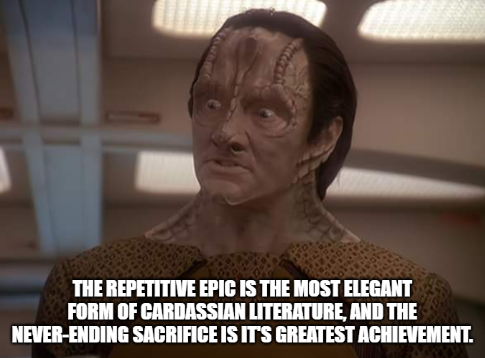
Image Analysis of Damar (Star Trek: Deep Space Nine)
1. Visual Description
The image is a close-up of Damar, a Cardassian character from Star Trek: Deep Space Nine. He’s a middle-aged man with a stern, intense expression. His Cardassian physiology is visible: ridged forehead, pronounced bone structure, and intricate markings (tattoos or inherent dermal patterns) across his neck and shoulders. He's wearing a dark, ornate Cardassian uniform (likely a high-ranking officer's dress uniform). The lighting is dim and somewhat diffused, creating shadows that emphasize his features and overall solemnity. The background appears to be part of a ship's interior, possibly a corridor or command center, with pale blue/grey paneling. The composition focuses tightly on Damar’s face, drawing the viewer's attention to his expression and the text superimposed on the image.
2. Foucauldian Genealogical Discourse Analysis
This framework applies strongly to the text and the image. The phrase “The repetitive epic is the most elegant form of Cardassian literature, and the never-ending sacrifice is its greatest achievement” is a claim about the discourse shaping Cardassian identity.
- Genealogy: A Foucauldian genealogy would trace how this 'repetitive epic of sacrifice' emerged. What historical circumstances (Cardassian poverty, militarism, struggle for survival, the Occupation of Bajor) produced this literary/cultural form? How did it become normalized, codified, and used to exercise power? It moves beyond simply describing Cardassian culture to understanding how it came to be.
- Power/Knowledge: The statement implies a specific relationship between knowledge (literature) and power. Whoever defines what Cardassian literature is, and declares sacrifice its "greatest achievement," holds power. This discourse constructs and reinforces Cardassian identity, potentially masking other ways of being or understanding the world.
- Discipline: The "never-ending sacrifice" can be seen as a form of disciplinary power—shaping Cardassian individuals to conform to a particular, self-sacrificing ethos. The visual of Damar, a figure embodying Cardassian military and political power, reinforces this association between sacrifice and authority. He is the embodiment of this discourse.
3. Critical Theory
Critical Theory, broadly, examines how power structures and ideologies are embedded within culture. This image resonates with several key Critical Theory concepts:
- Ideology: The statement is a clear example of ideology – a system of beliefs that serve the interests of a particular group (in this case, the Cardassian ruling class). It glorifies sacrifice, potentially obscuring the costs and benefits of that sacrifice, and legitimizing the existing power structure.
- Hegemony: The idea that this literary form and its associated values are considered "elegant" and "greatest" suggests a degree of cultural hegemony. Cardassian society has internalized these values to the point where they seem natural and unquestionable.
- Alienation: The phrase "never-ending sacrifice" could suggest a degree of alienation—Cardassians alienated from their own desires and needs, compelled to sacrifice for the collective (and perhaps for the benefit of those in power).
4. Marxist Conflict Theory
Marxist Conflict Theory focuses on the struggle between social classes and the role of ideology in maintaining that system. The image and statement are relevant because:
- Class Struggle: The Cardassian civilization in DS9 clearly exhibits class divisions. The statement about sacrifice could be read as a way to justify those divisions – framing sacrifice as a duty necessary to maintain social order, even if that order benefits some more than others.
- False Consciousness: It's possible that the Cardassian population is suffering from “false consciousness”– believing in the inherent goodness or necessity of this ‘sacrificial’ ideology, despite it potentially being exploitative.
- Material Conditions: The "never-ending sacrifice" might be a response to material conditions of scarcity or conflict. Analyzing the history of Cardassia Prime reveals a world of limited resources, which drove expansionist policies and a militaristic culture. This created a constant need for sacrifice.
5. Postmodernism
While not a central theme, some aspects of postmodernism are present:
- Meta-Narratives: The statement attempts to define a grand narrative ("Cardassian literature") and its inherent values. Postmodernism questions the validity of these "meta-narratives," suggesting they are constructed and serve particular interests.
- Deconstruction: One could deconstruct the statement, questioning the meaning of “sacrifice” and “elegance,” and revealing how those terms are loaded with cultural and political significance.
- Irony/Subversion: The image gains a layer of ironic subversion due to the fact that Damar himself undergoes a dramatic transformation in DS9. He rejects the traditional Cardassian values and allies himself with the Bajoran resistance. This undermines the inherent ‘truth’ of the statement.
6. Queer Feminist Intersectional Analysis
This framework is less directly applicable, as the image and statement don’t explicitly address issues of gender, sexuality, or intersectionality. However, it's possible to find points of connection:
- Sacrifice & Gendered Expectations: Historically, expectations of sacrifice have often fallen disproportionately on marginalized groups, particularly women. Analyzing Cardassian culture through a gender lens could reveal whether women are expected to bear a greater burden of sacrifice than men.
- Marginalized Voices: If the “repetitive epic” silences or excludes the voices of those who oppose the culture of sacrifice, that represents a form of power imbalance. Examining the narratives of Cardassian dissidents or marginalized communities could shed light on this.
- Intersectional Power Dynamics: If there are other forms of social differentiation on Cardassia (e.g., class, caste), analyzing how these intersect with expectations of sacrifice could reveal further power dynamics.
I hope this comprehensive breakdown is helpful! Let me know if you'd like me to elaborate on any particular point.
simple-description (llama3.2-vision)
This meme is an image of a Star Trek character, a Vulcan, with a quote from the TV show "Star Trek: Deep Space Nine" or "Star Trek: The Next Generation". The quote is: "The needs of the many outweigh the needs of the few... or the one." However, in this meme, the quote is modified to say "The needs of the many outweigh the needs of the few... or the one... but let's be real, the needs of the one are really what matters."
tesseract-ocr
i ' ™ 7 eae eter