First Seen
2023-09-29T21:01:43+00:00
simple-description (qwen3.5_2b-q8_0)
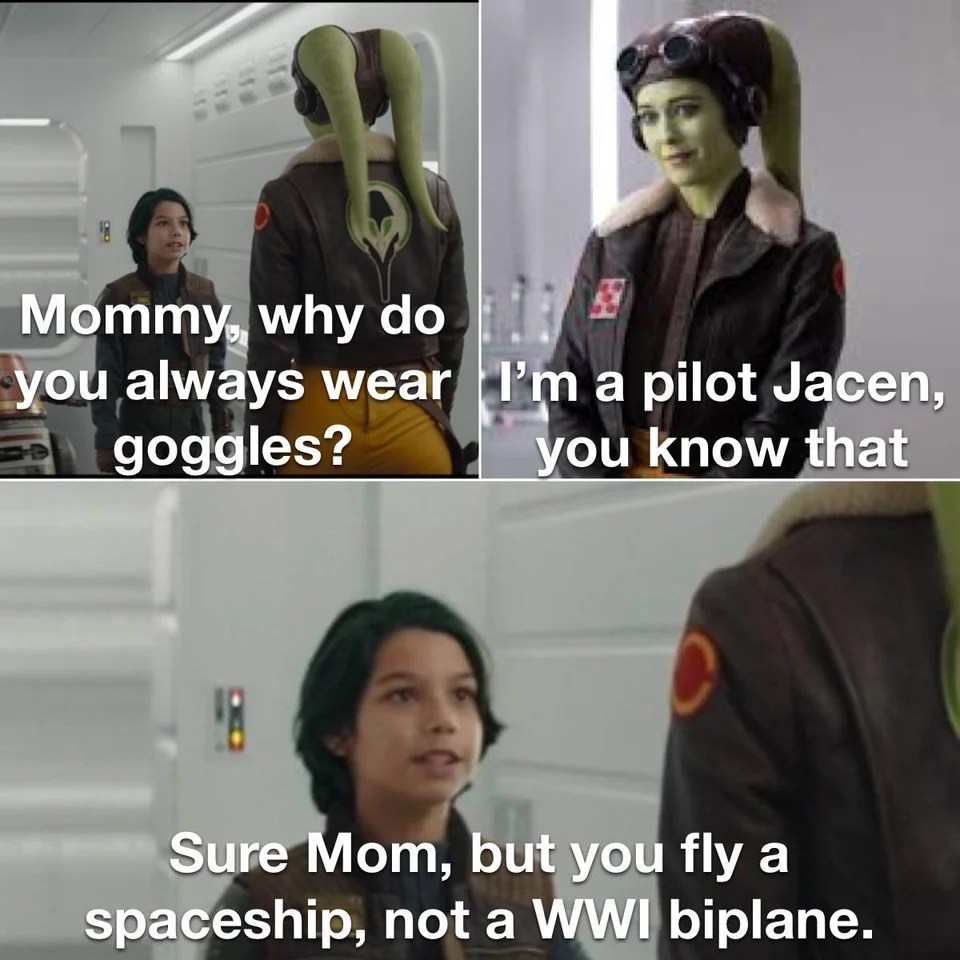
This meme features Ahsoka Tano and Jacen Solo, two prominent characters from the Star Wars franchise, engaging in a humorous dialogue about their flying equipment.
In the first panel, Ahsoka playfully asks Jacen, "Mommy, why do you always wear goggles?" implying the protective eyewear she sees on other Jedi pilots. Jacen replies with a cheeky jab, stating, "I'm a pilot Jacen, you know that."
The punchline delivers the joke in the final panel, where Ahsoka explains the difference: "Sure Mom, but you fly a spaceship, not a WWI biplane."
simple-description (llama3.2-vision_11b)
The meme is a screenshot from the Star Wars series Ahsoka, where a character, Bo-Ko, is trying to explain to a young Ahsoka why she is wearing goggles. The text in the image reads: "Mom, why do you always wear goggles?" "I'm a pilot, Bo-Ko. You have to be prepared for anything." The meme is a humorous take on this exchange, poking fun at the idea that a character's reason for wearing goggles is a silly excuse.
detailed-analysis (gemma3-27b-vision)
Okay, let's break down this image/meme using the requested theoretical lenses. It's a surprisingly rich piece for this kind of analysis, given its simple presentation!
Visual Description
The image consists of three panels presented as a conversation between a young boy (Jacen) and a woman (Shaak Ti). The setting appears to be the interior of a spaceship or station, judging from the metallic walls and ambient lighting. Shaak Ti, a Twi'lek Jedi Master, is wearing standard Jedi pilot attire—a reddish-brown flight suit and, crucially, a pair of aviator goggles pushed up onto her forehead. Jacen is looking up at her with a curious expression.
- Panel 1: Jacen asks, "Mommy, why do you always wear goggles?".
- Panel 2: Shaak Ti responds, “I’m a pilot Jacen, you know that.”
- Panel 3: Jacen counters, “Sure Mom, but you fly a spaceship, not a WWI biplane.”
The overall aesthetic is clean and digital, typical of the Star Wars: The Clone Wars animated series (where these characters originate). The composition emphasizes the face of the characters and their interaction, driving home the dialogue's core.
Foucauldian Genealogical Discourse Analysis
This meme provides a neat entry point into Foucauldian thought, particularly regarding the historical development of discourses and the construction of power/knowledge systems.
- The Discourse of Aviation: The goggles represent a specific historical discourse. They are loaded with meaning tied to early 20th-century aviation – bravery, daring, a specific style of technological engagement. This discourse is imported into the Star Wars universe—a galaxy far, far away.
- Power/Knowledge: Shaak Ti's initial response (“I’m a pilot, you know that.”) asserts her role within the Jedi Order and her proficiency. The goggles are a symbol of this proficiency. However, Jacen’s retort subverts this. He challenges the appropriateness of applying a historical signifier (the goggles) to a very different context (spaceship piloting). This reveals the arbitrary nature of symbolic systems.
- Genealogy: The meme implicitly traces the "genealogy" of the goggles. We understand where the image comes from and its previous usage, but it is then transplanted into the science fiction setting. It highlights how things are not natural or inevitable, but constructed over time.
- Disciplinary Power: In a more subtle read, the goggles can be seen as an element of disciplinary power. The Jedi Order enforces a particular aesthetic and functional standard of what a pilot looks like, and Shaak Ti, as a representative of the Jedi, conforms to this standard. This could even be linked to the broader control mechanisms of the Order.
Postmodernism
The meme is intensely postmodern in several ways:
- Pastiche/Intertextuality: It playfully combines elements from two distinct "texts" – the aesthetic of early 20th-century aviation and the science fiction universe of Star Wars. This is a key characteristic of pastiche—a blending of styles and references without necessarily creating a unified whole.
- Irony & Meta-Commentary: The humor relies heavily on irony. The goggles are functionally unnecessary in a spaceship cockpit, yet Shaak Ti wears them. Jacen’s remark highlights the absurdity of importing anachronistic aesthetics into a futuristic setting. It's a self-aware, meta-commentary on the conventions of storytelling and world-building.
- Deconstruction of Grand Narratives: The image implicitly questions the notion of technological progress. It implies that even in a technologically advanced galaxy, we still cling to antiquated symbols and aesthetics. This is a subtle challenge to the idea of a linear, progressive "grand narrative" of history.
- Simulacra and Simulation: The goggles have become a simulacrum—a copy without an original. They have lost their original functional connection and become a stylistic signifier detached from its referent. The goggles function as a visual cue to signify piloting but, in the context, are merely symbolic.
Critical Theory
From a Critical Theory perspective (influenced by thinkers like Adorno and Horkheimer), we can analyze the meme as a reflection of, and commentary on, the culture industry and its inherent contradictions.
- Commodification of Symbolism: The goggles become a commodity—a stylistic element divorced from its original context and used to create a specific image or “brand” of piloting. This reflects the broader tendency of the culture industry to turn everything into a marketable product.
- False Consciousness: Shaak Ti’s adoption of the goggles could be interpreted as a form of “false consciousness.” She is unconsciously adopting a symbol that is tied to a historical power structure (early aviation, which was often associated with masculine dominance and imperial ambition) that is incompatible with the values of the Jedi Order (peace, balance, wisdom).
- Reification: The meme highlights the reification of symbols. The goggles have become a thing in themselves, divorced from their original meaning and purpose. This process contributes to the alienation and dehumanization characteristic of modern society.
Queer Feminist Intersectional Analysis
This is trickier, but a queer feminist reading can still yield interesting insights:
- Challenging Gendered Aesthetics: Historically, aviation (and the aesthetics associated with it) has been heavily masculinized. The goggles themselves evoke images of male pilots from the early 20th century. Shaak Ti, as a female Jedi Master, appropriates this masculine aesthetic. This can be read as a form of reclaiming and subverting traditional gender roles.
- Intersection of Power: This example demonstrates how power operates through multiple intersecting vectors—gender, technology, history, and symbolism. The goggles are not simply a stylistic choice; they are a product of a specific historical and cultural context that has been shaped by power dynamics.
- Disruption of Norms: Jacen’s challenge, though seemingly innocent, implicitly disrupts the norms surrounding identity and appearance. He is questioning why Shaak Ti needs to conform to a particular aesthetic in order to be seen as a pilot. This challenges the idea that identity is fixed or essential.
Marxist Conflict Theory
While subtle, a Marxist lens can be applied:
- Ideological Apparatus: The adoption of the goggles is an example of how ideology operates through "apparatuses" (like the culture industry). The historical association of the goggles with a certain (often militaristic/imperialistic) worldview is subtly reinforced.
- Commodity Fetishism: The goggles are presented as a desirable object, divorced from the labor and social relations that produced them. This contributes to the process of commodity fetishism, where objects are valued for their symbolic meaning rather than their material reality.
- Class & Technology: Early aviation was often associated with the wealthy and the ruling class. Shaak Ti, as a representative of the Jedi Order (which, though seemingly altruistic, still functions as an elite institution), unconsciously reinforces this association.
In conclusion:
This seemingly simple meme is surprisingly rich and multifaceted. It's a testament to the power of visual culture and its ability to encapsulate complex ideas and critiques. It can be approached through a variety of theoretical lenses, each revealing new layers of meaning and significance.
Let me know if you'd like me to elaborate on any of these analyses, or explore a different theoretical perspective.
simple-description (llama3.2-vision)
This meme is a humorous exchange between a child and a Star Wars character, specifically Poe Dameron's mother, who is a rebel pilot. The child asks why Poe's mother always wears goggles, and she responds with a clever and unexpected twist, saying "I'm a rebel pilot, not a Jedi, but I am a pilot."
tesseract-ocr
; ( rs q % \ id ; is “Mommy, why do # ‘you always wear/ {I’m a pilot Jacen, =U goddies? A “llvou know Ai 4. goggles? you know that j } u . | _ sure Mom, butyou fly a Spaceship, not a WWI biplane.