First Seen
2023-10-06T20:23:10+00:00
simple-description (qwen3.5_2b-q8_0)
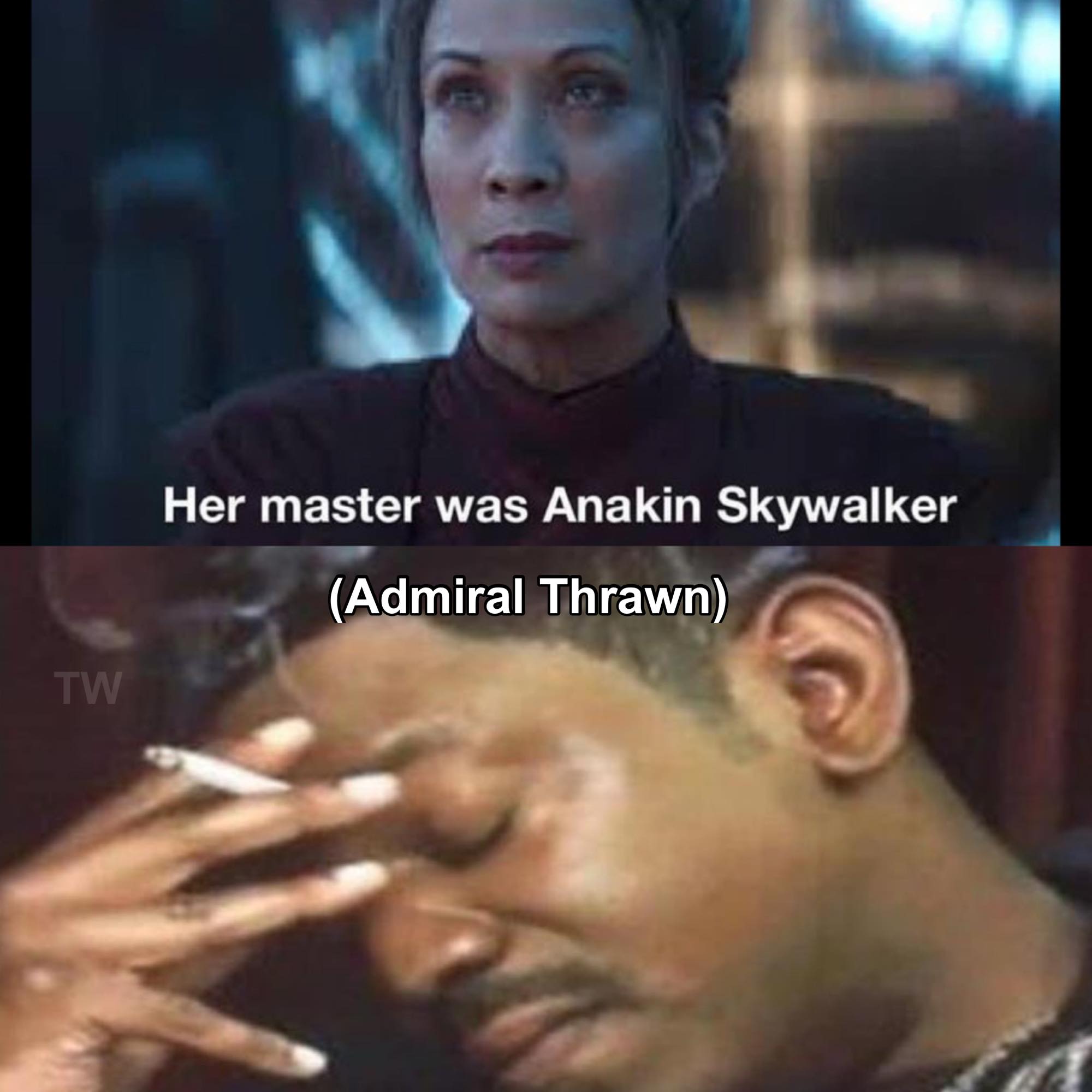
This meme features Jedi Master Ahsoka Tano (top) and Sith Lord Admiral Thrawn (bottom) making a reference to their connection with Anakin Skywalker. The text "Her master was Anakin Skywalker" describes Ahsoka as Anakin's former mentor, while the parenthetical "(Admiral Thrawn)" reveals the punchline: that Admiral Thrawn was, in fact, Anakin's actual master.
simple-description (llama3.2-vision_11b)
The meme is a humorous comparison between Ahsoka Tano, a character from the Star Wars franchise, and a specific individual. The image juxtaposes Ahsoka's serious expression with a photo of a person who appears to be in a similar state of distress, with the text "I can feel your pain" overlaid. The meme is likely referencing the Star Wars character's emotional connection to her mentor, Anakin Skywalker, who was later revealed to be Darth Vader.
detailed-analysis (gemma3-27b-vision)
Okay, here's an analysis of the image, broken down into sections as requested. Note that some sections won't apply, as the image doesn't necessarily lend itself to every theoretical framework. I'll explain why if that's the case.
Visual Description
The image depicts Ahsoka Tano, a character from the Star Wars universe, in a moment of distress. She is lying prone, head turned towards the viewer, revealing a clearly visible ear. Her skin has a golden-bronze tone and appears slightly wet, suggesting tears or some other fluid. Her face shows a grimace or expression of anguish. In the background, slightly blurred, is a figure whose face isn't fully visible, but seems to be looking down at her. Superimposed on the image is text that reads "Her master was Anakin Skywalker (Admiral Thrawn)." The image has a dark, muted color palette, creating a somber mood. There is a "TW" in the bottom left corner, indicating a potential trigger warning.
Foucauldian Genealogical Discourse Analysis
This image and its accompanying text open up interesting avenues for a Foucauldian analysis. The key here is to explore the discourse surrounding "master/apprentice" relationships within Star Wars, and how that discourse shapes our understanding of power, knowledge, and subjectivity.
- Power/Knowledge: The text "Her master was Anakin Skywalker" immediately establishes a power dynamic. The concept of a "master" in Star Wars (and in broader societal contexts) is inherently linked to the transmission of knowledge, skill, and authority. Anakin Skywalker represents a specific type of authority – a Jedi Knight initially, and later a figure who subverts that authority. By presenting this connection, the image compels us to view Ahsoka through the lens of this power relationship.
- Genealogy: Tracing the "genealogy" of the master/apprentice archetype within Star Wars reveals a history deeply tied to colonial structures and the imposition of one worldview onto another. The Jedi Order, despite its benevolent framing, acts as a colonizing force imposing a specific code of ethics and worldview onto its apprentices. Anakin's eventual turn to the dark side disrupts this genealogy, revealing the inherent instability of power structures. The added "(Admiral Thrawn)" is fascinating as it introduces another archetype - that of a strategically brilliant and cunning adversary, implying Ahsoka may have learned from both a flawed hero and a ruthless strategist.
- Discursive Formation: The image itself performs a discursive formation. It doesn't simply state a relationship; it enacts it visually, emphasizing the impact of that relationship on Ahsoka’s state of being.
Critical Theory
This image evokes themes central to Critical Theory, particularly concerning the construction of identity and the impact of dominant ideologies.
- Ideology & Subject Formation: The relationship between Ahsoka and Anakin, as presented in the text, speaks to how individuals are shaped by the ideologies of the institutions they are a part of (in this case, the Jedi Order). Anakin's fall and Ahsoka's subsequent struggles represent the failure of the Jedi ideology and the resulting damage inflicted upon those who internalized it.
- Trauma & Subaltern Voices: Ahsoka’s distressed expression suggests a deep emotional and psychological toll. Critical Theory would consider her as a potential “subaltern” figure – one whose voice has been marginalized or silenced within the dominant narrative. The image implies a history of trauma and the difficulty of negotiating a sense of self in the wake of that trauma.
- The Burden of History: The introduction of Admiral Thrawn introduces the concept of opposing ideologies and the conflict between them. It suggests that Ahsoka is a product of this clash, burdened with the weight of historical and political forces beyond her control.
Marxist Conflict Theory
While the Star Wars universe isn't strictly materialist, some Marxist lenses can be applied.
- Power Dynamics & Control: The master/apprentice relationship can be seen as a microcosm of broader power dynamics. Anakin's control over Ahsoka, both as a teacher and, potentially, a manipulator, mirrors the relationship between those in positions of authority and those subject to that authority.
- Internal Contradictions: The fall of Anakin demonstrates the inherent contradictions within the Jedi Order itself. The Order's attempt to maintain control and suppress dissent ultimately leads to its own fragmentation.
- Alienation: Ahsoka’s distress could be interpreted as a form of alienation – a feeling of disconnect from her own identity and from the society around her, due to the failures of the systems she believed in.
Postmodernism
Postmodernism emphasizes the deconstruction of grand narratives and the fluidity of identity.
- Deconstruction of the "Hero" Narrative: Anakin Skywalker is a figure who fundamentally challenges the traditional "hero" archetype. He embodies both light and darkness, and his flaws are central to his character. The image implicitly deconstructs the idea of a purely benevolent Jedi Master.
- Fragmentation & Instability: Ahsoka's emotional state suggests a fragmentation of self, a loss of certainty in a world where established truths have been shattered.
- Intertextuality: The reference to Admiral Thrawn introduces another layer of complexity. It suggests that Ahsoka’s identity is not solely defined by her relationship with Anakin, but also by her experiences and encounters with other powerful figures and opposing ideologies.
Queer Feminist Intersectional Analysis
This one is more nuanced, but possible.
- Challenging Patriarchal Structures: The Jedi Order, while not explicitly patriarchal, operates within a hierarchical structure that traditionally favors male figures. Ahsoka, as a female apprentice, faces unique challenges and expectations within this system.
- Emotional Labor & Vulnerability: Ahsoka's visible distress highlights the emotional labor often expected of female characters, particularly those who are positioned as caregivers or apprentices.
- Intersectionality of Trauma: Ahsoka’s trauma is not simply a result of Anakin’s actions; it is shaped by the intersection of multiple factors, including her gender, her position within the Jedi Order, and the broader political context of the Star Wars universe.
- Redefining Mentorship: Ahsoka's journey can be read as a rejection of traditional, hierarchical mentorship models in favor of a more equitable and empowering approach to learning and growth.
Disclaimer: These analyses are interpretations, and the image can be read in multiple ways. The effectiveness of these theoretical frameworks depends on your perspective and the specific aspects of the image you choose to emphasize.
simple-description (llama3.2-vision)
This meme is a humorous comparison between two iconic characters from the Star Wars franchise. It juxtaposes a quote from Princess Leia, "Help me, Obi-Wan Kenobi. You're my only hope," with a quote from General Leia Organa in the Disney Star Wars trilogy, "Help me, General Leia Organa. You're my only hope." The meme is captioned "When you think you're the original, but you're actually a reboot".
tesseract-ocr
‘ . . ee | Her master was Anakin Skywalker F' -aeteat ae : ~ (Admiral Thrawn) . y ae . ae s , - "7 2 . - , re A an > al 774