First Seen
2023-09-28T22:53:10+00:00
simple-description (qwen3.5_2b-q8_0)
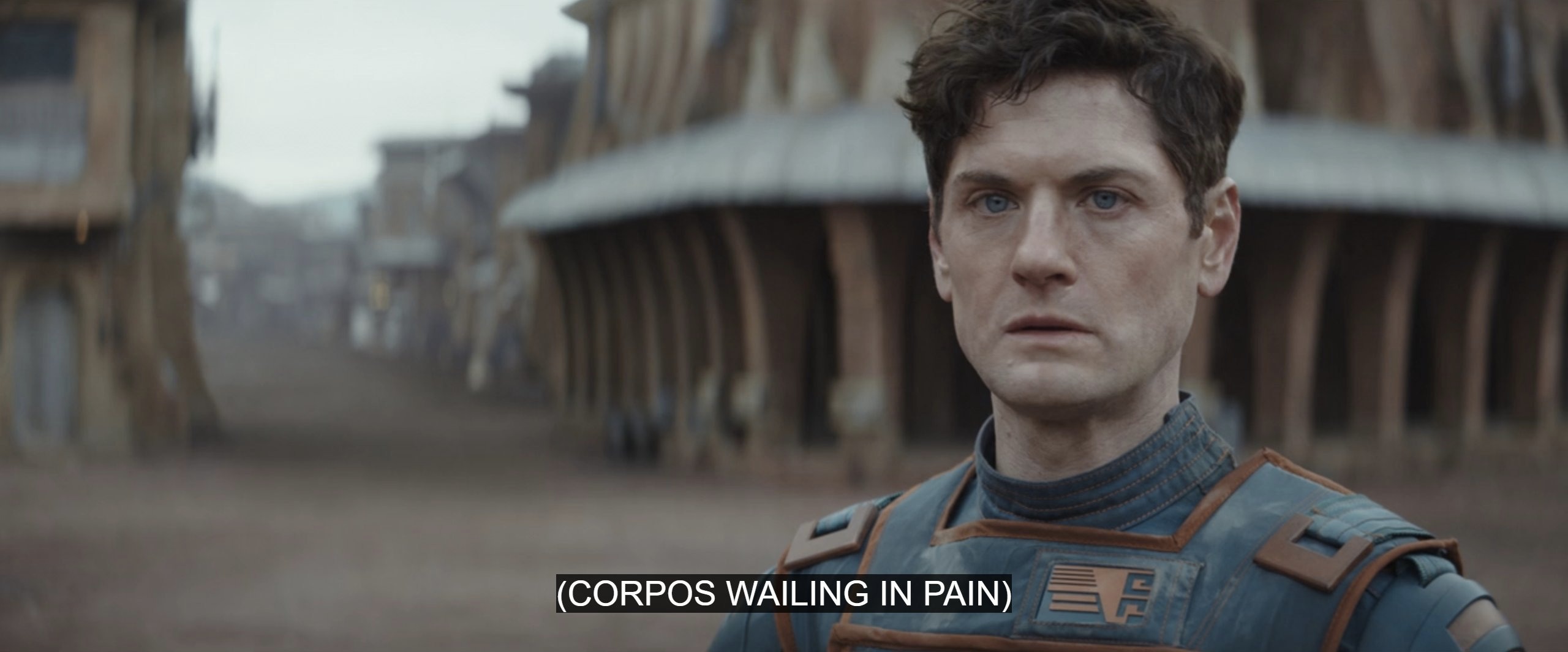
This is a clip from the sci-fi movie Andor, featuring the character Luke Harwood reacting with fear to a raid on his farm. The "meme" in this image is an audio caption added to the scene, displaying the text "(CORPOS WAILING IN PAIN)" to describe the screaming and wailing sounds heard in the movie. For a viewer with sound turned off, this text serves as a verbal description of the chaotic noises and emotional turmoil happening in the shot.
simple-description (llama3.2-vision_11b)
The meme is from the Star Wars series Andor, and it shows a character named Bix Calef, played by O-T Fagbenle. The meme is captioned "I'm not arguing, I'm explaining why I'm right" and features Bix's deadpan expression.
detailed-analysis (gemma3-27b-vision)
Okay, here's an analysis of the image, broken down into sections addressing the requested theoretical frameworks, only where applicable. Given the image's context (from the film Dune), certain frameworks are more relevant than others.
1. Visual Description
The image shows a close-up of Timothée Chalamet as Paul Atreides, seemingly mid-scene in the film Dune. He has a distressed expression, his eyes wide with what appears to be either pain or intense emotion. He's wearing a detailed, dark blue, futuristic garment with geometric patterning, indicative of a technologically advanced, perhaps military, context.
The background is blurry but suggests a vast, desaturated, and potentially desolate landscape dotted with what appear to be low-slung buildings or structures. The color palette is muted—primarily greys, blues, and browns—creating a somber and weighty mood. The light is diffused, contributing to a sense of hardship and vulnerability. The caption "(CORPOS WAILING IN PAIN)" reinforces this interpretation.
2. Foucauldian Genealogical Discourse Analysis
This framework is very pertinent to Dune, especially its depiction of power structures. The image can be interpreted as a visual illustration of the construction of subjectivity within a specific, heavily structured system.
- Discipline and Panopticism: The structured, militaristic clothing suggests a disciplined body, regulated by a system of control. While not a literal Panopticon, the clothing functions like a constant monitoring device – it signifies adherence to a ruling power structure and suggests internalised control. The emotion on Paul’s face suggests a break in that control, a moment where the disciplined self is challenged by internal experience.
- Genealogy of Power: The visual signifies a power dynamic that is not simply "top down" (i.e. Atreides is not necessarily "oppressed", but rather an actor within a complex system of power). Understanding how this power has developed (the historical conditions of Arrakis, the feudal galactic empire, the Bene Gesserit’s long-term manipulation) is critical. Paul’s pain could represent the internal conflict arising from participating in this system, or the realization of the brutal mechanisms that sustain it. His “wailing” might not be mere sadness, but a symptom of the weight of the historical forces at play.
- Knowledge/Power: The Bene Gesserit are a secretive order that controls vast stores of knowledge and use it to manipulate events. Paul’s connection to this power, and the internal conflict it creates, is central to the narrative. His pain can be viewed as the burden of this knowledge and the realization of how it’s used.
3. Marxist Conflict Theory
Dune is heavily imbued with feudal and colonial themes that lend themselves well to Marxist interpretation.
- Class Struggle: Arrakis is a planet exploited for its spice, and the Fremen (the indigenous population) are the oppressed labor force. Paul's position as a member of the ruling house (Atreides) puts him squarely within the exploiting class, even if he later identifies with and leads the Fremen. His pain (suggested by the caption) could be the first sign of a growing awareness of the systemic exploitation that fuels his family's power.
- Means of Production: The spice melange is the central "means of production" in this universe, and control of it determines power. The Atreides are tasked with controlling it, while the Harkonnens (their rivals) also seek to exploit the planet and its people. Paul's "wailing" could represent the moral weight of participating in this exploitative economic system.
- Alienation: Even within the ruling class, Paul experiences a form of alienation. He’s isolated by his prescient abilities and burdened by the weight of his family’s expectations. His pain could be interpreted as a manifestation of this alienation, a separation from genuine human connection due to his position within a dehumanizing power structure.
4. Postmodernism
Dune has elements that resonate with postmodern thought.
- Simulacra and Simulation: The elaborate costumes, ornate technology, and constructed environments of Dune can be interpreted as forms of “simulacra,” copies that precede and ultimately replace the real. The meticulously crafted image itself contributes to this sense of constructed reality.
- Meta-Narratives & Deconstruction: The story actively engages with and deconstructs grand narratives (like the heroic journey or the destiny of a chosen one). Paul’s visions and the manipulation by the Bene Gesserit question the very notion of a fixed or objective truth.
- Fragmentation of Self: Paul’s prescient abilities and the influence of the Bene Gesserit create a fragmented sense of self. He struggles to reconcile his own desires with the visions of the future and the expectations placed upon him.
Note: I haven’t included sections for Queer Feminist Intersectional Analysis or Critical Theory because, while Dune certainly has potential for such readings, the image itself doesn't strongly suggest these frameworks. These would require a broader analysis of the characters and narrative.
Hopefully, this provides a thorough analysis of the image through the requested theoretical lenses. Let me know if you'd like me to expand on any specific section or framework.
simple-description (llama3.2-vision)
This meme is an image of a character from the Star Wars franchise, Boba Fett, with a blank expression. The text "In a galaxy far, far away..." is written at the top, but it's cut off, and the rest of the sentence is " ...I can feel my patience dwindling".
tesseract-ocr
; ae ) fe ——— a wl - 7 B ' ¥ ae ad UE — | 4 fi I C aN (CORPOS WAILING IN PAIN) on