First Seen
2023-05-10T21:03:41+00:00
simple-description (llama3.2-vision_11b)
The meme is a screenshot from the Star Wars: The Mandalorian series, where "Baby Yoda" is being scanned by a computer system. The system's response is a humorous and ironic warning that "This is a Wookiee" is not a correct identification, instead stating "This is a Baby Yoda".
detailed-analysis (gemma3-27b-vision)
Okay, let's analyze the image, addressing the requested theoretical frameworks where relevant.
Visual Description
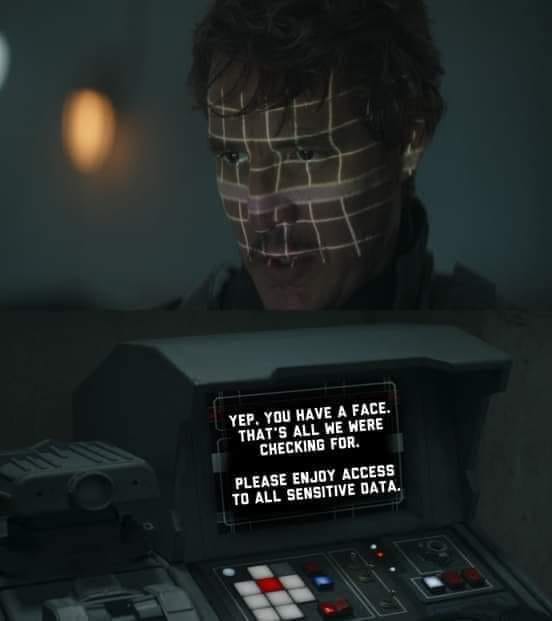
The image depicts a person, likely male (though intentionally obscured), standing in a dark, futuristic or technological setting. His face is almost entirely obscured by a complex grid of white light beams resembling a scan, creating a cage-like effect. The scan is so comprehensive it appears like a digital 'mask' over his features. Below the scan is a computer terminal display showing the text: "YEP. YOU HAVE A FACE. THAT'S ALL WE WERE CHECKING FOR. PLEASE ENJOY ACCESS TO ALL SENSITIVE DATA." The setting appears to be a control room or secure access point, with a panel of illuminated buttons and switches visible in the foreground. The lighting is low-key, and the overall atmosphere is unsettling and conveys surveillance. The lighting of the scan and the terminal display make them the focus of the image.
Foucauldian Genealogical Discourse Analysis
This image is profoundly resonant with Michel Foucault’s concepts of power, surveillance, and discourse.
- Panopticism: The scan acts as a modern, technological iteration of the panopticon. While we don’t see who is doing the scanning, the possibility of constant observation is present. The person is essentially “self-policing” because they know they are being observed and analyzed.
- Disciplinary Power: The scan is a form of disciplinary power; it doesn't repress through force, but by normalizing and categorizing. The very act of checking for a "face" implies that not having a "correct" face might be problematic. This can be expanded to broader categorization and the imposition of norms.
- Genealogy of Surveillance: The image can be seen as part of a historical "genealogy" of surveillance, tracing the evolution of techniques to control and categorize individuals. From physical guards to cameras to biometric scans, the image suggests that the goal is constant monitoring.
- Discourse and Knowledge: The text on the screen ("YEP. YOU HAVE A FACE...") highlights the power of discourse. The scan creates “knowledge” about the individual, and that knowledge is then used to grant or deny access. This implies that having a recognizable face is a prerequisite for participation in this system.
Critical Theory
This image strongly aligns with core themes in Critical Theory, specifically concerning alienation and the instrumentalization of the individual.
- Technological Rationality: The scan and the accompanying text illustrate the cold, detached logic of technological rationality. The person is reduced to a set of data points ("having a face") to be processed by a system, rather than being treated as a human being.
- Alienation: The person is alienated from their own identity. Their face, a fundamental part of their individuality, is being analyzed and categorized, stripping away its symbolic meaning.
- Commodification of Identity: This can be interpreted as the commodification of identity, where identity becomes something to be measured, recorded, and exchanged for access.
- The Culture Industry: The automated and impersonal nature of the scan echoes critiques of the "culture industry" (Adorno and Horkheimer). The scan is part of a system that treats individuals as passive consumers, subject to the logic of efficiency and control.
Postmodernism
The image embodies several characteristics of postmodern thought.
- Simulation & Hyperreality: The scan isn't necessarily about authenticity or truth, but about creating a "model" of the face. This aligns with Baudrillard’s concept of simulation, where signs become detached from reality, creating a "hyperreality".
- Deconstruction of the Subject: The image challenges the notion of a stable, unified subject. The scan breaks down the face into data points, questioning the idea of a coherent self.
- Distrust of Metanarratives: The seemingly arbitrary nature of the scan ("checking for a face...") suggests a rejection of grand narratives or universal truths. It implies that the criteria for access are fluid and potentially meaningless.
- The Loss of Meaning: The phrase "PLEASE ENJOY ACCESS TO ALL SENSITIVE DATA" sounds almost satirical, emphasizing the absurdity of the process and the potential for information overload.
Queer Feminist Intersectional Analysis
While not as immediately apparent, this image can be read through a queer feminist intersectional lens.
- Regulation of Bodies & Normativity: The scan is an act of bodily regulation. It implicitly enforces a norm of what a “valid” or “acceptable” face looks like. This can be extended to broader systems of power that police bodies based on gender, race, sexuality, and other marginalized identities.
- Biopower: The scan represents biopower (Foucault) – the control of life and bodies at the population level. This can be linked to systems that seek to categorize and control bodies based on perceived deviations from norms.
- Data as a Site of Oppression: Access to "sensitive data" could be unequally distributed based on how one’s face (or other biometric data) is categorized. This could reinforce existing inequalities and marginalization.
- Visibility and Erasure: The way the face is obscured can be seen as a metaphor for the erasure of marginalized identities, who are often rendered invisible or misrepresented in dominant systems.
Marxist Conflict Theory
This image can be interpreted as a depiction of power dynamics and control within a capitalist system.
- Technological Control: The scan represents the technological means by which the ruling class maintains control over the proletariat. This technology is used to monitor, categorize, and regulate access to resources.
- Commodification of Identity: Identity is reduced to data, and access is granted in exchange for this data, furthering the commodification of the individual.
- Alienation: The process of being scanned and categorized alienates individuals from their own sense of self.
- Unequal Access: The phrase "PLEASE ENJOY ACCESS TO ALL SENSITIVE DATA" suggests that access to information and resources is not equally distributed, reinforcing existing power imbalances.
Hopefully, this detailed breakdown of the image, using various theoretical frameworks, provides a comprehensive analysis of its complex meaning. Let me know if you'd like me to elaborate on any particular point.
simple-description (llama3.2-vision)
The meme is a screenshot from the Disney+ series "The Mandalorian" where a character is accessing a database on a computer screen. The text on the screen reads "Access denied. You must be the Mandalorian" but the character's face is shown instead of the expected image of the Mandalorian, with the caption "I am the Mandalorian" below it.
tesseract-ocr
7 ae 0 2 ge rs ' ; eo ri ve SR at radi cena Pau rot aati Pe kd Bag Pei TNC = i eae aS SS