First Seen
2023-05-10T21:03:41+00:00
simple-description (llama3.2-vision_11b)
This meme is a humorous image of Baby Yoda from the Star Wars series, dressed in a military uniform and holding a cup of coffee, with the caption "I am Baby Yoda and this is my war story" in a style reminiscent of a classic military propaganda poster. The image is a playful take on the idea of a young warrior, with the added humor of Baby Yoda's adorable expression and the absurdity of a tiny Jedi warrior. The caption is a tongue-in-cheek reference to the idea of a young warrior's "war story" and the expectation of a dramatic, action-packed narrative.
detailed-analysis (gemma3-27b-vision)
Okay, let's break down this image/meme through the lenses you've requested. It’s a complex visual playing with several layers of meaning, so each section will reflect that.
Visual Description
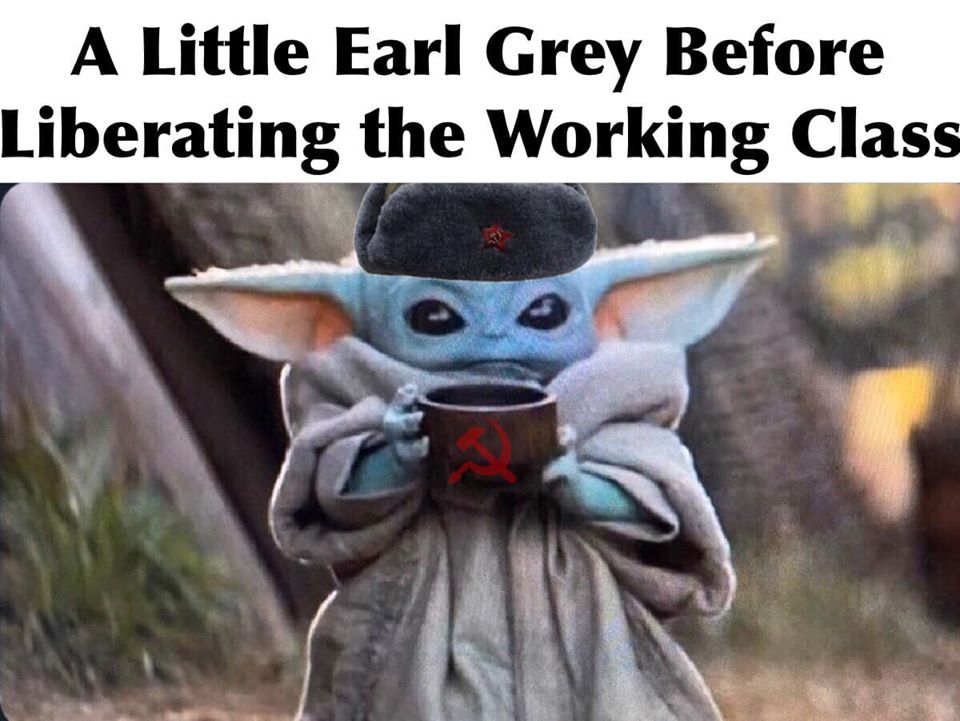
The image depicts “Baby Yoda” (Grogu) from the Disney+ series The Mandalorian. He’s rendered in a slightly muted, somewhat nostalgic style. Grogu is wearing a knitted Ushanka hat with a red star prominently displayed on the front, and is holding a cup or mug, appearing to drink. The background is blurred greenery, suggesting a natural setting. The image is digitally altered with the text "A Little Earl Grey Before Liberating the Working Class" superimposed. The composition plays on the contrast between the cute, innocent appearance of Grogu and the overtly political symbolism of the hat and caption. It's essentially a meme, relying on pre-existing cultural knowledge of The Mandalorian and socialist iconography to create a humorous, and arguably ironic, statement.
Marxist Conflict Theory
This image directly engages with Marxist conflict theory. The caption, "A Little Earl Grey Before Liberating the Working Class," frames Grogu as a revolutionary figure, a leader poised to overthrow the existing power structures. The reference to “the working class” immediately invokes the central tenet of Marxism – the struggle between the bourgeoisie (the owners of the means of production) and the proletariat (the workers).
The ironic juxtaposition of this imagery with Grogu, a figure associated with childlike innocence and cuteness, is key. This suggests a critique, or perhaps a playful reimagining, of revolutionary ideology. Is the image advocating for a violent overthrow? Is it suggesting that even the most endearing beings harbor revolutionary zeal? Or is it a satirical commentary on the romanticization of revolution? The image implies that revolution, even for the cutest of beings, is best fueled with a cup of tea, highlighting the mundane aspects that would be involved in such a radical change.
The red star on the hat is a clear visual signifier of communist or socialist ideology, solidifying the connection to Marxist thought. The image suggests that Grogu, despite his diminutive size and perceived harmlessness, embodies the potential for social change.
Foucauldian Genealogical Discourse Analysis
From a Foucauldian perspective, this image is fascinating because it disrupts existing discourses surrounding power, innocence, and revolution. Foucault’s genealogical method focuses on uncovering the historical and social forces that have shaped our understanding of concepts.
The image appropriates and remixes several pre-existing discourses: The Mandalorian's depiction of a found family and protector-protege relationship, socialist iconography, and the cultural discourse surrounding “cuteness” and consumerism. The combination creates a new discourse that questions the boundaries between these previously distinct categories.
The image suggests that power isn't solely about grand political movements or military force but can also be found in the seemingly insignificant – a cute character, a cup of tea, and a strategically placed symbol. The red star doesn’t just represent communism; it represents a discourse of resistance and opposition. The image challenges us to consider how that discourse is constructed and maintained, and how it can be subverted or reappropriated.
Postmodernism
The image leans heavily into postmodern aesthetics and sensibilities. It’s a clear example of pastiche – a playful mixing of different styles, genres, and cultural references. The combination of Star Wars (a science-fiction fantasy) with socialist symbolism creates a jarring but intriguing effect.
Postmodernism often challenges grand narratives and overarching ideologies. This image can be interpreted as a playful dismantling of the “revolutionary hero” archetype. Grogu is not a traditional revolutionary leader; he’s a small, alien creature known for his cuteness and vulnerability. This subversion of expectations is a hallmark of postmodern art and thought.
The image also highlights the fragmented and fluid nature of meaning in the postmodern world. The meaning of the image isn’t fixed or stable; it's open to interpretation and depends on the viewer’s own cultural background and experiences.
Critical Theory
From a critical theory perspective, the image can be seen as a critique of the commodification of political ideology. The image appropriates a powerful political symbol (the red star) and places it on a character (Grogu) who has been heavily marketed and commodified by Disney.
This raises questions about the relationship between ideology, consumerism, and resistance. Does the image genuinely challenge the status quo, or is it simply another form of consumerist spectacle? Does the image reinforce the existing power structures by turning political ideology into a marketable commodity?
Critical theory also focuses on the ways in which power operates through culture. The image can be seen as a demonstration of how even seemingly innocuous cultural products can be used to reinforce or challenge existing power dynamics.
Queer Feminist Intersectional Analysis (This one is harder to apply, but here’s an attempt)
While the image doesn't directly address queer or feminist issues, a queer feminist intersectional analysis can still shed some light on its underlying dynamics. The image presents a seemingly innocent, even vulnerable, figure (Grogu) in a position of potential power.
Queer feminist theory often challenges traditional notions of power and vulnerability. Grogu’s cuteness and vulnerability could be seen as subverting traditional masculine ideals of strength and dominance. The image suggests that power can be found in unexpected places, even in those who are marginalized or deemed “weak.”
An intersectional approach would also consider how the image intersects with other forms of power and oppression. The image appropriates socialist iconography, which has historically been associated with movements for social justice and equality. This suggests a potential connection between the image and broader struggles for liberation and empowerment.
It's important to acknowledge that this analysis is somewhat speculative, as the image doesn't explicitly address queer or feminist issues. However, by applying a queer feminist intersectional lens, we can gain a deeper understanding of the image's underlying dynamics and its potential implications.
Hopefully, this breakdown offers a multi-faceted perspective on this surprisingly complex image! Let me know if you'd like me to elaborate on any of these points further.
simple-description (llama3.2-vision)
This meme features a screenshot from the 1971 film "A New Hope" where a young Luke Skywalker (played by Mark Hamill) says "It's a trap!" when he realizes that the Death Star's weakness is actually a trap set by the Rebel Alliance. In the meme, the image is replaced with a picture of a young Luke Skywalker (in a white robe and holding a lightsaber) being replaced with a picture of Baby Yoda from the Disney+ series "The Mandalorian" holding a cup of coffee and wearing a hat. The text "It's a trap!" is replaced with "It's a latte!".
tesseract-ocr
A Little Earl Grey Before Liberating the Working Class , 7 | _ me_2 , Te a eg || \) See