First Seen
2023-05-10T21:03:41+00:00
simple-description (llama3.2-vision_11b)
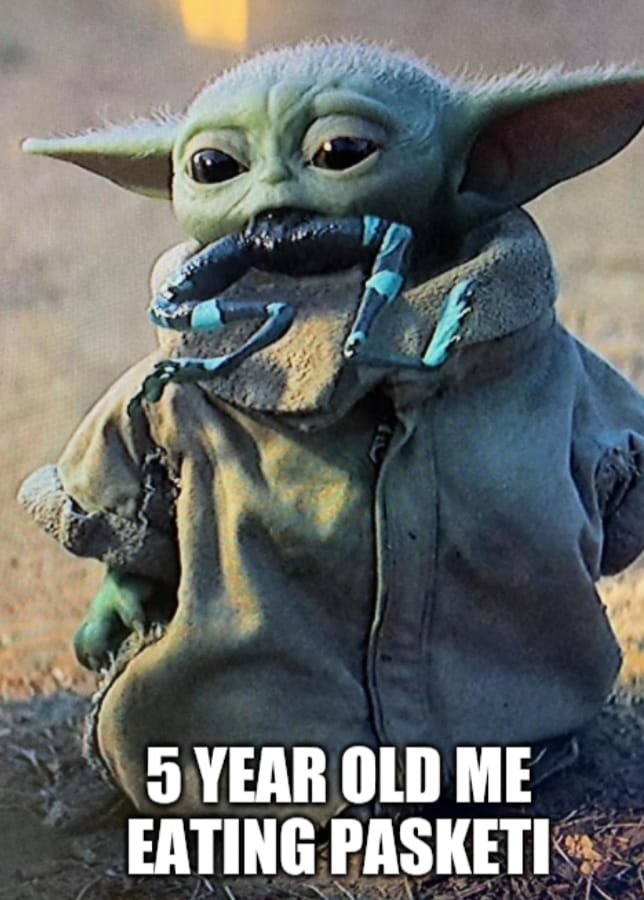
The meme features Baby Yoda, a character from the Star Wars series, eating a frog leg, with the caption "I ate a frog leg when I was 5...". The meme is a humorous take on the idea that even young children can be adventurous eaters, and is likely referencing the popular "I ate a frog when I was 5" joke.
detailed-analysis (gemma3-27b-vision)
Okay, here's an analysis of the image, broken down into sections as requested. Note that some sections won't be relevant, and I'll explain why as needed.
Visual Description
The image depicts "Baby Yoda" (Grogu) from the Disney+ series The Mandalorian. Grogu is a small, green, humanoid creature with large ears and expressive eyes. He's dressed in his signature tan/grey robe with a fur-trimmed hood. He appears to be in a state of enthusiastic consumption: a large, blue, tentacled/squiggly object (identified by the text as "Pasketi") is stuffed entirely into his open mouth. Grogu’s expression is one of apparent enjoyment, or at least determined consumption. The background is a blurred, warm-toned environment suggesting a natural or outdoor setting. A caption at the bottom reads "5 YEAR OLD ME EATING PASKETI". The overall effect is humorous and slightly grotesque.
Foucauldian Genealogical Discourse Analysis
This image can be explored through a Foucauldian lens by examining the discourse surrounding "Baby Yoda" and childhood consumption.
- Power/Knowledge: The image participates in the discourse of online meme culture, which is a form of decentralized power/knowledge. Memes are created and spread by users, but they also shape understanding and reinforce cultural norms. The association of Baby Yoda with unrestrained, even messy, consumption can be seen as a normalization of excessive behavior.
- Genealogy of "Cute Aggression": The image evokes a response of “cute aggression” - the urge to squeeze or pinch something very cute, often associated with babies or small animals. This response isn't innate; it's a historically constructed way of regulating our emotional responses to vulnerability and powerlessness. The image plays on this, making the normally adorable Baby Yoda slightly unsettling due to his extreme eating.
- Discipline & Consumption: The act of eating itself is a highly disciplined activity in childhood, with rules and expectations set by parents and society. This image subverts those expectations, presenting unbridled, even reckless, consumption. It implies a desire to bypass or reject those forms of control.
- Discourse of 'Relatability': The caption "5 YEAR OLD ME" attempts to create a personal connection between the viewer and the image. This is a function of the broader internet discourse of relatability which serves to build online community.
Critical Theory
The image allows us to explore the concept of "the grotesque" as theorized by thinkers like Bakhtin.
- The Grotesque Body: Bakhtin describes the grotesque body as one that is open, unfinished, and often violates boundaries. Baby Yoda, with his mouth completely full of Pasketi, presents an exaggerated and somewhat disturbing image of consumption – a bodily function pushed to its extreme. This disrupts the idea of a contained, clean, and controlled body.
- Subversion of Infantilization: Baby Yoda is, by design, infantilized to elicit a protective response. However, the image subverts this by presenting him as actively, even aggressively, consuming. This challenges the notion of the helpless child and introduces an element of agency, even chaos.
- Rejection of Normative Consumption: The image could be interpreted as a rejection of normative consumption. While typically a pleasurable act, Baby Yoda’s unrestrained eating could be seen as a commentary on excess, gluttony or even, in a broader sense, capitalist consumer culture.
Marxist Conflict Theory
While not a primary focus, a loose Marxist reading is possible:
- Commodification of Childhood: Baby Yoda is a highly marketable character – a commodity designed to appeal to a broad audience. This image, as part of online meme culture, further reinforces his commodity status. The playful yet slightly unsettling depiction of consumption could be read as a subtle commentary on the way childhood is often exploited for profit.
- Desire & Excess: The image taps into the concept of desire – the insatiable drive to consume. In a Marxist framework, this desire is often manufactured and fueled by capitalist systems. Baby Yoda's unrestrained eating could be seen as a symbolic representation of this endless drive for more.
Postmodernism
The image exhibits several characteristics of postmodernism:
- Pastiche & Intertextuality: The image is a blend of different cultural elements. It combines the popular character of Baby Yoda, meme culture, and a reference to an obscure food item ("Pasketi") that requires external knowledge. This mixing of elements is a hallmark of postmodern pastiche.
- Irony & Playfulness: The image relies on irony – the juxtaposition of the adorable Baby Yoda with the somewhat repulsive act of stuffing his mouth full of something. This playful subversion of expectations is a common postmodern tactic.
- Deconstruction of Meaning: The image resists a single, definitive interpretation. It’s open to multiple readings and invites viewers to project their own meaning onto it.
- Simulation & Hyperreality: The image is a simulation—a mediated representation of reality. Baby Yoda doesn’t actually eat Pasketi, and the image exists as a digital artifact separate from any “real” event. This contributes to the sense of hyperreality—a blurring of the lines between the real and the simulated.
Queer Feminist Intersectional Analysis
This section is the least directly applicable, but some possibilities exist:
- Disrupting the 'Cute': Traditional notions of 'cuteness' can be deeply gendered, often associated with passivity and helplessness, especially for women and children. The image disrupts this expectation by presenting a creature normally coded as adorable engaging in a messy, almost aggressive, act of consumption. This could be seen as a subtle challenge to the constraints of femininity or childhood.
- Bodily Autonomy: While speculative, the image can be read as a representation of bodily autonomy. Baby Yoda is unapologetically consuming whatever he wants, rejecting any attempts to regulate his appetite or behavior. This can be framed as a feminist assertion of control over one's own body and desires.
- Intersectionality of Consumption: Consumption is linked to power dynamics. Who has access to resources, who controls distribution, who dictates taste - all these questions intersect with gender, race, class, and other social categories. The image, while playful, could prompt reflection on these broader power structures.
I've attempted to be thorough and to demonstrate how different theoretical frameworks can be applied to analyze a seemingly simple image. Let me know if you'd like me to elaborate on any specific section!
simple-description (llama3.2-vision)
This meme is an image of the character Baby Yoda from the Star Wars franchise, with a caption that says "I'm 5, I'm 5" in a childlike handwriting style. The meme is a humorous take on the idea that Baby Yoda is a young and innocent character, and the caption is a playful way of saying that the speaker is still young and naive.
tesseract-ocr
io P= Ce A a) i~ oe Say | mi ee Ce SUVA b (3 Us Rte cy oo, 2 LE nT ated ie