First Seen
2023-05-10T21:03:41+00:00
simple-description (llama3.2-vision_11b)
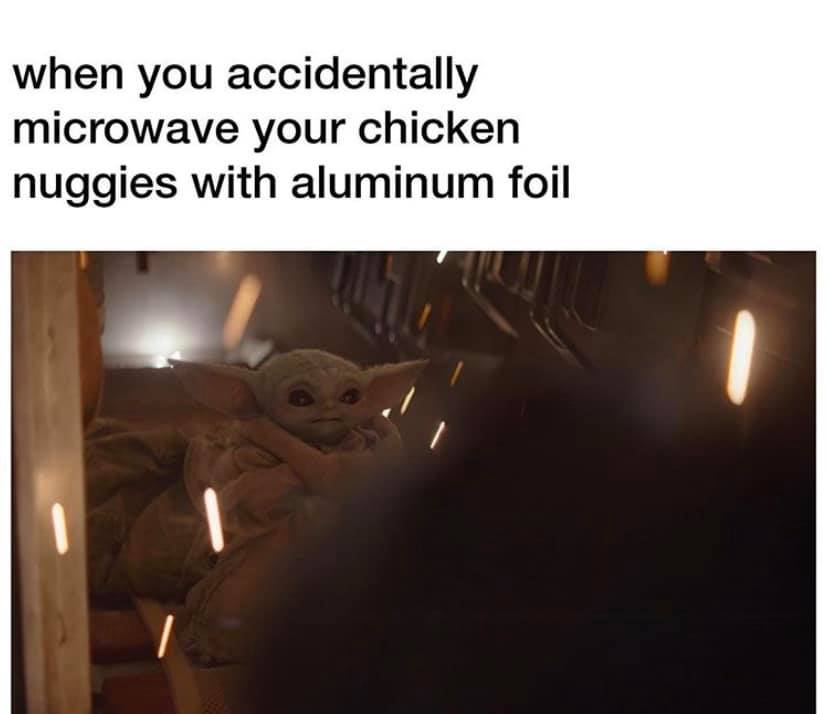
The meme features a screenshot from the Star Wars series "The Mandalorian," showing a young Yoda-like creature, known as Baby Yoda, in a humorous situation. The text above the image reads: "When you accidentally microwave your chicken nuggets and they explode in a fireball." The meme is a play on the character's innocent and curious nature, juxtaposed with the chaos of a kitchen disaster.
detailed-analysis (gemma3-27b-vision)
Okay, here's an analysis of the meme, broken down into the requested sections. I'll state at the beginning if a section doesn't apply, as some of these frameworks won't quite fit.
Visual Description
The image shows a close-up view inside a microwave oven. The interior is dimly lit, dominated by dark tones. Bright white streaks of arcing electricity are visible, radiating from what appears to be a piece of metal (presumably aluminum foil) inside the microwave. The focus point is a bewildered-looking Baby Yoda (Grogu) from The Mandalorian seemingly witnessing the disastrous event. The image has a slightly grainy or low-light quality. The overall effect is chaotic and humorous, conveying a sense of "oh no!" moment.
Foucauldian Genealogical Discourse Analysis
This meme utilizes a discourse around domestic technology and kitchen "fails." A genealogical approach reveals how the "rules" surrounding microwave use – what can and cannot be placed inside – are not natural or inherent, but are socially constructed through a history of technological development, safety manuals, public service announcements, and repeated anecdotes.
The act of placing metal inside a microwave is framed as "incorrect" or "dangerous" through these discourses. The meme plays with that established discourse by presenting the event as a relatable mistake. The focus on Baby Yoda witnessing the "sparking" is key. Grogu, a symbol of innocence and learning, embodies the process of internalizing these rules and witnessing their violation. The humor arises from the subversion of expectation: we know you shouldn’t put metal in the microwave, and seeing it happen (and Grogu’s reaction) disrupts that established knowledge. The "discourse" of culinary competence is temporarily fractured by this relatable failure. The meme constructs a micro-narrative about this rule-breaking.
Critical Theory
This meme can be interpreted through a Critical Theory lens by examining how seemingly mundane everyday experiences are connected to broader systems of power and control. The microwave itself, as a piece of consumer technology, is a product of capitalist production. The emphasis on "correct" usage (no metal) reinforces the idea that individuals must conform to the rules and expectations imposed by the technology and the system that produces it.
The meme’s humor derives from a deviation from this expected conformity. The relatable mistake implies a resistance to the “perfect” consumer ideal. While the resistance is lighthearted (a failed meal), it hints at a broader questioning of the standards of competence and control that are embedded in everyday life. We are subtly invited to laugh with the “mistake” rather than condemning it, implying a rejection of the rigid order dictated by consumer technology.
Marxist Conflict Theory
The meme’s connection to Marxist conflict theory is subtle, but present. The microwave, as a mass-produced commodity, is a product of the capitalist mode of production. The act of “misusing” it – putting foil inside – can be seen as a minor disruption of the intended function of this commodity, and therefore, a momentary break from the system.
The humor arises from the relatable failure, implying a sort of resistance against the demands of efficiency and perfect adherence to consumer norms that are inherent in capitalist production. Though minimal, it suggests an individual momentarily breaking free from the cycle of consuming and following pre-defined rules. It can also be seen as a commentary on the alienation inherent in modern technology – we’re so focused on “getting things done” efficiently that we sometimes make mistakes, highlighting our disconnect from the object and the process.
Postmodernism
The meme perfectly embodies a postmodern sensibility through its intertextuality and playfulness. The pairing of a relatable domestic mishap with the image of Baby Yoda, a character deeply embedded in popular culture, creates a juxtaposition that defies logical explanation. It's absurd and ironic, relying on a shared understanding of both the situation (messing up in the kitchen) and the cultural reference (Baby Yoda).
The meme doesn’t mean anything in a direct, singular way. Instead, it’s open to interpretation, and its humor arises from the unexpected combination of elements. It’s a playful acknowledgement that meaning is fluid and constructed, and that we find humor in the unexpected, fragmented, and ironic juxtapositions of modern life. It playfully destabilizes traditional notions of seriousness.
Queer Feminist Intersectional Analysis
This section is difficult to apply directly. While one could stretch to analyze how kitchen labor is historically gendered (women being disproportionately responsible for cooking and kitchen maintenance), and therefore, the meme subtly references those power dynamics, it feels somewhat forced. The act of “messing up” could be interpreted as a rejection of the pressure to perform perfect domesticity, but the meme isn’t strongly focused on gender or sexuality. The intersectional aspects, while potentially present in a broader cultural context of gendered labor, are not central to the meme’s meaning.
Let me know if you'd like me to elaborate on any of these sections, or explore a different theoretical framework!
simple-description (llama3.2-vision)
The meme is a humorous image of the character Baby Yoda from the Star Wars series, with a shocked expression on his face. The text accompanying the image reads: "When you accidentally microwave your chicken nuggets with aluminum foil". The meme is poking fun at a common mistake that can happen in the kitchen, with Baby Yoda's startled expression adding to the comedic effect.
tesseract-ocr
when you accidentally microwave your chicken nuggies with aluminum foil : | i ce. /