First Seen
2023-05-10T21:03:41+00:00
simple-description (llama3.2-vision_11b)
The meme is a play on the Star Wars character Baby Yoda from the show "The Mandalorian." It shows Baby Yoda holding a band-aid and the text "For the wound is deep" is written above it, referencing the Star Wars character's name and the phrase "for the wound is deep" from the song "The Wound Is Deep" by The Wailin' Jennys.
detailed-analysis (gemma3-27b-vision)
Okay, here's an analysis of the image, broken down into sections based on the frameworks you requested. Note that some frameworks will be more applicable and fruitful than others.
Visual Description
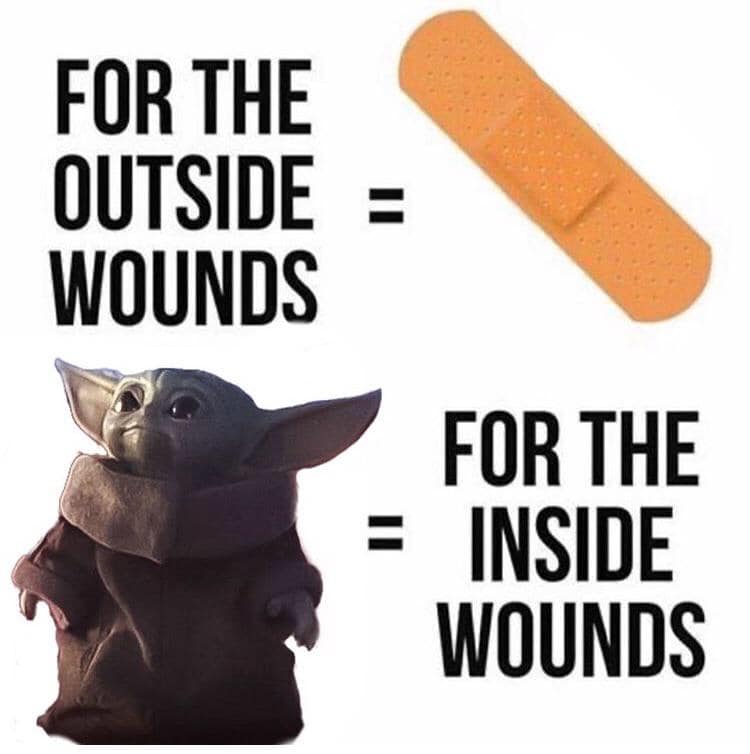
The image is a meme composed of text and imagery. It features a simple graphic arrangement. On the left side is an image of “Baby Yoda” (Grogu) from The Mandalorian, looking somber and appearing to be in emotional distress. Across the top are the words “FOR THE OUTSIDE WOUNDS =” in large, bold, black font. A simple, orange adhesive bandage is positioned to the right of this phrase, implying a direct equivalence. On the right is the phrase “FOR THE INSIDE WOUNDS =” in the same font.
The image utilizes a basic equation-like format to visually represent a perceived relationship between physical and emotional trauma. The contrasting images—the vulnerable "Baby Yoda" and the commonplace bandage—highlight the implied connection.
Foucauldian Genealogical Discourse Analysis
This image lends itself well to a Foucauldian reading. Michel Foucault explored how discourses—systems of thought, language, and practices—shape our understanding of power, knowledge, and subjectivity.
- Discourse of Trauma: The meme engages with the contemporary discourse surrounding trauma, especially the growing awareness of emotional and psychological wounds. It positions these 'inside wounds' as equivalent to 'outside wounds,' which are immediately addressable with a bandage, a simple, accepted remedy. This can be interpreted as a normalization of treating emotional trauma, a move towards making it part of everyday discourse and acknowledging its existence.
- Power/Knowledge & Medicalization: The bandage, as a symbol of physical healing, represents the power of medical/therapeutic discourse. This discourse defines what constitutes a 'wound' and how it should be treated. The meme subtly implies that the 'inside wounds' should be treated with the same logic as physical wounds—through intervention, perhaps even medicalization.
- Genealogical Perspective: From a genealogical perspective, we could trace the historical shift in how emotional distress has been framed. Historically, emotional suffering was often seen through religious or moral lenses. Now, it’s increasingly understood as a medical/psychological condition requiring intervention. The meme reflects and contributes to this shift, presenting emotional wounds as something needing to be 'fixed' or 'bandaged.’
- Disciplinary Power: The meme hints at the way disciplinary power operates. By equating internal and external wounds, it encourages self-surveillance and self-treatment. One is encouraged to identify and ‘bandage’ their inner wounds, potentially reinforcing norms of emotional regulation.
Critical Theory
From a Critical Theory perspective (drawing from thinkers like Adorno and Horkheimer), we can analyze the image's role in perpetuating potentially problematic cultural trends.
- Instrumental Reason: The meme’s simplistic equation (outside wounds = bandage, inside wounds = ??) reflects a reliance on instrumental reason – the idea that everything can be solved through technical means or rational application of logic. This can lead to a devaluing of subjective experience, emotional complexity, and nuance in favor of a 'quick fix.'
- Commodification of Suffering: The bandage, as a commercial product, can be seen as symbolizing the commodification of suffering. The meme suggests that emotional pain, like a physical cut, can be ‘treated’ and ‘fixed’ through external interventions (therapy, medication, etc.)—which are often commercially driven.
- Loss of Authenticity: A critical theorist might argue that the meme contributes to a culture of superficiality, where emotional depth and genuine vulnerability are replaced with a focus on managing symptoms rather than addressing root causes.
Postmodernism
A Postmodern reading would focus on the image’s deconstruction of conventional notions of ‘wounds’ and its play with meaning.
- Deconstruction of Binary Oppositions: The image attempts to break down the binary opposition between ‘physical’ and ‘emotional’ pain. By equating the two, it challenges the notion that emotional suffering is somehow less 'real' or less deserving of attention than physical injury.
- Relativism & Subjectivity: A postmodernist might emphasize the subjective nature of 'wounds.' What constitutes a 'wound' is dependent on individual experience and interpretation. The meme encourages a broader understanding of what can be considered harmful or damaging.
- Intertextuality: The image relies on intertextuality – the relationship between text and other texts. It draws on the cultural context of The Mandalorian and the widespread image of Baby Yoda as a symbol of vulnerability, and the common understanding of a bandage as a healing item.
- Simulacra and Simulation: One could argue the bandage is a simulacrum – a copy without an original. It’s a symbol of healing, but it doesn’t actually heal. The meme, therefore, suggests that our attempts to 'fix' emotional wounds may be superficial and based on empty symbols.
Note: I've intentionally omitted Marxist Conflict Theory and Queer Feminist Intersectional Analysis, as they appear less directly applicable to the core message and imagery of the meme. While those frameworks could be applied (perhaps to analyze the cultural context of the image or the power dynamics surrounding mental health), it would be a stretch and require significant speculation.
Let me know if you'd like me to elaborate on any of these analyses!
simple-description (llama3.2-vision)
This meme is a play on the phrase "for the inside" and "for the outside" by replacing the words with "for the inside" and "for the inside" with "for the inside" and "for the inside" and replacing the words "inside" and "outside" with "inside" and "outside".
tesseract-ocr
FOR THE OUTSIDE = WOUNDS \ FOR THE | = INSIDE | WOUNDS