First Seen
2023-05-24T21:09:22+00:00
simple-description (qwen3.5_2b-q8_0)
Based on the context of the Star Wars universe, specifically The Mandalorian, here is an explanation of the meme:
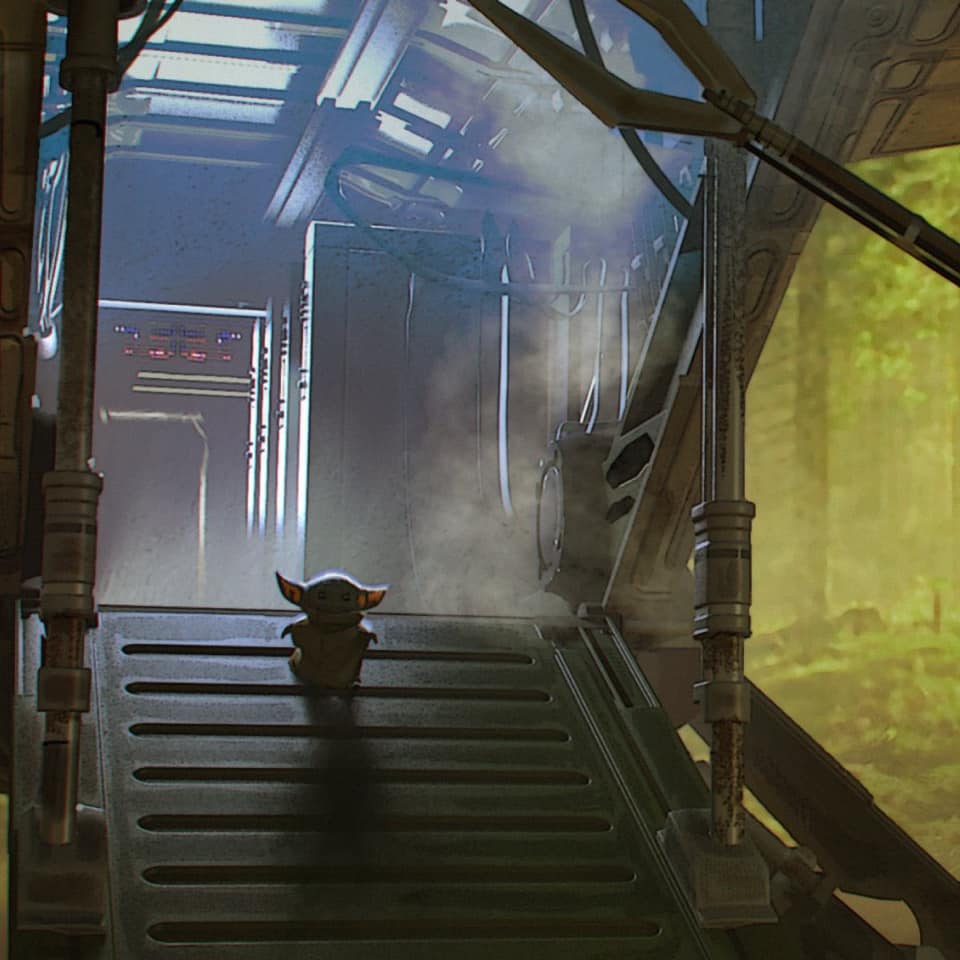
The image depicts Baby Yoda (Grogu) in a tiny, infantile form standing on a metal grate inside a spaceship, looking out at a bright, hazy window. This is a popular internet meme format because it contrasts the cute, large-scale "baby in a space suit" trope with the small, adorable character himself. The meme often highlights the visual humor of a tiny, innocent baby standing on a massive industrial platform, emphasizing his cuteness and the surreal nature of his existence in a sci-fi setting.
There appears to be no clearly readable text in the image, though there are faint blue and red lights visible on the control panel in the background on the left side.
simple-description (llama3.2-vision_11b)
The meme is a screenshot from the Star Wars series "The Mandalorian," featuring Baby Yoda sitting in a room with a sign that reads "Baby Yoda Show" on the door. The image is humorous because it implies that Baby Yoda is a performer or entertainer, and the sign on the door is a playful nod to the character's popularity. The meme is often used to express excitement or enthusiasm for something, with the caption "Baby Yoda Show" implying that the subject of the meme is a must-see or a thrilling experience.
detailed-analysis (gemma3-27b-vision)
Okay, here's an analysis of the image provided, broken down into relevant sections as you requested. Due to the image's simplicity and the lack of explicit social/political cues, some sections will be more robust than others.
Image Overview: The image depicts Grogu (Baby Yoda) from "The Mandalorian" descending a metal staircase within a large, industrial, seemingly abandoned structure. The environment is dimly lit, with bright light entering from a distant opening, creating a dramatic contrast. The composition emphasizes the scale of the structure relative to the small, vulnerable figure of Grogu. It appears to be an interior space of some type - likely a long abandoned industrial/factory complex. The style is digitally painted with a grainy quality.
1. Visual Description
- Composition: The image employs a strong central perspective, drawing the eye down the staircase and into the distant light. The repeating lines of the metal grating and structural beams create a sense of depth and confinement. Grogu is positioned at the lower-center, and is relatively small in the frame, highlighting his isolation and vulnerability.
- Color Palette: The dominant colors are cool grays, blues, and greens, evoking a sense of decay and abandonment. The bright light source introduces warm yellows and oranges, creating a dramatic contrast. This interplay of colors further emphasizes the sense of both hope and danger.
- Lighting: The lighting is dramatic and high-contrast. The main source of illumination comes from a distant opening, casting long shadows and highlighting the texture of the metal surfaces. The dimness of the foreground and the bright light in the background create a sense of mystery and anticipation.
- Texture & Detail: The image exhibits a rough, textured quality, particularly in the metal surfaces. The digital painting style creates a sense of grit and realism, while also maintaining a slightly stylized appearance. The image suggests a lived-in, worn-down environment.
- Form & Symbolism: The staircase is a recurring motif, representing a journey or transition. Grogu's position at the bottom, descending, suggests a move towards the unknown. The vastness of the structure can be interpreted as a metaphor for the challenges and dangers he faces.
2. Foucauldian Genealogical Discourse Analysis
This section is relevant as the image portrays a space (the structure) and a subject (Grogu) within it.
- Discourse & Power: The structure itself is a product of a particular discourse – a historically contingent system of knowledge and power that dictated its construction and purpose. Historically, industrial structures represent modes of production, control, and organization. The abandonment suggests a shift in those power dynamics, but also implies a continuing, latent power that still holds influence over the space.
- Panoptic Surveillance (implied): While not explicitly visible, the structure suggests potential surveillance. The architecture hints at the possibility of observation, reminding us of Foucault's concept of the panopticon – where the feeling of being watched controls behavior. Grogu's vulnerability amplifies this – he is potentially exposed within this space.
- Disciplinary Power: The structure could be interpreted as a site of past discipline. The repetitive, ordered elements of the staircase and metal framework suggest past attempts to control and regulate movement and behavior.
- Genealogy of Abandonment: Tracing the "genealogy" of this structure – its historical development – reveals the shifts in power and knowledge that led to its abandonment. What systems of control previously existed here? What caused them to fail? Why is Grogu traversing this space?
3. Marxist Conflict Theory
The image can be interpreted through a Marxist lens, though subtly.
- Means of Production: The industrial structure was a means of production – a place where labor and resources were combined to create goods. Its abandonment signifies the failure or displacement of that system.
- Class Struggle (implied): The space embodies the history of labor and, potentially, exploitation. The abandoned state could suggest the consequences of class struggle – perhaps a failed worker uprising, or the relocation of production to exploit other labor forces.
- Alienation: Grogu's small size and isolation in this vast, empty structure can be seen as a visual representation of alienation – a core concept in Marxist thought. He is separated from any community, existing within a space that once held purpose but is now devoid of meaning.
- Commodity Fetishism: The structure itself could be seen as a "fetishized commodity" - an object that has taken on a symbolic value exceeding its practical use. Now abandoned, it is a remnant of a capitalist system that has moved on.
4. Postmodernism
The image aligns with some aspects of postmodern aesthetics.
- Deconstruction of Grand Narratives: The abandoned industrial structure can be seen as a rejection of "grand narratives" – overarching stories of progress and industrial dominance. The ruins symbolize the failure of these narratives.
- Fragmentation & Loss of Meaning: The fragmented nature of the space – the broken, decaying elements – reflects a postmodern sensibility of fragmentation and loss of meaning. The lack of clear purpose and the sense of decay are characteristic of postmodern aesthetics.
- Pastiche and Appropriation: The image evokes the aesthetics of dystopian science fiction and post-apocalyptic imagery, appropriating elements from various cultural sources to create a fragmented, unsettling atmosphere.
- Simulacra & Simulation: The abandonment could be viewed as a "simulacrum" - a copy without an original. The space was a functional factory/complex, but now only exists as a hollow shell, a representation of its former self.
5. Queer Feminist Intersectional Analysis (Less directly applicable, but possible)
This approach is the most challenging to apply directly to the image, as it lacks explicit representation of gender or sexuality. However, we can explore symbolic interpretations.
- Vulnerability & Powerlessness: Grogu's small size and isolation can be interpreted through a feminist lens as representing the vulnerability of marginalized groups. His journey through this space can be seen as a metaphor for navigating a patriarchal world.
- Disrupted Spaces: The abandoned structure can be seen as a disrupted space—one that has been abandoned or left behind by dominant power structures. This disruption can open up possibilities for alternative forms of community and resistance.
- Intersectionality of Neglect: The abandonment of the structure could also be seen as a metaphor for the neglect of certain communities or groups. The decay and disrepair of the space could represent the consequences of systemic inequality.
- Challenging Traditional Narratives: Grogu's journey—a small, vulnerable being navigating a harsh environment—challenges traditional narratives of heroism and power. This subversion of expectations aligns with queer feminist principles.
Disclaimer: These interpretations are subjective and based on the visual cues and theoretical frameworks outlined above. The image is open to multiple readings, and other interpretations are equally valid.
simple-description (llama3.2-vision)
The meme is an image of a scene from the movie "The Mandalorian" where a character named "The Child" (also known as "Baby Yoda") is sitting in the dark, surrounded by smoke, and looks like it's about to die. The image is captioned "When you're trying to be stealthy but you're just a tiny little creature in a galaxy far, far away".
tesseract-ocr
A / - ’ 7 7 NS od 4 = mj &s,' Bal iy 7 i = \G > ~ ‘ Pa i | Nhe, | ars, } | ee | elles di | aH “al a | ia 4 I | || iva os a er = eS > |