First Seen
2023-05-10T21:03:41+00:00
simple-description (llama3.2-vision_11b)
This meme features Baby Yoda from the Star Wars series sitting in a car, surrounded by food containers, with a caption "I am 600 years old. I have eaten 600 meals. This is my 600th meal." The meme is a humorous take on the character's age and eating habits, exaggerating the idea that he's been eating constantly for centuries. The image is likely a photo of Baby Yoda from the Disney+ series "The Mandalorian" with a caption that pokes fun at the character's age and eating habits.
detailed-analysis (gemma3-27b-vision)
Okay, here's an analysis of the image, broken down into the requested sections where applicable. This is a complex image, and the analysis will reflect that. I'll attempt to be thorough and sensitive, recognizing the potential for problematic imagery. Please read the disclaimer at the end.
Please note: The image contains elements that could be interpreted as racially insensitive or problematic, and the analysis will address that where it's relevant.
1. Visual Description
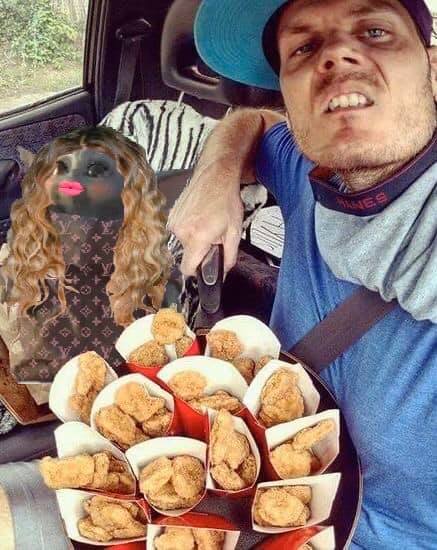
The image appears to be a selfie taken from within a car. The focal point is a large pile of fast-food chicken nuggets in red cardboard containers, prominently displayed in the foreground. To the right is a man with a light complexion, wearing a baseball cap and a gray shirt. His facial expression is somewhat strained or pensive. On the left, partially obscured, is a person with dark skin and a vibrant, highly stylized makeup look, wearing a designer jacket. The interior of the car is visible, with a steering wheel and patterned seat. The image has a somewhat grainy quality, as if taken quickly on a mobile phone. The lighting is uneven.
2. Foucauldian Genealogical Discourse Analysis
This image can be seen through a Foucauldian lens as a construction of power/knowledge related to food, consumption, and identity.
- Discourse of Abundance/Excess: The overwhelming pile of chicken nuggets represents a discourse of abundance, specifically linked to fast-food culture in consumer societies. This isn't simply about hunger, but about a spectacle of consumption, demonstrating access to and the flaunting of surplus.
- Biopower & Control: Fast food, as a regulated and mass-produced item, is connected to biopower – the ways in which modern states manage and control populations through the regulation of bodies and life processes. The availability (and often targeted marketing) of fast food can be seen as a facet of this control.
- Discipline and Self-Regulation (or lack thereof): The image subtly touches on the idea of self-discipline. The overabundance of the food could represent a subversion of that discipline, an indulgence that challenges norms of “healthy eating” or portion control.
- The Gaze & Surveillance: The selfie format immediately implicates the viewer within a system of surveillance. The subjects present themselves for the gaze, contributing to a digital archive of images.
3. Critical Theory
This image lends itself to interpretation through a Frankfurt School-inspired Critical Theory lens, focusing on the culture industry and its impact on perception and identity.
- Commodification of Desire: The chicken nuggets aren't merely food; they're symbols of a larger consumer culture. They represent a fabricated desire, manufactured and marketed by corporations.
- Loss of Authenticity: The highly stylized makeup on the person on the left, the designer jacket, and even the presentation of the food, all point to a construction of identity that is divorced from “authentic” experience.
- The Spectacle: The image is, in effect, a small-scale spectacle. It's not about genuinely enjoying the food; it's about presenting the enjoyment (or, potentially, a performance of enjoyment) to an audience.
4. Marxist Conflict Theory
A Marxist reading centers on class, labor, and the means of production.
- Commodification of Food & Labor: The chicken nuggets are the end result of a complex chain of labor—farming, processing, transportation, and finally, service at a fast-food restaurant. The image obscures this labor, focusing instead on the finished product. It is a commodified abstraction of a complex chain of events.
- Consumerism as Hegemony: The image embodies the idea of consumerism as a form of ideological control. By participating in this cycle of consumption, the individuals reinforce the capitalist system that exploits labor.
- Class Performance (Potential): While the imagery doesn't explicitly convey class, the designer jacket could be interpreted as a display of status. However, it is important to not make immediate assumptions.
5. Postmodernism
This image embodies several core tenets of postmodern thought.
- Hyperreality: The image presents a heightened, artificial reality. The food is a simulation of nourishment, the makeup a simulation of beauty, and the entire scene a simulation of a spontaneous moment.
- Loss of Grand Narratives: The image doesn't subscribe to any overarching meaning or ideology. It's fragmented, ambiguous, and open to multiple interpretations.
- Irony & Parody: There's a potential for irony in the presentation of the food—is it a genuine indulgence, a critique of consumer culture, or simply a performative gesture?
- Fragmentation and Pastiche: The combination of different elements—designer clothing, fast food, stylized makeup—creates a fragmented and eclectic aesthetic.
6. Queer Feminist Intersectional Analysis
This section is the most complex and requires careful nuance. The image's potential for problematic representations needs to be addressed.
- Racial Dynamics & Objectification: The stark contrast in skin tone between the two individuals, the focus on the person of color's face, and the potentially fetishistic presentation of their makeup, raise concerns about racial dynamics. It’s possible the image reproduces harmful tropes or power imbalances. Without context it is difficult to determine if the person of color has agency in their portrayal or if they are objectified.
- Gender Performance & the Male Gaze: The stylized makeup on the person on the left, and how it is framed, could be read through the lens of gender performance. The image could reinforce traditional ideas about beauty or, conversely, subvert them. Without context, we do not know if the individual expressed agency or if it was a forced portrayal.
- Intersectional Power Dynamics: The interplay of race, class (suggested by the designer clothing), and gender is crucial to understanding the image. The intersection of these identities shapes the power dynamics at play and the potential for oppression or marginalization.
- Agency and Subversion: It’s important to consider the possibility that the individuals are intentionally subverting dominant norms and reclaiming their identities. However, this is difficult to determine without further context.
Disclaimer: This analysis is based solely on the visual information available in the image. It is impossible to know the intentions of the individuals involved or the context in which the image was created. It’s important to approach this analysis with sensitivity and to acknowledge the potential for misinterpretation. This interpretation is offered as a starting point for further discussion and critical engagement, not as a definitive statement.
I have attempted to be thorough and nuanced in my analysis, but I acknowledge that my own biases and perspectives may influence my interpretation.
simple-description (llama3.2-vision)
The meme features a photo of a man with a shocked expression, with a caption "I can smell the desperation" and a "I can smell the desperation" sticker on his shirt. The image is likely a screenshot from a video or a still photo that has been edited to add the sticker and the caption. The overall tone of the meme is one of humor and irony, poking fun at the idea that someone is trying to make a big impression or get attention.
tesseract-ocr
oi a pe ze pe f Li yy » Ae : . p MT Poca a 2) yea yt V4 f nn SGN y M$ ye - / Soe Ww d 4 ee WS) \ a ie dd A he i ' A = CN 4