First Seen
2023-05-10T21:03:41+00:00
simple-description (llama3.2-vision_11b)
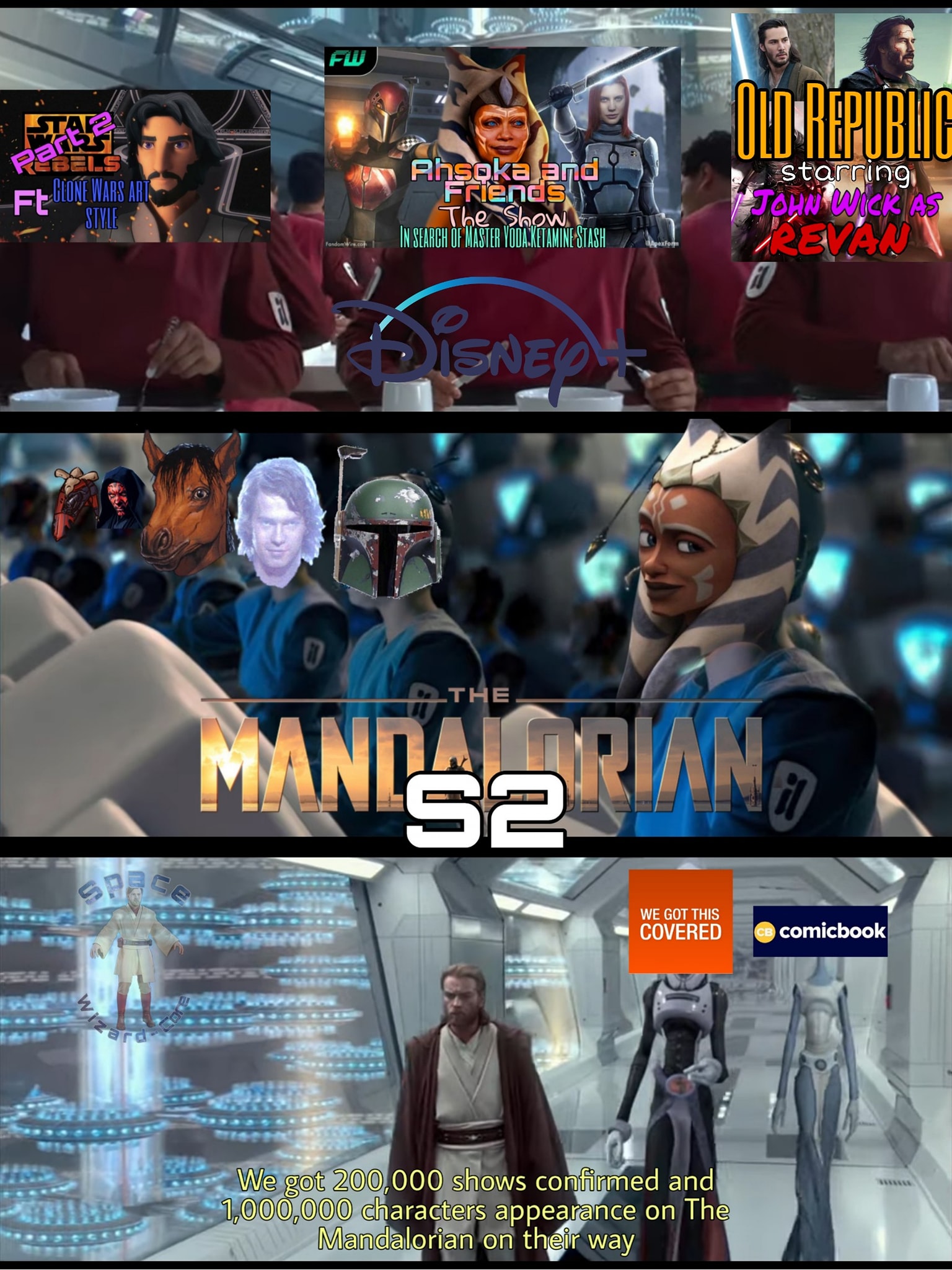
This meme is from the category "Star Wars - Baby Yoda Show". The meme appears to be a screenshot from the "Baby Yoda Show" segment of the Star Wars series, where a character is shown in a humorous or unexpected situation. The text "I can see children now" is overlaid on the image, implying that the character's ability to see children has been activated.
detailed-analysis (gemma3-27b-vision)
Okay, here's an analysis of the image, broken down into sections as requested. Given the image's nature (a collage of promotional material and fan hype), certain sections will be more applicable or more robust than others.
Visual Description
The image is a densely layered collage combining elements from Star Wars media, specifically focusing on The Mandalorian and related series like Rebels and Ahsoka. It's a chaotic, high-information graphic meant to generate excitement and convey a sense of expansive content.
- Layout: The image is broken into rectangular sections, each containing scenes or character depictions. These sections are stacked vertically and horizontally, creating a dense grid.
- Imagery: Prominent figures include Ahsoka Tano (animated and live-action), Din Djarin (The Mandalorian), Bo-Katan Kryze, Luke Skywalker, and elements from Star Wars Rebels. There's also a floating head of Palpatine, and a horse. The background is filled with swirling nebulas and digital effects.
- Text/Branding: The collage is overlaid with text, promotional logos (Disney+, Star Wars logos), and fan-made branding ("Old Republic," "John Wick as Kevan"). The text proclaims, "200,000 shows confirmed and 1,000,000 characters appearance on The Mandalorian".
- Color Palette: The overall color scheme is dominated by blues, purples, and blacks, typical of Star Wars' space settings. Brighter colors (reds, oranges) are used in the text and promotional elements to attract attention.
- Overall Impression: The image feels overwhelming. It is a maximalist expression of fandom, suggesting a vast and ever-expanding universe of content.
Foucauldian Genealogical Discourse Analysis
This image is rich with discourse, particularly regarding how Star Wars is constructed, circulated, and ultimately, understood.
- Discourse and Power: The image itself is a discourse. It participates in a wider conversation about Star Wars. Disney (through the Disney+ branding) exerts a significant power in shaping this discourse. The sheer volume of 'confirmed shows' and 'characters' presented isn't objective reality but a construction meant to establish the scope of Disney’s Star Wars Universe and its dominance in the sci-fi/fantasy market.
- Archaeology of Knowledge: Examining the imagery reveals layers of Star Wars history. The inclusion of Rebels and Ahsoka characters points to a genealogy of content – a tracing of how narratives and characters have evolved over time. The image shows how older content is being integrated into the newer, flagship Mandalorian series.
- Genealogical Approach: The hype surrounding the amount of content suggests a lineage of fan expectation. The constant expansion of the Star Wars universe is linked to a desire for “more” – more characters, more stories, more connectivity. This is a genealogical tracing of how Disney leverages nostalgia and fan desire to maintain a dominant position.
Critical Theory
The image prompts questions related to the nature of spectacle and commodification within contemporary pop culture.
- The Culture Industry: The image exemplifies the 'culture industry' as described by Adorno and Horkheimer. It’s a product designed for mass consumption, meant to generate excitement and drive engagement with a commercial franchise. The sheer volume of content promised suggests a focus on quantity over quality.
- Spectacle: The image is spectacle – a visual overload meant to distract and captivate. The chaotic layout and abundance of characters create a sensory experience that prioritizes excitement over deep engagement with narrative or character development.
- Commodification: Everything in the image is ultimately tied to commodification. The characters, the stories, the franchise itself – all are products to be bought and consumed. The image itself is a form of free advertising, designed to promote Disney’s Star Wars ecosystem.
Marxist Conflict Theory
The image reflects and perpetuates power dynamics related to ownership and control of media production.
- Means of Production: Disney controls the “means of production” – the resources, technology, and distribution networks required to create and disseminate Star Wars content. This allows them to shape the narrative and control the audience's access to the story.
- Class Struggle (Symbolic): While not a direct representation of economic class, the image could be interpreted as reflecting a 'struggle' for control over the narrative. The integration of various Star Wars series suggests a hierarchical structure where certain storylines and characters are prioritized over others.
- Ideology: The image promotes an ideology of endless consumption and expansion. It reinforces the idea that more content is always better, and that Star Wars is an infinite source of entertainment. This serves to legitimize Disney’s continued control over the franchise.
Postmodernism
The image exhibits several characteristics associated with postmodern aesthetics.
- Pastiche and Intertextuality: The image is a prime example of pastiche – a mixing and blending of styles, characters, and narratives from different Star Wars eras. The intertextuality is strong – the image relies on the audience’s knowledge of various Star Wars series to create meaning.
- Hyperreality: The overwhelming amount of "confirmed" content can be seen as a form of hyperreality – a simulation of reality that blurs the lines between what is real and what is constructed.
- Loss of Grand Narratives: While Star Wars once presented a relatively straightforward “good vs. evil” narrative, the constant expansion and integration of different storylines suggest a fragmentation of meaning. The image reflects a postmodern skepticism towards grand narratives.
Queer Feminist Intersectional Analysis
This section is the least directly applicable, but points can be made.
- Representation (Limited): The image primarily features male characters, with Ahsoka representing a comparatively small amount of female/non-binary representation. This could be seen as perpetuating gender imbalances within the Star Wars universe.
- Intersectionality (Potential): The image lacks any obvious representation of racial diversity or queer identities. The characters presented are largely homogenous, and the image does little to challenge existing power structures related to identity.
- Commodification of Femininity/Queerness: If any queer or feminist themes were present, they would likely be commodified and incorporated into the larger commercial enterprise of Star Wars.
I hope this detailed breakdown is helpful. Let me know if you'd like me to elaborate on any of these sections further.
simple-description (llama3.2-vision)
This meme is a screenshot from the TV show "The Mandalorian" with a caption that reads "When you finally get to the part of the show where you're actually supposed to be watching." The image shows a character from the show looking bored and unimpressed, with a caption that pokes fun at the show's tendency to drag on and take a long time to get to the good stuff.
tesseract-ocr
’ al neh 4 5 * ehh / \ J ee we | | | Beg CO tS = UIINIRIBI so i a ine a Pe a rel Lh EEN RL Bera alice aa |} et me TED GN Gia os ales NU . a ; | \ Uo ry P Po 1 é Dy a iP ar a \ See - — » a — ~ AP pe fea (Gara) I J - a So OP ba 7 a ie Fa, oo 7 Se wt v ao | aN WEBIN . pree -sT ) t = r ; . <€ A ? - . iI (a g eo. ! Ie 4 —" oe , — P q e f — - Vi) ay tee) ; eit is c j > Fh a a Ce iy fDi == Wereow200) 000 SHO epirgacenetat] wn we bt tne Soo CEU TS CIS heel eialas on The pres Mlainelalorian on ey