First Seen
2023-05-10T21:03:41+00:00
simple-description (llama3.2-vision_11b)
The meme features an image of Baby Yoda from the Star Wars series, holding a sign that says "I am 600 years old" in a playful and sarcastic tone, implying that the character's age is a joke. The meme is a humorous take on the character's age, which is often referenced in the series. The image is likely captioned with a humorous quote or phrase, such as "I'm not old, I'm just experienced".
detailed-analysis (gemma3-27b-vision)
Okay, here's an analysis of the image, broken down into sections relevant to the theoretical frameworks you requested. Given the content, several frameworks do apply strongly, while others are less central.
Please note: These are interpretations based on the image and applying the theories. There's room for nuance and different readings.
Visual Description
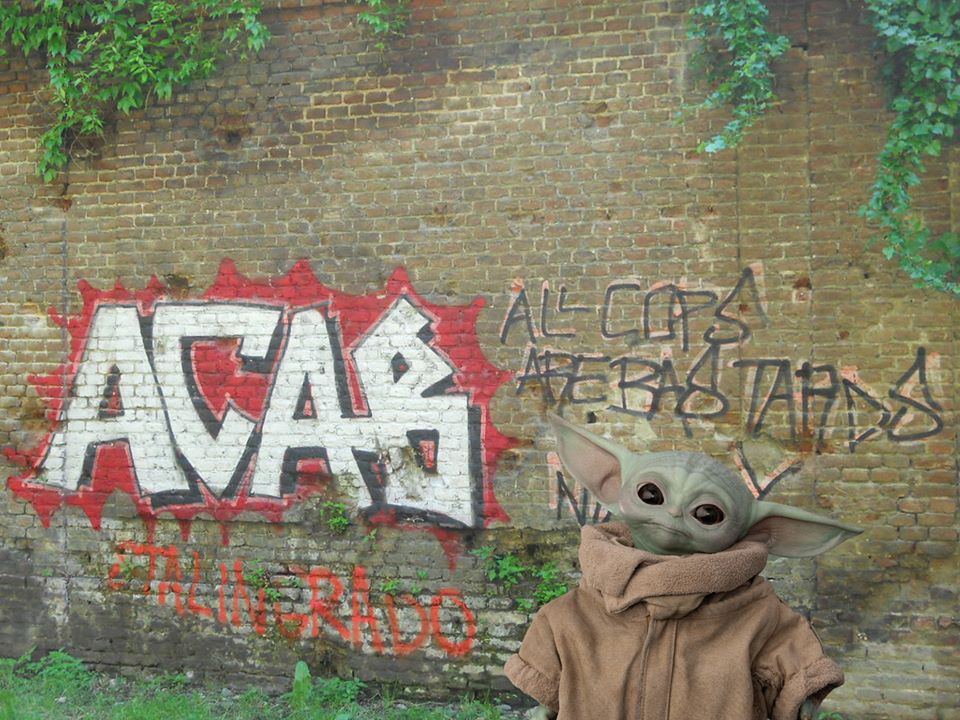
The image depicts a brick wall covered in graffiti. Prominently displayed on the left is the acronym "ACAB" in large, black spray-painted letters with red outline. To the right of "ACAB," in smaller and somewhat less defined lettering, is the phrase "ALL COPS ARE BASTARDS." Below the acronyms is a thin red line. In the foreground, slightly to the right of center, is a figurine of "Grogu" (Baby Yoda) from the Disney+ series The Mandalorian. Grogu is positioned as though 'wearing' a beige coat/cloak. The overall aesthetic is urban, gritty, and suggestive of street art/protest. The lighting suggests a somewhat overcast day.
Foucauldian Genealogical Discourse Analysis
This image is rich for a Foucauldian analysis.
- Power/Knowledge: The graffiti itself is an expression of power against established power. The statement "ACAB" is not simply a declaration of opinion, but a challenge to the authority and legitimacy of policing. It's an attempt to define and contest the discourse of law and order. The graffiti is a site of counter-discourse.
- Genealogy: A genealogical approach would examine the historical development of the "ACAB" slogan and its meaning. When and why did it originate? How has it evolved? Tracing this history reveals shifts in the relationship between citizens and law enforcement, and the ways in which this relationship is constructed through language and practice. The context of historical police brutality and systemic injustice would be crucial.
- Discipline & Panopticism: The slogan inherently critiques the disciplinary mechanisms of policing. It implies that policing, rather than being a neutral force for maintaining order, is a system of control, surveillance, and often, oppression. It subverts the narrative of police as benevolent protectors.
- The Inclusion of Grogu: This is particularly interesting. Grogu, as a figure of innocence, is juxtaposed with a potentially volatile statement. This implies an act of resistance from even the most innocent.
Critical Theory
The image encapsulates several core tenets of Critical Theory.
- Critique of Ideology: The graffiti challenges the dominant ideology that positions police as inherently just and necessary. It exposes the power structures that uphold this ideology and the ways in which it obscures the realities of police violence and systemic racism.
- Hegemony: The graffiti functions as a disruption of hegemonic control. Hegemony, in this context, refers to the way in which the ruling class maintains power not just through force, but through the construction of consent. The graffiti challenges this consent, forcing a re-evaluation of established norms.
- Emancipation: Implicit within the statement is a desire for a more just and equitable society, a society free from systemic oppression. This speaks to the emancipatory goals of Critical Theory.
- Juxtaposition of Innocence: Again, the inclusion of Grogu challenges the established norms and suggests that even the most innocent would challenge the current system.
Marxist Conflict Theory
The image lends itself well to a Marxist interpretation.
- Class Conflict: The "ACAB" slogan can be seen as an expression of the conflict between the working class/oppressed communities and the state apparatus (police) which often serves to protect the interests of the ruling class. It suggests that police are instruments of control used to maintain the existing power structures.
- Ideological Struggle: The graffiti is part of a broader ideological struggle between opposing classes. It represents a challenge to the dominant ideology that justifies the existence of policing as a neutral and benevolent force.
- Alienation: The image can be interpreted as reflecting a sense of alienation and distrust between communities and law enforcement.
- Revolutionary Potential: While the image is a singular instance, it represents the seeds of potential revolutionary change.
Postmodernism
The postmodern elements are subtler, but present:
- Deconstruction of Authority: The graffiti acts as a deconstruction of the authority traditionally vested in policing. It challenges the idea of a single, objective truth about law and order.
- Fragmentation of Meaning: The pairing of "ACAB" with the innocent figure of Grogu creates a fragmented and unsettling juxtaposition. This challenges traditional narratives and expectations.
- Rejection of Grand Narratives: The image implicitly rejects the "grand narrative" of a just and equitable legal system. It suggests that power operates in more complex and often oppressive ways.
- Playfulness/Irony: The inclusion of Grogu adds a layer of playfulness and irony. It subverts the seriousness of the message while simultaneously amplifying its impact.
Queer Feminist Intersectional Analysis
This is less directly evident than some of the other frameworks, but still applicable.
- Critique of Power Structures: This framework is about critiquing all power structures that oppress marginalized groups. "ACAB" can be viewed as a rejection of a patriarchal, white supremacist system that often relies on policing to enforce oppressive norms.
- Intersectionality: While the image doesn't explicitly show intersectional concerns, the slogan itself often arises in the context of police brutality disproportionately affecting Black, Indigenous, and LGBTQ+ communities. The slogan is frequently used in movements demanding justice for all marginalized groups.
- Challenging Traditional Authority: Both feminism and queer theory critique traditional structures of power and authority. The graffiti embodies this spirit of resistance and challenges the legitimacy of policing as a patriarchal and often homophobic institution.
- Reclaiming Space: Graffiti itself can be seen as a way of reclaiming public space and asserting the voices of marginalized communities.
I hope this comprehensive analysis is helpful! Let me know if you'd like me to elaborate on any of these points.
simple-description (llama3.2-vision)
The meme is an image of the Star Wars character Yoda, but with his face replaced with that of Baby Yoda from The Mandalorian. The text "I find your lack of faith disturbing" is written in a bold, Star Wars-inspired font, but with the words "I find your lack of" replaced with "I find your memes of".
tesseract-ocr
f nse es a 4. . , rl LOS SE a are # ke = yen Re Sere Oo as gas a / ; era : eR ry aes i ee a eE (asad Pty ee r Sos Te oe je ye bal fess" ae Sanat ao x ' Bee SS gis ‘ a ee re eae a Spt oe Seta 7 - pi “* See Be gia na onseeae tao ne re s p ag a Saeas Fae wee Tee ern eee « i : Tel eee eae eae ae fel a 3 nee ee ee Ms ie Sea? ia rae ee a AS oD ee ee apeiai ss eronaren es. ase ah Se ae ge a Pe ye as ee a [i " pee aay 2 ag pu ie a i ieee Spt a ae 7 a ae ana ea Pe tee As i oe fo CA F Ae ed ee] Fh (at Bact os |S pai ae aoe \e a” ee ef AC en ee st a a 7h we “Se ee ee fe A isha Eo j L ¢ S i VL Ee, pl he Ut i age ri cd . rn een LN dam Lea a we SN od eh ey 7° a » pa 7 7 FeAl SN eee rat i Wists ~ Pha tier ® ey J sa ee a) qT aa 24 a ei Ak gl ge: 7 ge aC NRE bs i NS : oy eam ya al aN Oe Ba AW eh WA “ 2 pote an WD ‘ by iA : Ei & we sor AQ 2 * a <a Nie BY < Te ot - ape : ons gk CS TE oe arn eee ieee er = “2 Pies ae aes ele a: =o hat aay eee yee OTS = 1 i ft a oe re war be iniooe ty idee Lt Bat, per aa BG reo es Hie ani eee is sa , selene ee ee 1° tos aly DT * Psyc be j ca ; Fg (I Te for —— a