First Seen
2023-05-10T21:03:41+00:00
simple-description (llama3.2-vision_11b)
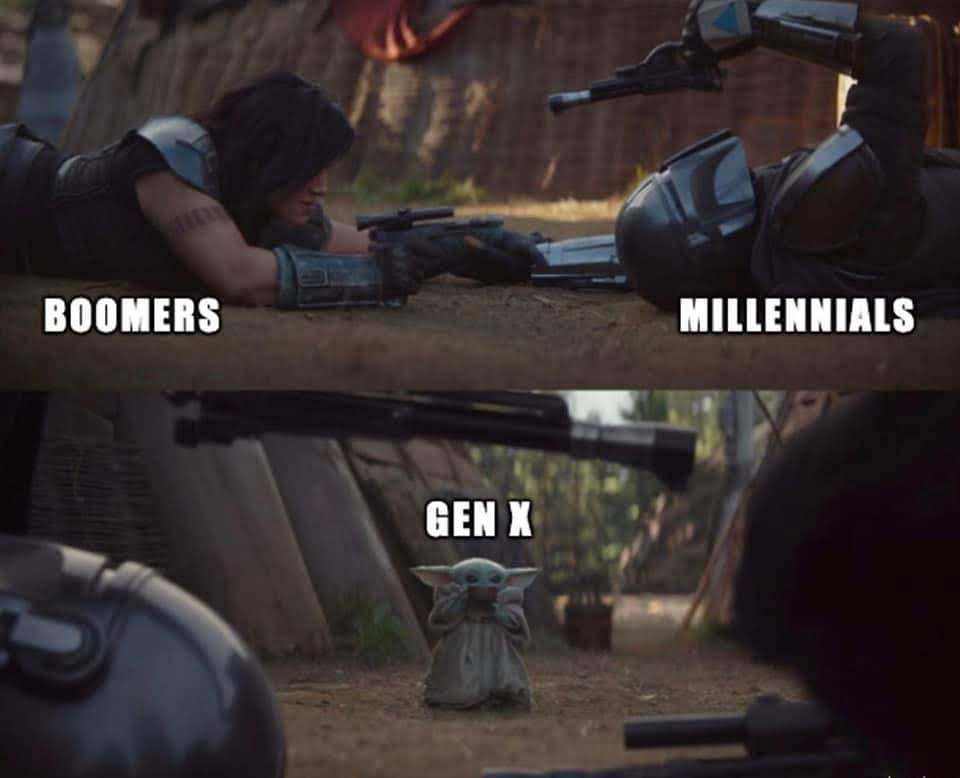
The meme features a screenshot from the Star Wars series "The Mandalorian" where a character is holding Baby Yoda, a young and powerful Jedi. The meme juxtaposes this image with a humorous and relatable scenario of a Baby Yoda sitting at a desk, surrounded by papers and pens, looking bored and uninterested. The text overlay reads "When you have to do adulting but you're a 600-year-old Jedi"
detailed-analysis (gemma3-27b-vision)
Okay, let's break down this meme using the requested theoretical frameworks.
Visual Description
The image is a multi-panel meme using scenes from The Mandalorian (a Star Wars series). Each panel features a Mandalorian helmet pointed at a character from the series. The panels are labeled with generational cohorts: "Boomers," "Millennials," and "Gen X."
- Panel 1 (Boomers): Shows the Mandalorian (Din Djarin) aiming a blaster rifle at a character who's a bit obscured, likely a bounty target.
- Panel 2 (Millennials): Features a sleek, futuristic, weaponized droid also aiming a blaster, looking very advanced.
- Panel 3 (Gen X): The Mandalorian's weapon is aimed at a tiny "Baby Yoda" (Grogu), who is standing on a pile of books. Grogu has a stoic, seemingly unbothered expression.
The overall tone is satirical, implying a power dynamic or relationship between the generations.
Foucauldian Genealogical Discourse Analysis
This meme's humor lies in the way it constructs generational 'truths' through discourse. A Foucauldian lens allows us to trace the history of power/knowledge that has led to these perceptions.
- Discourse & Normalization: The meme participates in a broader discourse about generational differences – arguments about work ethic, values, financial stability, etc. By labeling each panel with a generation, it normalizes the idea that each group is inherently distinct.
- Power Relations: The image creates a hierarchy of power (symbolized by the weapons). Din Djarin (Boomers) is actively pointing a weapon, suggesting a traditional, proactive approach to control. The droid (Millennials) represents a technological, advanced, but ultimately automated/remote form of power. Gen X is seemingly powerless, facing a weapon wielded by others.
- Genealogical Trace: We can trace how these generational stereotypes emerged. Boomers are often associated with a "take-charge" attitude and a certain level of entitlement. Millennials are framed as tech-savvy but potentially lacking in grit. Gen X is frequently presented as a "lost generation" – independent and self-reliant, but somewhat overlooked.
The meme isn't about the truth of these statements; it performs the discourse, reinforcing existing power dynamics and stereotypes.
Critical Theory
From a Critical Theory perspective (rooted in the Frankfurt School), the meme can be analyzed as a piece of cultural production that reflects and reinforces societal ideologies.
- Ideology: The meme subtly promotes a specific ideology about generational conflict and roles. It suggests that Boomers are in control, Millennials are technologically advanced but potentially detached, and Gen X is vulnerable and lacks agency.
- Mass Culture: As a meme shared widely online, it becomes part of mass culture, contributing to the normalization of these perceptions. This can be seen as a form of social control, subtly shaping our understanding of the world.
- False Consciousness: The meme's reliance on broad stereotypes could be seen as contributing to "false consciousness" – preventing us from recognizing the underlying social and economic forces that actually shape generational experiences. It encourages us to see conflict as simply between generations, rather than focusing on systemic issues.
- Commodification of Generational Conflict: The meme format, readily shared and adapted, also commodifies generational conflict for entertainment value.
Marxist Conflict Theory
A Marxist analysis focuses on class struggle, but can be adapted to understand conflict between generational groups as a proxy for larger economic and power imbalances.
- Resource Allocation: We can interpret the image as representing the shifting allocation of resources (wealth, power, opportunity) between generations. Boomers, having benefited from a period of economic growth, are depicted as wielding control. Millennials and Gen X are potentially facing a more precarious economic landscape.
- Capital & Labor: The droid, representing Millennials, could be seen as a symbol of automation—a force that disrupts traditional labor markets and contributes to economic inequality. Gen X, facing the consequences of those shifts, is left vulnerable.
- Class Position: The meme subtly reinforces existing class divisions. It doesn't address the diversity within each generation – the range of socioeconomic backgrounds and experiences.
- False Consciousness: A Marxist analysis might argue that the meme distracts from the real source of conflict – the capitalist system that creates inequality and competition between groups.
Postmodernism
A Postmodern lens emphasizes the breakdown of grand narratives and the instability of meaning.
- Hyperreality: The meme exists in a hyperreal space—a simulation of reality created through digital media. The generational labels become detached from actual lived experiences, becoming abstract signifiers.
- Deconstruction of Identity: The meme plays with the idea of generational identity, reducing complex individuals to stereotypes. It deconstructs the notion of a cohesive, unified generation.
- Irony & Parody: The meme relies on irony and parody to create humor. It mocks the stereotypes associated with each generation, but also reinforces them through repetition.
- Instability of Meaning: The meme's meaning is open to interpretation. Different viewers might find different levels of humor or satire, depending on their own experiences and perspectives.
Queer Feminist Intersectional Analysis
This analysis examines how various power structures intersect (gender, sexuality, class, race, generation) to create unique forms of oppression and marginalization.
- Generational Trauma: The image could be interpreted as a representation of generational trauma—the ways in which past experiences shape the present. Boomers potentially represent a generation that perpetuated certain forms of oppression, while Millennials and Gen X grapple with the consequences.
- Intersectionality: The meme doesn’t explicitly address intersectionality, but it’s important to consider how these generational dynamics intersect with other forms of identity. For example, the experiences of women or LGBTQ+ individuals within each generation might be significantly different.
- Power Dynamics: The image reinforces traditional power dynamics—the gun representing dominance and control. This could be seen as a reflection of patriarchal structures that privilege certain groups over others.
- Silencing & Erasure: Gen X being aimed at, as a stoic entity, could also be seen as a metaphor for the silencing and erasure of that generation's experiences and contributions. This is compounded by the fact the meme relies on broadly accepted, stereotypical tropes.
I hope this thorough analysis using the requested theoretical frameworks is helpful! Let me know if you'd like me to expand on any particular aspect.
simple-description (llama3.2-vision)
This meme is a humorous comparison between two generations: Boomers and Millennials. The image depicts a scene from the movie "The Mandalorian" where a character is about to shoot a target, but instead of a person, it's a baby Yoda. The text above the image reads "Boomers" and below it reads "Millennials". The meme is poking fun at the stereotype that Boomers are more likely to shoot first and ask questions later, while Millennials are more cautious and would rather ask questions first.
tesseract-ocr
y a\ A a ar ; ik tt aed f po 3 PLU La BY MILLENNIALS my _ ie he i 13 7 a > ol ~~ ah 7)