First Seen
2023-05-10T21:03:41+00:00
simple-description (llama3.2-vision_11b)
The meme is a screenshot from the Star Wars series "The Mandalorian" featuring Baby Yoda, a young and adorable version of the character Yoda from the Star Wars universe. The image shows Baby Yoda holding a lightsaber and looking adorable, with the caption "Baby Yoda Show" written above it. The meme is a playful and humorous take on the character's popularity and the show's title, implying that the show is all about Baby Yoda's adventures and antics.
detailed-analysis (gemma3-27b-vision)
Okay, let's break down this phone screen image through several analytical lenses.
Visual Description
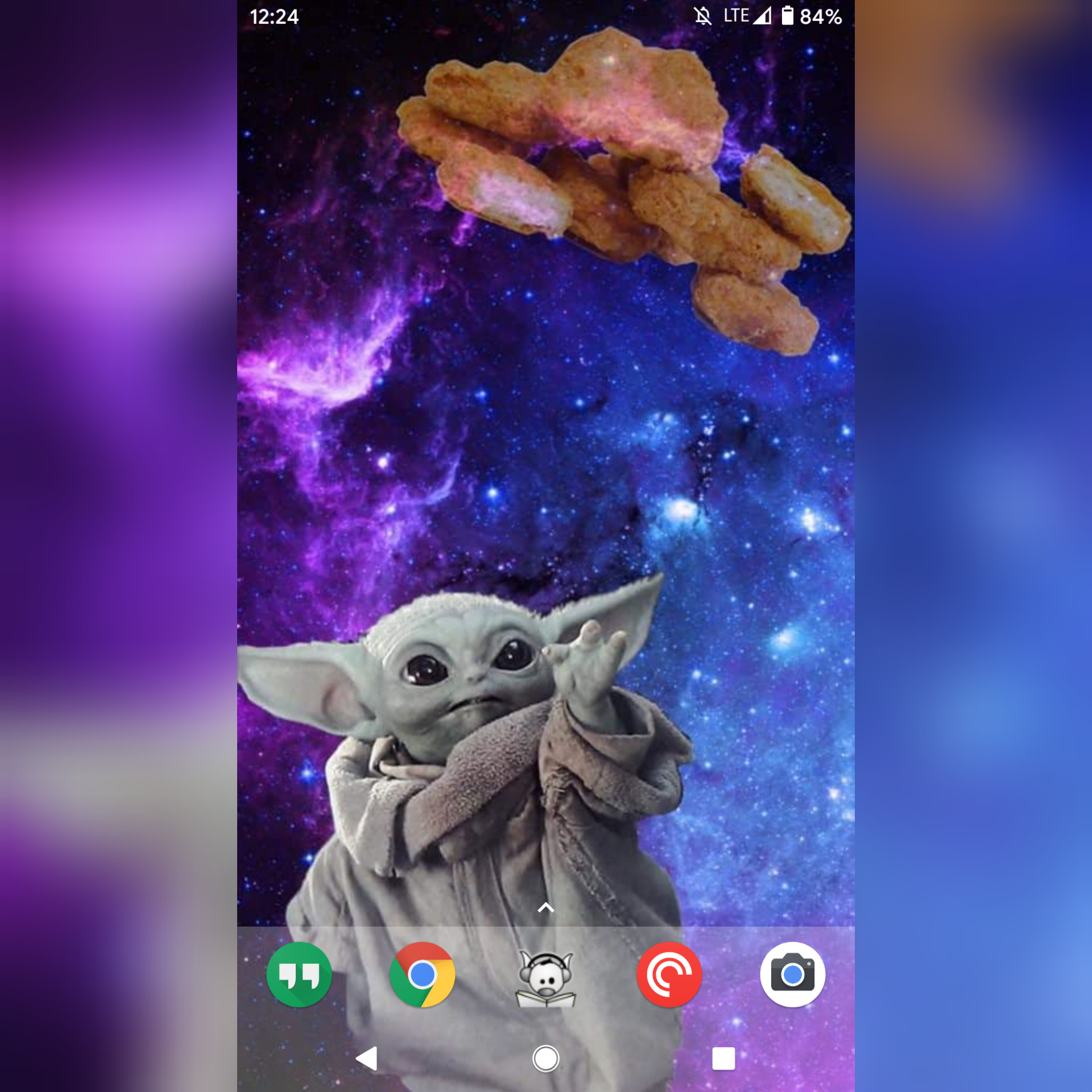
The image is a phone screen capture. It showcases a digitally composed image set as the background. The background is a vibrant, colorful depiction of space, resembling a nebula with swirls of purple, blue, and pink hues. In the foreground, there's a large depiction of “Grogu” (commonly known as “Baby Yoda”) from The Mandalorian, appearing to be praying or in a state of reverence. Above Grogu, seemingly floating in space, are three fried chicken nuggets. The bottom of the screen displays the typical Android user interface with app icons including Voice Search, Google, Google Play Music, etc. The top of the screen displays the time (12:24), signal strength, and battery percentage (84%). The whole composition has a whimsical, meme-like quality, blending pop culture elements with a slight absurdity.
Foucauldian Genealogical Discourse Analysis
This image is a fascinating site for a Foucauldian analysis. The composition isn't simply about the elements depicted (Baby Yoda, chicken nuggets, space), but rather a discursive formation. We need to examine how these elements have been constructed through discourse to hold meaning.
- Power/Knowledge: The image highlights how power operates through seemingly innocent visual configurations. Baby Yoda is a product of Disney’s media empire, a constructed icon used to generate capital and emotional attachment. Similarly, chicken nuggets are not “natural” food items but a product of industrialized agriculture and marketing. The image juxtaposes these forces.
- Genealogy: By tracing the “genealogy” of each element, we can see how they came to mean what they do. Baby Yoda’s popularity arose through a deliberate media strategy leveraging nostalgia and cuteness. Chicken nuggets are a relatively recent invention, born out of the need for efficient protein production.
- Disciplinary Power: The image implicitly speaks to the modern human’s need for comfort and indulgence. The juxtaposition of spiritual reverence (Baby Yoda’s pose) and fast food gratification (“chicken nuggets”) suggests a subtle critique of consumerist culture. It illustrates how our desires are shaped and controlled by external forces.
Critical Theory
This image can be approached through the lens of Critical Theory, which aims to understand how power structures are maintained through cultural products.
- Commodification of Culture: The most striking aspect is the mixing of a popular entertainment character (Baby Yoda) with a mass-produced consumer item (chicken nuggets). This illustrates how virtually everything in contemporary society is commodified. Emotion, spirituality (suggested by Grogu's pose), and even basic sustenance are turned into objects to be bought and sold.
- Spectacle & Distraction: The image’s visual absurdity can be seen as part of the “spectacle” as described by Guy Debord. The vibrant colors and strange juxtaposition distract from deeper social and political issues. It provides a momentary burst of amusement, but does not invite critical engagement.
- False Consciousness: The image might reflect a “false consciousness” where individuals are distracted by superficial pleasures while ignoring the structures of power that govern their lives.
Marxist Conflict Theory
From a Marxist perspective, the image highlights the conflicts inherent in a capitalist society.
- Production & Consumption: The image directly represents the relationship between production (the creation of both entertainment like The Mandalorian and mass-produced food) and consumption. It visually reinforces the capitalist imperative to constantly create needs and satisfy them through purchasing.
- Alienation: The image could be interpreted as representing alienation. The juxtaposition of a character embodying spiritual sensitivity with a highly processed food suggests a disconnect from natural processes and authentic experience.
- Ideology: The image promotes an ideology of instant gratification and escapism, diverting attention from material conditions and class struggles.
Postmodernism
This image is strongly aligned with postmodern aesthetics.
- Pastiche & Intertextuality: The image is a pastiche, blending elements from different sources (space imagery, The Mandalorian, fast food) in a playful, often ironic way. It relies heavily on intertextuality—the assumption that viewers will recognize and understand the references.
- Blurring Boundaries: The image challenges traditional boundaries between high and low culture, spirituality and consumerism, the real and the artificial.
- Loss of Grand Narratives: The image undermines any sense of overarching meaning or purpose. It's a fragmented, ironic statement reflecting a postmodern distrust of grand narratives.
- Simulation & Hyperreality: The image itself is a simulation—a digitally created representation of reality. It blurs the line between what is “real” and what is manufactured.
Queer Feminist Intersectional Analysis
This is potentially more subtle but still applicable.
- The Infantilization of ‘Cutness’: Baby Yoda's design relies heavily on "cuteness" - a traditionally gendered trope often associated with femininity and vulnerability. The over-saturation of this aesthetic in popular culture can be seen as a way to disempower and infantilize audiences.
- Consumerism and Body Image: The image indirectly speaks to the pressures on bodies within consumer culture. Fast food advertising often promotes unhealthy body standards and contributes to anxieties about appearance.
- Intersectionality: While not explicit, the image could be understood as representing the way different forms of power (capitalism, media, gender norms) intersect and reinforce each other. The commodification of ‘cuteness’ and the promotion of consumer culture are not neutral; they disproportionately affect marginalized groups.
Disclaimer: These analyses are interpretations. The beauty of visual culture is that it can be understood in many different ways.
simple-description (llama3.2-vision)
The meme is an image of the Star Wars character Yoda, but with a surprised expression and his hands raised in a "what's going on?" gesture. The text "I find your lack of snacks disturbing" is overlaid on the image, a play on Yoda's famous phrase from the Star Wars franchise. The image is likely a humorous take on the idea that someone's snack supply is running low.
tesseract-ocr
sayz! : RIG EVRA A os R : —— | . Pa — - Ss . \ ’ ~—— >, ; tae a } c a : ’ i : s 7 ov ‘ e \ , £ . : a 5-3 . ‘ — y 7s 7 g P ; ee P Z aa 7 _ a r ‘ F 22 a om 4 E » .. k “. : b a ‘ 4 ite! ms x ae r 4 } ‘ e ‘ , , , , tees PN er - 6 Aid _ Z - ; ol * . i, @ By [sa » f \ Zo ; ‘ x. ‘ . ? ae oe | b> lag es as | bs r Pe aN (2 =) et + P a — 2 Ss a y oe F . “ i L ‘>. | ' : oS es oe y yn “4 ¥ 3 ¥ 2 bt : \% a be oe 2 ae . = pe é 7 % \h 0 y a Ri ae 4 q ns. coe . ' - 1s a> ite ¢ = s cee )) <= a TAS: a ' ; Ay SS, a Pr : -— te