First Seen
2023-05-24T21:09:23+00:00
simple-description (qwen3.5_2b-q8_0)
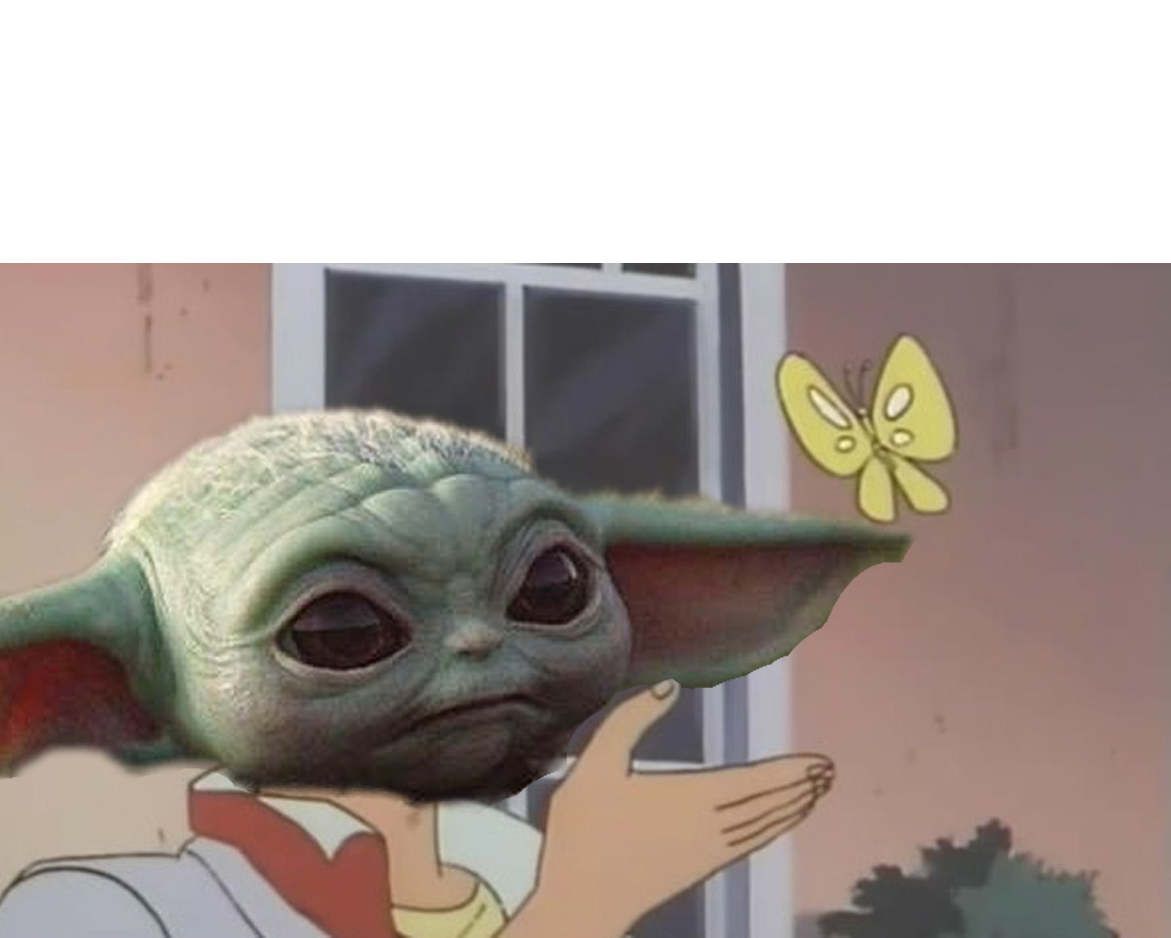
This meme is a popular "face swap" trend originating from the Star Wars fandom, featuring the character Grogu from The Mandalorian superimposed over a scene from the show. The image shows a young boy from the animated series gesturing with a hand near a yellow butterfly, effectively blending the alien's large, expressive green eyes into the frame. This humor relies on the contrast between the serious, alien nature of the character and the whimsical, innocent action of the child, which is a common joke in the community about the show.
simple-description (llama3.2-vision_11b)
The meme features Baby Yoda from the Star Wars series, who is holding a small frog in his hand. The frog is wearing a tiny hat and holding a sign that says "I can smell the desperation". The meme is a humorous commentary on the idea that even the smallest creatures can sense the emotions of those around them.
detailed-analysis (gemma3-27b-vision)
Okay, let's analyze this image through the lenses you've provided. It's a composite image, seemingly combining elements from The Mandalorian (Baby Yoda/Grogu) and a classic cartoon aesthetic, with a distinct Disney vibe.
1. Visual Description
The image is a digital composite. In the foreground is a close-up of Grogu (Baby Yoda) from The Mandalorian, rendered realistically. He has a slightly forlorn or questioning expression. Superimposed on a cartoon-style background is a hand reaching out toward a bright yellow butterfly. The background is a simplified depiction of a window and foliage, evoking a classic animated film look (think 1950s Disney). The contrast between the hyperrealistic rendering of Grogu and the flat, stylized cartoon background is immediately striking. The colors are muted except for the very bright, stylized butterfly.
2. Postmodernism
This image screams postmodernism. It is a prime example of pastiche – combining disparate elements from different sources (realistic CGI, cartoon animation) without a unifying, original intention. It's a self-aware play on cultural signifiers – The Mandalorian is a contemporary pop culture phenomenon, while the animation style deliberately references a nostalgic era. This blend deconstructs the original contexts of both elements.
The image isn't about anything in a traditional narrative sense; it’s about the relationship between images, and the way we consume and remix culture. The image plays with the familiar, but doesn't offer a singular, coherent "meaning," therefore, it exemplifies the loss of grand narratives associated with postmodern thought. The image lacks any depth or intention.
3. Queer Feminist Intersectional Analysis
While not immediately obvious, we can apply an intersectional lens. The image can be seen as a disruption of traditionally masculine tropes. Grogu, while not explicitly gendered, is a figure of vulnerability and emotional openness. The image portrays a moment of gentle connection and curiosity with the butterfly, which can be linked to queer feminist concepts of challenging rigid binaries and embracing fluidity. The gentle embrace of something whimsical and fragile can be seen as a rejection of dominant patriarchal systems that emphasize strength and control.
4. Critical Theory
The image functions as a form of culture jamming. It appropriates familiar imagery, distorts it, and presents it in a way that compels us to reconsider its meaning. Grogu, as a beloved pop culture figure, is being re-signified. The cartoon background and the butterfly create a disjunction that forces us to question the image’s purpose. This is a form of ideological critique. It subverts the original context of both elements to create a new and potentially subversive message.
5. Foucauldian Genealogical Discourse Analysis
From a Foucaultian perspective, we can look at how power operates through the discourse surrounding both The Mandalorian and classic animation. The Mandalorian has spawned a massive industry of merchandise and fan theories, creating a powerful discursive formation around Grogu. This image, by placing him in a radically different context, attempts to disrupt that discourse.
The visual style of classic animation also has a history of power dynamics—Disney often portrayed simplistic or stereotyped representations of other cultures. The image, by referencing this style, can be interpreted as a deconstruction of these power structures. The image could be interpreted as a questioning of the established norms and discourses surrounding both The Mandalorian and Disney animation. It's not about "truth" but about the ways knowledge and power are constructed through discourse.
6. Marxist Conflict Theory
From a Marxist perspective, we can examine the image as a commentary on the commodification of culture. The Mandalorian and Disney animation are both products of a capitalist system. This image, by remixing these elements, can be seen as a critique of the relentless pursuit of profit in the entertainment industry. It's an example of how culture is increasingly being treated as a commodity, stripped of its original meaning and repurposed for commercial gain. The bright, attention-grabbing butterfly serves as a distraction, similar to how consumer culture seeks to distract us from more pressing social and economic issues.
Important Note: Many of these interpretations are subjective and open to debate. The image is intentionally ambiguous, which allows for a wide range of analyses. The applicability of each theoretical framework depends on how you choose to interpret the image and the specific themes you focus on.
simple-description (llama3.2-vision)
This meme features a photo of a baby Yoda (also known as "Baby Yoda" or "The Child") from the Star Wars series, looking concerned or worried. The image is captioned with the text "When you finally understand the concept of a 401(k) but your employer still hasn't given you a raise".
tesseract-ocr
a B\ Wo ata | aX Ia ‘ae x - i = ej — 1