First Seen
2023-05-24T21:09:23+00:00
simple-description (qwen3.5_2b-q8_0)
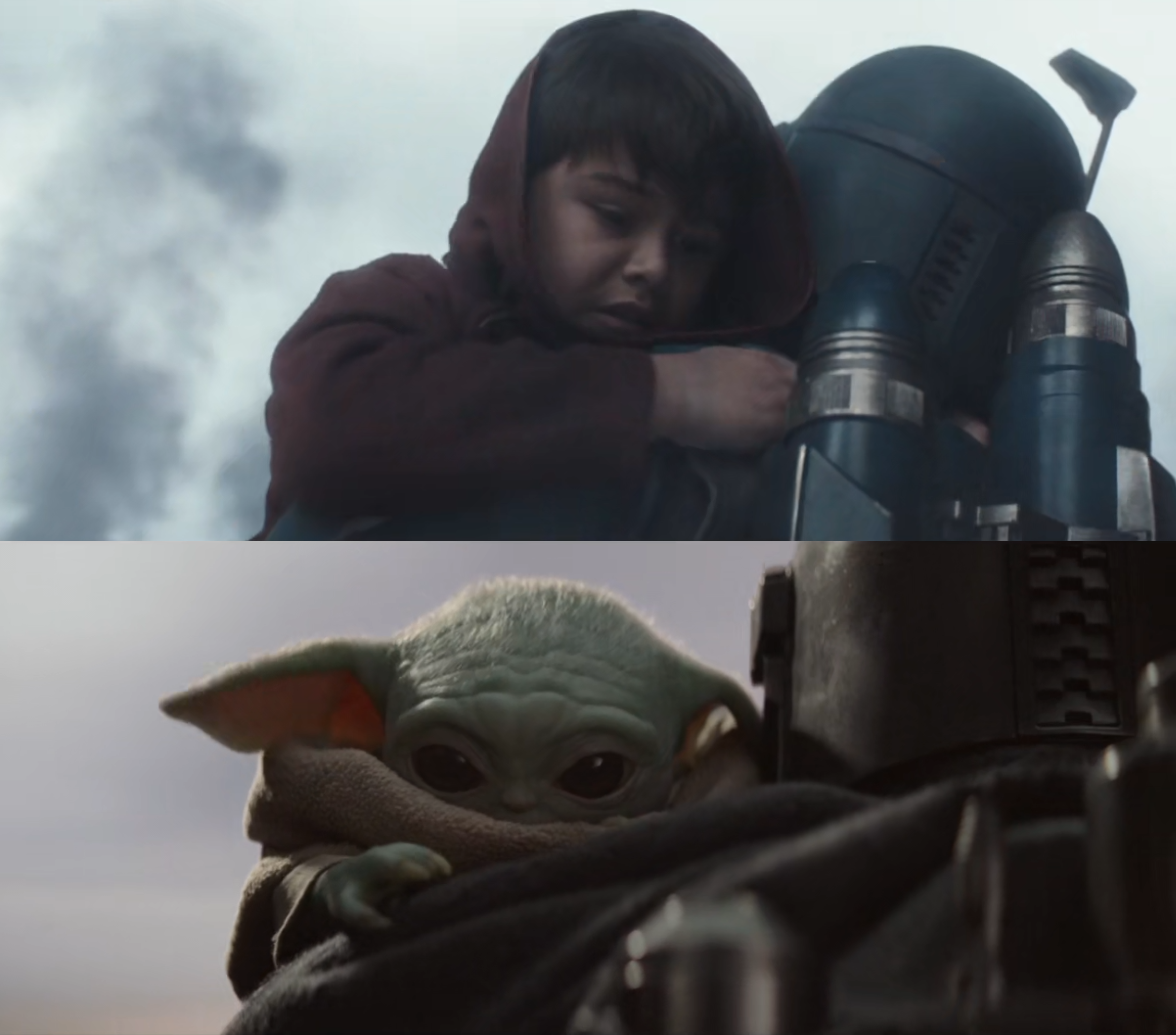
In the Star Wars universe from the show The Mandalorian, this meme highlights the striking resemblance between the young apprentice named Grogu and the Jedi Master Yoda. The top image shows Grogu being carried by the Master Yoda figure (Tormund Gaten), while the bottom close-up shows the actual Baby Yoda, revealing that the human boy looks just like the green Jedi Master. The text visible on the armor, including "Star Wars" branding, anchors the scene within the franchise.
simple-description (llama3.2-vision_11b)
The meme is a screenshot from the Star Wars series "The Mandalorian" featuring a character known as "Baby Yoda" (officially named "The Child") from the Disney+ series. The meme is captioned "Baby Yoda Show" and features the character in a humorous, adorable pose, implying that the character is the main attraction in a fictional "show" or event. The image is likely used to express excitement or enthusiasm for the character, or to poke fun at the character's popularity.
detailed-analysis (gemma3-27b-vision)
Okay, let's break down this compelling image pair from The Mandalorian, applying the requested theoretical lenses.
Visual Description
The image presents a diptych, juxtaposing two scenes of emotional vulnerability and protection.
- Top Panel: A young boy, Grogu, wrapped in a red cloak, is embracing Din Djarin (the Mandalorian), who is shown in full armor, facing away from the viewer. The background is a hazy, grey sky, and the boy's expression is one of sadness and seeking comfort. The composition emphasizes the physical contrast between the soft, vulnerable child and the hard, armored protector.
- Bottom Panel: A similar framing is present, with Grogu embracing the Mandalorian’s armor. The color palette has shifted to a warm, orange-grey, hinting at a changed setting (possibly a different planet or time). Again, Grogu appears to seek comfort. The angle is slightly lower, enhancing the protective posture of the Mandalorian.
The common threads are dependency, trust, and the creation of a familial bond despite the Mandalorian's traditionally stoic and warrior-like identity.
Foucauldian Genealogical Discourse Analysis
This diptych can be examined through a Foucauldian lens by investigating the discourses surrounding ‘fatherhood,’ ‘protection,’ and ‘warrior identity’.
- Historical Discontinuities: Traditionally, the ‘warrior’ archetype is constructed as emotionally detached, strong, and focused on conquest. This image challenges that discourse. The Mandalorian's act of allowing – even accepting – a child’s comfort-seeking breaks with established power dynamics. We see a shift from a purely warrior-focused identity towards one incorporating nurturing, even vulnerability.
- Power/Knowledge: The Mandalorian’s armor represents a system of power, a code (the Way of the Mandalore), and a structure of knowledge. This armor, traditionally signifying distance and control, becomes the surface against which Grogu seeks comfort. This represents a re-negotiation of power. The child's trust "knows" the Mandalorian as safe, even though logic would suggest the opposite. This underscores how subjective experience, rather than objective "truth", constructs reality.
- Genealogy of Care: We can trace a genealogy of care within the Star Wars universe. The Jedi Order, while seemingly committed to protecting the galaxy, largely lacked individualized nurturing. The Mandalorian, despite his rigid code, is offering a more personal, intimate form of protection, challenging this established power structure.
Critical Theory
Examining the diptych through Critical Theory (particularly a Frankfurt School lens), we can look at how the images function as a critique of traditional societal norms.
- The Family & Ideology: The image challenges the traditional nuclear family model. The relationship between the Mandalorian and Grogu is unconventional; a hardened bounty hunter becoming a surrogate father figure. This challenges the idea that parenthood is defined by biological connection or conventional structures.
- Commodity Fetishism & the Mandalorian as Object: Din Djarin’s Beskar armor, a valuable and manufactured commodity, becomes more than just protection. It is a site of emotional connection for Grogu. This inverts the logic of commodity fetishism where value is assigned to objects. Here, the experience associated with the object (comfort, safety) becomes more important than the object itself.
- Alienation & Connection: The Mandalorian, initially driven by a profession isolating him from emotional connection, is shown experiencing a sense of belonging through his relationship with Grogu. This provides a critique of the alienation inherent in late-capitalist societies and the search for authentic connection.
Marxist Conflict Theory
While not explicitly about class struggle, the image can be analyzed through the lens of conflict and resource control:
- Control & Protection of “Capital”: Grogu can be seen as a valuable asset—someone with unique power (the Force) that others would exploit. The Mandalorian’s primary motivation is to protect Grogu from those who seek to control him, mirroring a struggle over resources.
- The Power of the Individual vs. Institutional Forces: Din Djarin, an individual operating outside the established structures of the New Republic or Imperial remnants, is positioned against forces attempting to exploit Grogu. This is a micro-level representation of conflict between individual agency and institutional power.
- The Redemptive Value of Unconventional Relationships: The relationship defies the typical hierarchical power structures. The Mandalorian is motivated by something beyond profit. It is a suggestion that authentic relationships can subvert the dehumanizing forces of power.
Postmodernism
This image resonates with key postmodern themes:
- Deconstruction of Archetypes: The Mandalorian is a deconstruction of the stoic, lone warrior archetype. He is allowed to be vulnerable, to feel, and to prioritize emotional connection over duty or profit. This subverts traditional expectations and breaks down rigid categories.
- Simulacra & Hyperreality: The Mandalorian's armor is a constructed identity, a representation of a warrior culture. Grogu’s trust isn’t based on an “authentic” understanding of the Mandalorian, but on the feeling of safety provided by the armor. This creates a blurring of reality and representation.
- Fragmentation of Meaning: The image rejects grand narratives about heroism or destiny. The relationship between the Mandalorian and Grogu is built on personal connection, defying overarching ideologies.
Queer Feminist Intersectional Analysis
While not immediately apparent, an intersectional lens can offer insights:
- Redefining “Familial” Structures: The relationship rejects the normativity of traditional, heteronormative family structures. The bond between Din Djarin and Grogu isn’t based on biological kinship but on chosen connection. This challenges the assumption that families must conform to a specific model.
- Vulnerability as Strength: Traditionally, vulnerability is often associated with femininity and seen as a weakness. The image subverts this. Din Djarin allows himself to be a source of comfort for Grogu, challenging hegemonic masculinity.
- Intersection of Care and Power: The Mandalorian’s power (his armor, his fighting skills) is used to provide care. This intersection challenges the idea that power is inherently oppressive. He uses his agency to protect and nurture a vulnerable being.
I have attempted to provide a thorough analysis using each of the theoretical frameworks you requested. The richness of this visual pairing allows for multiple interpretations through diverse lenses. Let me know if you'd like me to expand on any specific area!
simple-description (llama3.2-vision)
This meme is a still image from the Star Wars franchise, specifically from the character of the Child (also known as "Baby Yoda") from the Disney+ series "The Mandalorian". The image shows the Child looking at the camera with a concerned expression, as if it's about to say something. The text overlay on the image reads: "When you're about to say something but you're not sure if you're allowed to".
tesseract-ocr
- _ ik —— | . A di Lad Z 4a ; an a ‘ - "4 / 7