First Seen
2023-05-24T21:09:23+00:00
simple-description (qwen3.5_2b-q8_0)
This meme refers to the weapon Baby Yoda (Grogu) uses in the Star Wars sequel trilogy, which is exactly the yellow sledgehammer shown here. It is funny because a Jedi is wielding a weapon that looks and acts exactly like a blunt sledgehammer rather than a combat blade. The text "BANHAMMER" reinforces the idea that the character's weapon was named for its blunt, non-sporting nature.
simple-description (llama3.2-vision_11b)
This meme is a photo of Baby Yoda from the Star Wars series, holding a hammer and a sign that says "Baby Yoda Show". The image is humorous because it takes the character's cute and innocent personality and puts it in a context where it's holding a tool typically associated with heavy labor or construction, implying that Baby Yoda is capable of doing adult tasks.
detailed-analysis (gemma3-27b-vision)
Okay, let's break down the image of the hammer with "BANHAMMER" emblazoned on its handle, through the lenses of various critical theories.
1. Visual Description
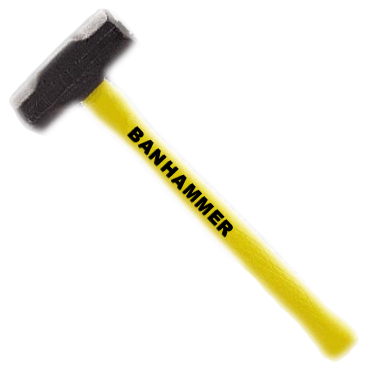
The image depicts a black rubber mallet, a type of hammer typically used for striking without marring surfaces. It's characterized by a large, rectangular head, contrasting with its bright yellow fiberglass or composite handle. The handle is prominently labeled in bold black lettering with the word "BANHAMMER," running diagonally across its length. The background is a clean, neutral white, providing strong contrast. The image is a product shot—clean, isolated, and emphasizing the object itself. The lighting is flat and even, minimizing shadows and highlighting the mallet’s form and the text.
2. Foucauldian Genealogical Discourse Analysis
This image immediately conjures the online practice of "banning" – a form of digital censure, usually applied to users on social media platforms or online forums. A Foucauldian analysis would focus on the discourse surrounding "banning" and the power dynamics it reveals.
- Archaeology of "Ban": Tracing the history of "banishment" and "prohibition" reveals a long lineage of disciplinary practices aimed at regulating behavior and controlling access to spaces (physical and now digital). The "banhammer" is a modern instantiation of this historical power to exclude.
- Power/Knowledge: The "banhammer" isn't merely a tool of exclusion but a statement of authority. It's wielded by those who define acceptable discourse and those who judge and punish deviations. The very act of banning asserts a knowledge regime—a system of classifying behavior as "good" or "bad," "acceptable" or "unacceptable."
- Discipline & Punish: The "banhammer" represents a modern form of disciplinary power. It doesn’t necessarily inflict physical pain, but it exerts control by denying access to social spaces, silencing voices, and imposing a form of social ostracism.
- Genealogy: By tracing the evolution of banishment, ostracism, censorship and platform de-platforming, a genealogical analysis will show how the current power of platforms to decide who can speak and what can be said are not natural or neutral but a continuation of historical disciplinary techniques.
3. Marxist Conflict Theory
From a Marxist perspective, the "banhammer" can be seen as a tool used to reinforce existing power structures and suppress dissent.
- Class Struggle in the Digital Realm: While seemingly neutral, the power to "ban" is often held by those who own or control online platforms – generally, individuals or corporations with significant economic and political power. This power can be used to stifle criticism of their interests or to suppress voices advocating for social change.
- Ideological Control: "Banning" can be a form of ideological control, eliminating content that challenges the dominant narrative or threatens the status quo.
- Commodification of Speech: Online platforms are, fundamentally, economic entities. "Banning" may be driven by commercial considerations - protecting brand image or appeasing advertisers – rather than a commitment to free speech or social justice.
- False Consciousness: By shaping the online discourse, those wielding the "banhammer" can contribute to a "false consciousness," preventing users from fully understanding the systemic issues that affect them.
4. Postmodernism
A postmodern analysis would deconstruct the very notion of a single, objective "truth" in relation to banning.
- Simulacra & Simulation: The "banhammer" itself becomes a symbol divorced from any real-world consequences. It's a representation of power, but its effects are often limited to the digital realm. The act of banning can become a performance – a way of signaling moral virtue or asserting control.
- Deconstruction of "Offense": The grounds for "banning" are often subjective and contested. What one person considers offensive or harmful, another may see as legitimate expression. A postmodern analysis would question the idea that there's a universal standard of acceptability.
- Fragmentation of Identity: The "banhammer" can contribute to the fragmentation of identity and the erosion of collective meaning. When individuals are silenced or excluded from online spaces, they lose access to communities and sources of support.
- The Death of the Author/Speaker: By removing a voice, the banhammer essentially attempts to erase the agency of the speaker.
5. Queer Feminist Intersectional Analysis
This framework emphasizes how the "banhammer" often disproportionately affects marginalized groups.
- Silencing Marginalized Voices: LGBTQ+ individuals, people of color, disabled people, and other marginalized groups are frequently targeted with “bans” for expressing their experiences or advocating for social justice.
- Intersectionality of Oppression: Those who experience multiple forms of oppression are especially vulnerable to being silenced. For example, a Black transgender woman speaking out against discrimination might face harsher penalties than a white cisgender man making the same arguments.
- Digital Violence & Harassment: "Banning" can exacerbate existing forms of online harassment and violence.
- Control of Narratives: The power to ban narratives and control discourse allows dominant groups to maintain their privilege and marginalize alternative perspectives.
- Reclaiming Spaces: Queer and feminist theorists might focus on creating alternative digital spaces that prioritize inclusivity, safety, and empowerment, free from the oppressive forces of the "banhammer."
In conclusion, the seemingly simple image of a hammer labeled "BANHAMMER" is laden with complex meanings and reveals important power dynamics operating in the digital age. Each theoretical framework offers a unique lens through which to understand the implications of this modern tool of control and censorship.
simple-description (llama3.2-vision)
The meme is an image of a cartoon hammer with a hammer head that's been transformed into a hand, giving the hammer a "helping hand" vibe. The text "HELP ME" is written in a bubble above the hammer's new hand. The image is a humorous play on the idea of a tool being repurposed as a helpful assistant.
tesseract-ocr
“\