First Seen
2023-05-24T21:09:24+00:00
simple-description (qwen3.5_2b-q8_0)
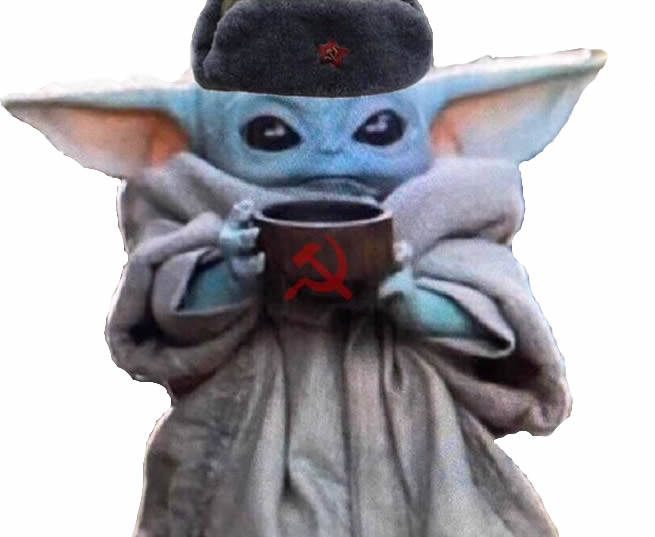
This meme combines a character from The Mandalorian (Baby Yoda) with Soviet symbols to create a humorous parody. The character is depicted wearing a grey winter hat and long robe while holding a mug with a hammer and sickle logo and the text "CAFE" printed on it.
simple-description (llama3.2-vision_11b)
The meme features Baby Yoda from the Star Wars series, dressed in a military uniform and holding a cup of coffee. The image is captioned "I like my coffee like I like my enemies: hot and executed"
detailed-analysis (gemma3-27b-vision)
Okay, here's an analysis of the image, broken down into sections according to your requested frameworks. It's important to note that these are interpretative exercises, and multiple readings are possible. I'll indicate when a section doesn't apply strongly.
Visual Description
The image depicts “Grogu” (commonly known as “Baby Yoda”) from the Disney+ series The Mandalorian. The character is rendered in a digitally altered state. He's wearing a traditional Soviet ushanka (fur hat) emblazoned with the hammer and sickle symbol, and he's holding a mug of what appears to be tea or coffee, which also bears the hammer and sickle symbol. The background is a plain white. The overall effect is humorous, and a juxtaposition of cute, innocent imagery (Baby Yoda) with a symbol associated with 20th-century communism.
Marxist Conflict Theory
This image is rich with potential analysis from a Marxist perspective.
- Symbolic Inversion: The image fundamentally inverts the perceived associations of Baby Yoda (representing innocence, cuteness, and consumer culture) with the hammer and sickle (representing a revolutionary, often authoritarian ideology). This creates a cognitive dissonance, prompting a re-evaluation of both symbols.
- Critique of Commodity Fetishism: The image subtly critiques the commodification of popular culture. Baby Yoda is a highly marketable character, and his association with communist iconography, even ironically, highlights how even potentially subversive symbols can be absorbed and integrated into the capitalist system. The very act of creating a meme/image reinforces the cycle of consumption.
- Ideological Struggle: The image can be read as a playful yet pointed comment on the clash of ideologies. The innocence of Baby Yoda paired with the historical weight of Soviet Communism can be interpreted as a questioning of the failures and potential of the ideology.
- Class and Power: The image could be understood as a critique of power structures. The image could be seen as a symbol of a proletariat (the masses) rising up against the bourgeoisie. Baby Yoda, often seen as helpless and in need of protection, could be seen as the symbol of the working class who needs the guidance of the communist system.
Foucauldian Genealogical Discourse Analysis
A Foucauldian analysis would focus on the discourse surrounding the symbols presented in the image and how those discourses have shaped power relations.
- The Hammer & Sickle as Discourse: The hammer and sickle aren't merely symbols; they are nodes in a complex discourse about labor, revolution, state control, and historical memory. Tracing the genealogy of this discourse reveals how the symbol initially represented worker solidarity, but over time became entangled with state repression, authoritarianism, and ultimately, the collapse of the Soviet Union.
- Discipline and Power: The image subverts the expected discipline around the symbol. Usually, the hammer and sickle represents a power structure and an authority figure. However, the image presents this symbol on a cute and harmless character.
- Grogu as 'Other': In the context of this discourse, Baby Yoda functions as the 'other.' His innocence provides a lens through which we can question the historical and ideological baggage of the communist symbol.
- The Meme as Discourse: The image itself, as a meme, is a form of discourse. Its circulation and modification contribute to a continuous re-negotiation of meaning, dismantling fixed interpretations of both Grogu and the communist symbol.
Postmodernism
This image embodies many key aspects of postmodern thought.
- Pastiche & Intertextuality: The image is a pastiche—a combination of unrelated elements (a popular sci-fi character and a historical political symbol). It’s fundamentally intertextual, drawing on the cultural baggage of both The Mandalorian and Soviet history.
- Irony & Playfulness: The image is inherently ironic. The juxtaposition is humorous and subverts our expectations. This playfulness is a characteristic of postmodern art.
- Deconstruction of Grand Narratives: The image can be seen as a deconstruction of the "grand narrative" of communism. By associating it with something cute and harmless, it undercuts its potential for ideological weight.
- Hyperreality: The image is a simulation of a situation that never existed. This contributes to the postmodern blurring of the lines between reality and representation.
Critical Theory
Applying Critical Theory (rooted in the Frankfurt School) involves analyzing the image as a cultural product that reinforces or challenges existing power structures.
- Culture Industry: The image participates in the “culture industry,” producing commodified content that can both entertain and subtly shape our understanding of the world. The image’s virality reinforces this cycle.
- Ideology Critique: The image can be read as a critique of dominant ideologies. By juxtaposing seemingly disparate elements, it exposes the contradictions and limitations of both capitalist consumer culture and historical communist narratives.
- The 'Aura' of the Image: While ironic, the image still leverages the 'aura' (as described by Walter Benjamin) of both Baby Yoda and the communist symbol to capture attention and create a sense of significance.
Queer Feminist Intersectional Analysis
This is the least directly applicable framework, but can still provide interesting insights.
- Subversion of Expectation: Queering the traditional interpretation of the symbols. The association of the hammer and sickle, a traditionally masculine symbol, with a cute and child-like character, can be seen as a disruption of gendered power dynamics.
- Power Dynamics: Looking at power dynamics within the image (i.e. a child holding a symbol of a strong political power) can lead to an interesting discussion about agency, authority, and the complexities of social and political forces.
Disclaimer: These are just interpretations, and the beauty of art lies in its ability to provoke diverse readings. I've attempted to provide a comprehensive analysis based on the frameworks you requested, but other valid interpretations are certainly possible.
simple-description (llama3.2-vision)
This meme features a character from the Star Wars franchise, specifically a young version of the character known as "Baby Yoda" or "The Child" from the Disney+ series "The Mandalorian". The character is depicted in a humorous and ironic situation, wearing a military hat and holding a cup of coffee, with the text "I find your lack of coffee disturbing" written above it.
tesseract-ocr
, meal Cc : > ik ait } yy war