First Seen
2023-05-24T21:09:24+00:00
simple-description (qwen3.5_2b-q8_0)
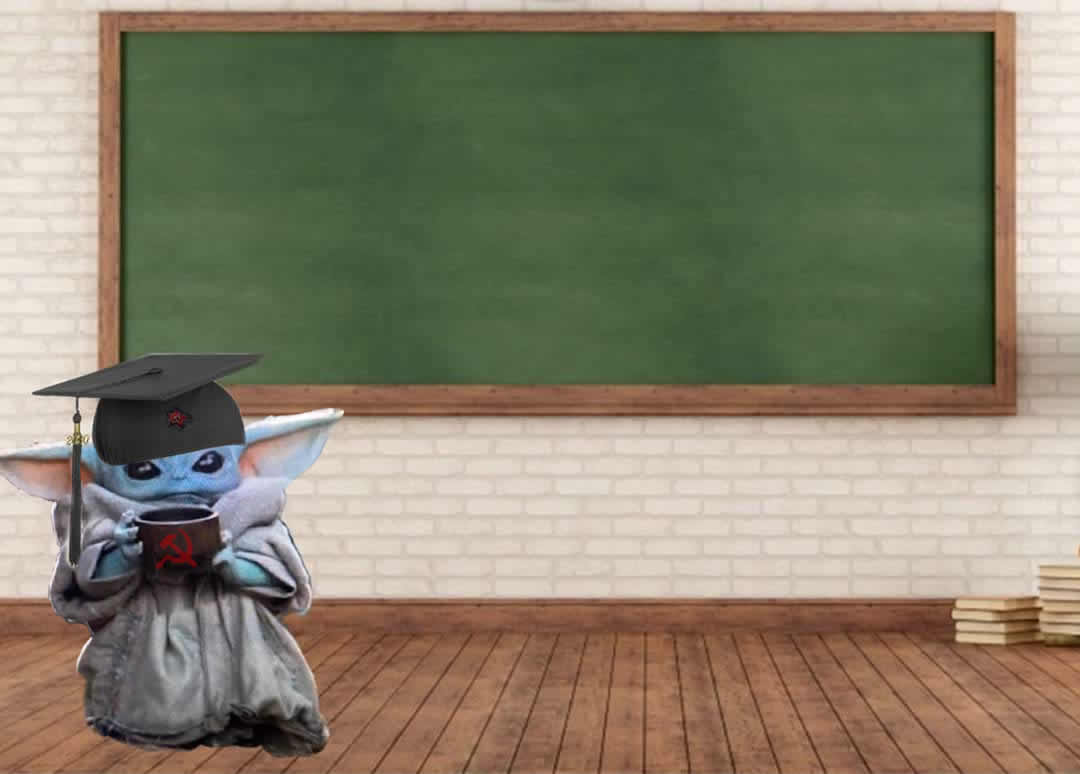
In this Star Wars context, Baby Yoda is depicted wearing a graduation cap and gown while holding a mug with a hammer and sickle symbol, suggesting a political transformation. The text "2020" on his mortarboard implies that the Jedi Order has become a political movement, humorously comparing the Jedi to a communist party or university course. It jokes about the Jedi becoming a serious academic discipline rather than a peaceful order.
simple-description (llama3.2-vision_11b)
This meme is a still image from the Star Wars series "The Mandalorian" featuring a young Yoda-like character, Baby Yoda, sitting in a classroom setting, wearing a mortarboard and holding a diploma. The image is captioned with a quote from Yoda, "When 900 years old you reach, look as good you will not."
detailed-analysis (gemma3-27b-vision)
Okay, let's analyze this image through a few of the lenses you've suggested. Given the image, some lenses are more applicable and yield richer interpretations than others.
1. Visual Description
The image depicts "Grogu" (commonly known as Baby Yoda) from the Star Wars series The Mandalorian. Grogu is digitally placed in a seemingly empty classroom setting. He is wearing a miniature graduation cap and appears to be holding a mug. He is kneeling on a dark wood floor in front of a brick wall with a large, empty green chalkboard. A small stack of books is partially visible on the right side of the image. The overall color scheme is muted with earth tones dominating, accented by the vibrant green chalkboard. The composition suggests a moment of quiet contemplation or perhaps a sardonic commentary on education.
2. Foucauldian Genealogical Discourse Analysis
This image is ripe for a Foucauldian analysis. The classroom, with its empty chalkboard, is a crucial site of discourse – the systems of thought, language, and practice that produce knowledge and power.
- Power/Knowledge: The classroom historically represents an institution where power is exercised through the creation and transmission of knowledge. The empty chalkboard highlights the absence of a defining discourse. What is not being said is as important as what could be. Is this a critique of the institutionalization of knowledge, suggesting its emptiness or irrelevance?
- Disciplinary Practices: Even without a teacher or explicit lesson, the setting evokes disciplinary power. We expect rules, assessment, and normalization within this space. Grogu’s positioning—kneeling, seemingly pondering—could be read as a response to this unseen power dynamic.
- Genealogy: Tracing the history of the classroom reveals a shift in how knowledge is produced and controlled. From monastic settings to modern public schools, the classroom has evolved. Grogu, as a figure representing a futuristic, advanced civilization (within the Star Wars universe), placed in this traditional setting, is a disruption of this historical trajectory. It suggests a questioning of the very foundations of our educational practices.
- Panopticon: The implicit expectation of surveillance, even in an empty classroom, evokes the panoptic model. Grogu, despite being seemingly alone, is still 'under observation' (by the viewer, and by the implied structure of the educational system).
3. Critical Theory (Frankfurt School)
Applying a Critical Theory lens, the image can be read as a commentary on the culture industry and the commodification of education.
- Mass Culture: Grogu, as a popular character from a massive media franchise, represents the product of the culture industry. His presence in the classroom suggests a blurring of the lines between entertainment and education. Is this image critiquing the way popular culture infiltrates and potentially devalues genuine learning?
- Instrumental Reason: The classroom, in a highly rationalized modern society, can be seen as a site of instrumental reason—where knowledge is valued primarily for its utility in achieving specific goals (e.g., career advancement). Grogu, potentially a being of ancient wisdom, seems to be observing or commenting on this instrumental approach.
- Loss of Authenticity: The combination of the traditional classroom setting and the popular culture figure suggests a loss of authenticity in education. The image might question whether education has become merely a performance of cultural trends rather than a genuine pursuit of knowledge.
4. Postmodernism
This image readily lends itself to a postmodern reading.
- Pastiche & Intertextuality: The image is a deliberate mix of different texts and contexts. The traditional classroom setting is juxtaposed with a character from a sci-fi/fantasy universe. This is intertextuality—a hallmark of postmodernism.
- Deconstruction of Grand Narratives: The empty chalkboard can be seen as a deconstruction of the “grand narrative” of education. The idea that there is one true way to learn or a single body of knowledge is challenged. What is left when we strip away the predefined curriculum?
- Simulation & Hyperreality: Grogu in the classroom becomes a simulation of education. It's a staged image that doesn't necessarily represent a genuine learning experience. This can be interpreted as a commentary on the increasingly mediated and artificial nature of modern life.
- Irony & Parody: The image could be read as a playful, ironic commentary on the pressures and expectations surrounding education. The graduation cap on a creature that has existed for centuries seems inherently humorous, a form of parody.
I hope this analysis is useful and gives you a good starting point for further discussion. Let me know if you'd like me to elaborate on any of these points or apply other theoretical frameworks.
simple-description (llama3.2-vision)
This meme features a picture of Baby Yoda from the Star Wars franchise, but with a twist: it's wearing a mortarboard and holding a diploma. The text "I've got a degree in the dark side" appears above Baby Yoda's head. The meme is likely referencing the idea that Baby Yoda has become so powerful in the dark side that he's earned a degree in it.
tesseract-ocr
eee , SR mi =