First Seen
2023-05-10T21:03:41+00:00
simple-description (llama3.2-vision_11b)
The meme is an image of Baby Yoda from the Star Wars series, captioned with a quote from the show. The image shows Baby Yoda looking at something with a mix of confusion and curiosity. The text reads: "I don't like it. I don't trust it. I don't like it. I don't trust it."
detailed-analysis (gemma3-27b-vision)
Okay, let's break down this meme, applying the requested theoretical lenses. It's a rich image for analysis!
Visual Description
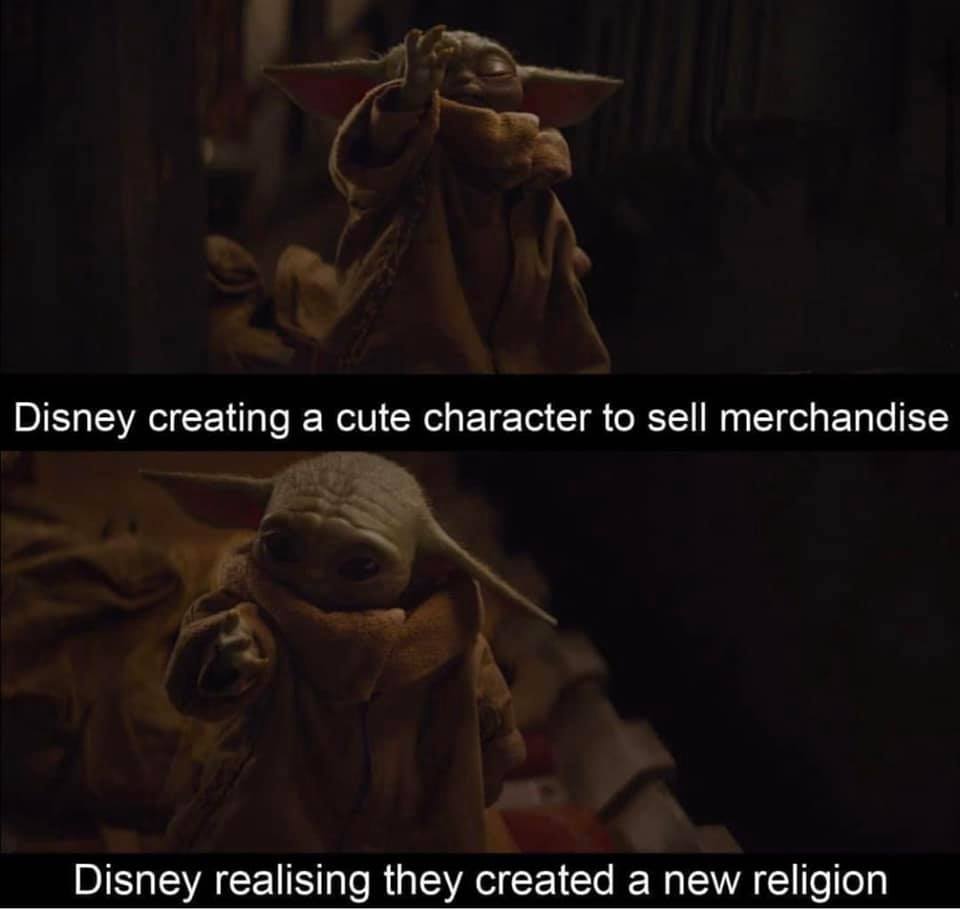
The meme is a two-panel format employing a "Drakeposting" style. The image features "Baby Yoda" (Grogu) from The Mandalorian. The top panel depicts a close-up of Grogu looking content and appealing. The bottom panel shows a more stark, shadowed close-up of Grogu appearing somewhat ominous or shocked. Text overlays define the two states: "Disney creating a cute character to sell merchandise" (top) and "Disney realising they created a new religion" (bottom). The contrast between the images highlights the unintended consequences of commodification.
Foucauldian Genealogical Discourse Analysis
This meme taps into the power dynamics inherent in the creation and circulation of culture. A Foucauldian approach would see Disney as a "discursive force"—an institution that shapes knowledge, values, and ultimately, how we perceive the world.
- Discourse & Power: Disney establishes a discourse around "cuteness," "nostalgia," and "wholesome entertainment." This discourse is not neutral; it's tied to power – the power to define cultural trends, to drive consumption, and to influence emotional responses. Grogu (Baby Yoda) becomes a node within this discourse.
- Genealogy: Tracing the "genealogy" of Grogu's popularity, we’d look at the historical factors that enabled this phenomenon: the pre-existing affection for Yoda, the successful Star Wars franchise as a foundation, the rise of social media (meme culture) as a means of dissemination, and the broader cultural tendency to imbue objects with emotional meaning. The meme acknowledges that Disney may not have intended a "religion," but the conditions existed for it to emerge.
- Subjectivation: The "religion" isn't literal worship, but rather the subjectivation of fans. Grogu becomes an object of intense emotional investment, a focus for collective feeling and shared identity, a focus for an almost religious devotion, and this shapes how fans understand themselves and their place in the world.
Critical Theory (particularly Adorno & Horkheimer - Culture Industry)
The meme directly critiques the "culture industry," a central concept in the Frankfurt School’s critical theory.
- Commodification of Affect: Disney, as part of the culture industry, deliberately standardizes and commodifies emotional responses. Grogu is designed to evoke a specific feeling (cuteness, protectiveness), and this feeling is then exploited for profit (merchandise, streaming views).
- False Consciousness: The meme suggests that fans may be unaware of the manipulative forces at play. The "realization" of creating a "religion" is a moment of potential awareness, but also a demonstration of how successfully Disney has captured collective imagination.
- Loss of Autonomy: The culture industry, according to critical theorists, diminishes individual autonomy by providing pre-packaged experiences and emotions. Fans become passive consumers rather than active creators of meaning.
Marxist Conflict Theory
A Marxist perspective would view the meme through the lens of class struggle and the inherent contradictions of capitalism.
- Capital Accumulation: Disney’s primary goal is capital accumulation. Grogu is a tool for maximizing profits. The cuteness factor is a deliberate strategy to increase demand.
- Commodification of Culture: Culture is treated as a commodity, stripped of its intrinsic value, and used to generate revenue. Grogu's character and likeness are assets to be exploited.
- Alienation: While fans feel connection with Grogu, this connection is ultimately superficial. It's mediated by the capitalist system and serves to reinforce consumerism rather than genuine social relationships. The ‘religion’ is a symptom of this alienation.
- Ideology: The meme suggests that Disney inadvertently created a new form of ideology – a set of beliefs and values centered around a commodified character.
Postmodernism
This meme resonates with postmodern themes of simulation, hyperreality, and the blurring of boundaries.
- Hyperreality: The "religion" is not a traditional religion with spiritual beliefs. It’s a hyperreal phenomenon – a simulation of religion based on a manufactured character. It's more about the feeling of devotion than any actual belief system.
- Pastiche & Irony: The meme itself is a form of pastiche, remixing a popular meme format with a critique of Disney. It's ironic because it acknowledges the absurdity of treating a corporate creation as a sacred object.
- Loss of Grand Narratives: Postmodernism rejects grand narratives (like traditional religion). The "religion" of Grogu is a fragmented, localized, and ultimately fleeting phenomenon. It’s a product of the moment, fueled by social media and consumer culture.
Queer Feminist Intersectional Analysis
While not as immediately apparent, a queer feminist lens can add interesting layers:
- Commodification of Affect & Gender: Cuteness is often heavily gendered, historically connected to femininity and caregiving roles. Grogu’s cuteness taps into these established associations. Disney, as a corporation, profits from these historically gendered affects.
- Fan Labor & Affective Labor: The devotion to Grogu often manifests in "fan labor" – creating fan art, writing fan fiction, participating in online communities. This labor is often unpaid and emotionally demanding, and Disney benefits from the enthusiasm it generates.
- Intersectionality: The meme can spark discussion about how Grogu's appeal intersects with various social identities (gender, race, class). Is the cuteness of Grogu particularly appealing to certain demographics? How does this affect the commodification process?
In essence, the meme is a concise, witty critique of late-stage capitalism, the power of the culture industry, and the ways in which we invest meaning in manufactured objects. It's a fascinating example of how memes can serve as both a reflection of and a commentary on our contemporary culture.
simple-description (llama3.2-vision)
This meme is an image of a character from the Disney movie "The Lion King" (Simba's friend and confidant, Timon the meerkat) with a sarcastic expression. The text above the image reads: "Disney created a character that is literally just a meerkat with a bad attitude and a penchant for singing about hating your parents."
tesseract-ocr
Ta rf | Disney creating a cute character to sell merchandise i ‘ “ Disney realising they created a new religion