First Seen
2023-05-24T21:09:25+00:00
simple-description (qwen3.5_2b-q8_0)
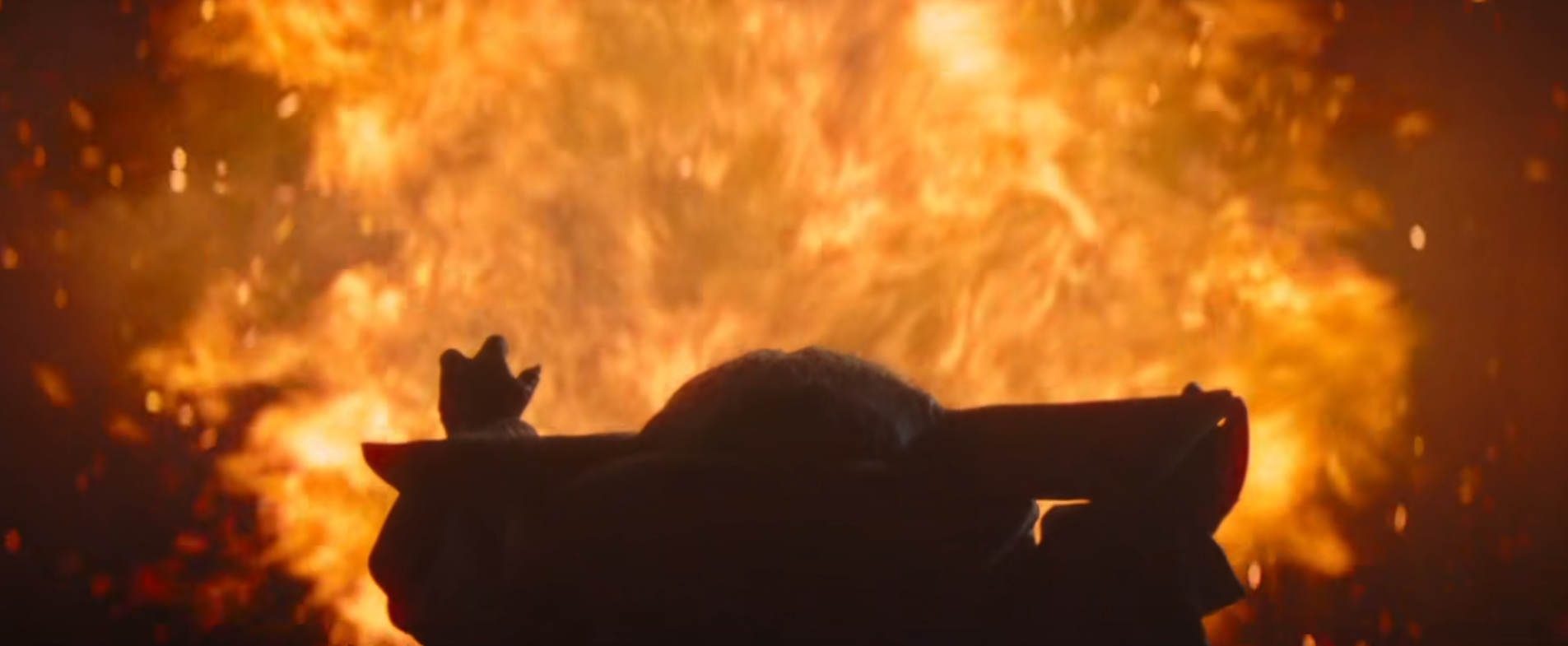
This image depicts the character Grogu (Baby Yoda) from The Mandalorian Season 4. He stands serenely with his arms raised while a massive, raging explosion of fire engulfs the forest behind him in the scene. This visual is a popular meme format that plays on the absurdity of a calm, innocent little one being the center of a chaotic and violent disaster. In the context of the "Baby Yoda" meme, this specific image is frequently paired with text like "You're a Jedi, right?" to highlight how out of place the peaceful little one is in that dangerous environment.
simple-description (llama3.2-vision_11b)
In this meme, Baby Yoda is shown holding a lightsaber and standing in front of a massive explosion. The image is captioned "When you finally get a job that lets you use your skills for evil." The meme is a humorous take on the character's abilities and the idea that even the smallest and most innocent-looking creatures can be powerful and destructive.
detailed-analysis (gemma3-27b-vision)
Okay, here's an analysis of the image, broken down into the requested sections. Since the image is quite stark, not all sections will be deeply applicable, but I'll address where they fit and explain the degree to which they do.
Image Description
The image is dominated by a fiery, orange-red background, resembling an explosion or intense flames. A dark silhouette of a person’s upper body is visible in the foreground, obscuring most of the figure’s form. The figure is positioned in a way that suggests holding or resting on a large, rectangular object (perhaps a book or a wooden surface). One hand is raised in a gesture that is difficult to fully interpret – it might be a sign of defiance, supplication, or even simply an attempt to shield from the heat. The overall impression is one of powerlessness amidst a catastrophic event or a dramatic transformation. The stark contrast between the darkness of the silhouette and the brightness of the fire creates a visually striking and emotionally charged composition.
Foucauldian Genealogical Discourse Analysis
This image lends itself well to Foucauldian analysis. The fire can be seen as a symbol of power and discipline. Historically, fire has been used as a tool for punishment, cleansing, and creating boundaries. A genealogical approach, rather than asking what the fire means, would examine how the association of fire with control and transformation developed historically. We'd look at how discourses surrounding fire have been constructed (e.g., religious associations with purification/hell, military uses, industrial revolution, etc.).
The silhouette’s position – seemingly attempting to cling to the object (book/surface) – suggests a struggle against the forces represented by the fire. This struggle isn’t necessarily about truth or morality but about power relations. The silhouette represents a subject attempting to navigate, resist, or be constituted within the dominant discourse (the fire).
The object being held can be examined as a site where power operates. Is it a text representing established knowledge? Is it a material foundation upon which knowledge is built? The silhouette’s relationship to this object reveals the subject’s position within the network of power/knowledge.
The image asks: what historical formations have shaped the discourse of destruction and how does this individual position themself within that discourse?
Critical Theory
The image invokes themes central to the Frankfurt School's Critical Theory. The overwhelming fire can be interpreted as a metaphor for the destructive forces of instrumental reason—the relentless pursuit of efficiency and control, often at the expense of human values. The silhouette, attempting to cling to the rectangular object, could represent a last vestige of enlightenment, humanity, or culture in the face of encroaching barbarism or a world overtaken by technology and systems of domination.
The image critiques the notion of progress. The fire might symbolize the unintended consequences of unchecked technological advancement or a society driven by purely rational calculations. The silhouette's struggle suggests the alienation of the individual within a totalizing system.
It asks us to question the underlying power structures that create the conditions for such devastation, and to consider whether the pursuit of rationality has led to a loss of meaning and value.
Marxist Conflict Theory
From a Marxist perspective, the image can be seen as a representation of class conflict and revolutionary struggle. The fire embodies the forces of destruction that are inherent in capitalist systems—the cycles of boom and bust, the exploitation of labor, and the constant drive for accumulation.
The silhouette, attempting to protect the object, may represent the proletariat clinging to their means of production or their cultural heritage in the face of bourgeois domination. The fire could also be interpreted as the historical inevitability of class struggle, the burning away of the old order to make way for the new.
The object being held could symbolize the material conditions of society, the foundations upon which class relations are built. Its protection, therefore, can be seen as a fight to maintain some semblance of stability and control in a world undergoing radical transformation. However, without more context, it's hard to be precise. It could also be a critique of clinging to old material conditions instead of embracing necessary change.
Postmodernism
The image aligns with several key themes in Postmodern thought. The stark contrast and lack of clear narrative invite multiple interpretations. There is no single, fixed meaning. The fire can be seen as a symbol of chaos, fragmentation, and the collapse of grand narratives.
The image disrupts the notion of linear history. It represents a moment of discontinuity, a break from the past. The silhouette's struggle is not necessarily about achieving a specific goal but about navigating a world without inherent meaning.
The absence of a clear context encourages a focus on the surface of the image—the play of light and shadow, the textures, the composition—rather than attempting to uncover a hidden truth. It highlights the constructed nature of reality and the impossibility of achieving objective knowledge.
Queer Feminist Intersectional Analysis
While the image isn’t explicitly gendered or sexually coded, an intersectional reading can be applied. The fire can be viewed as a symbol of patriarchal violence and systemic oppression. Historically, women, queer individuals, and marginalized communities have been disproportionately affected by violence, both physical and symbolic. The fire can represent the destructive forces of dominant ideologies and power structures that seek to silence and erase these groups.
The silhouette's struggle to protect the object may represent the fight to preserve cultural heritage, knowledge, and traditions that have been marginalized or suppressed by dominant cultures. The fact that the silhouette is obscured suggests the invisibility and erasure of these groups within mainstream narratives.
The act of clinging to the object might also be seen as a form of resistance—a refusal to be consumed by the forces of oppression. It's a claim of agency in a world that seeks to deny it.
However, this is a more speculative reading and requires more contextual information. The image doesn't overtly depict any gendered or sexualized content, but it can be interpreted through an intersectional lens to address themes of power, oppression, and resistance.
Let me know if you'd like me to elaborate on any of these sections, or explore other potential interpretations of the image.
simple-description (llama3.2-vision)
The meme is a picture of the "Tatooine" scene from the movie Star Wars, where a group of characters are standing in front of a massive explosion. The image is captioned "When you finally get the internet to work after a 3 hour outage".
tesseract-ocr
e's ‘sia ~.\ . | 2, * ; re 4 | . * 2 a ha rd . - Ry ee ee mn ‘ —_ , P * . " Ss ht be, ca ‘ a ¢ 4 . = — tne aa : a , Sy a. y . % a]