First Seen
2023-05-10T21:03:41+00:00
simple-description (llama3.2-vision_11b)
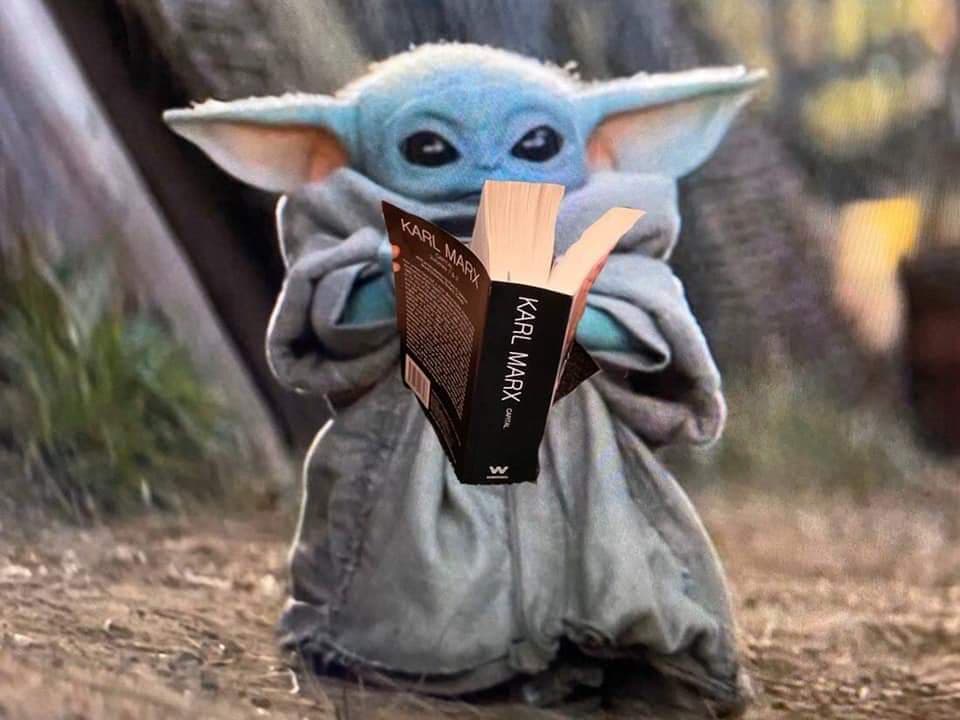
The meme features Baby Yoda from the Star Wars series holding a book with the title "Das Kapital" by Karl Marx. The image is a humorous take on the character's fascination with reading, as it is a book about economics and politics.
detailed-analysis (gemma3-27b-vision)
Okay, here's an analysis of the image, broken down into the requested theoretical frameworks, only where applicable. Given the nature of the image, some sections will be much more developed than others.
Visual Description
The image features “Baby Yoda” (Grogu) from The Mandalorian, rendered in a digital, possibly AI-generated, format. The character is seated, appearing to hold a book open in its hands. The book's spine clearly displays the name "KARL MARX," alongside the letter "W". The setting appears to be a forest floor, with blurred foliage in the background. The image has a somewhat surreal quality, due to the incongruous juxtaposition of a popular culture character with a foundational figure in Marxist thought. The image seems created for humor or internet meme culture, leaning into the unexpected pairing.
Marxist Conflict Theory
This image is most directly amenable to a Marxist interpretation. The juxtaposition of Grogu with a book by Karl Marx is immediately provocative.
- Ideology: The image presents a playful, even absurd, confrontation between a symbol of "innocence" (Grogu) and a figure associated with revolutionary thought and critique of capitalist society (Marx). This can be seen as a comment on the process of ideological interpellation – the way in which individuals are "hailed" and come to accept dominant ideologies. Here, the image ironically "hails" Grogu as a potential Marxist, undermining the assumed innocence and suggesting the possibility of ideological awareness even in the most unexpected places.
- Class Struggle/Potential: Grogu, as a dependent, non-productive character in The Mandalorian, can be seen as representative of the proletariat – those who rely on others for survival. Presenting Grogu reading Marx hints at the potential for class consciousness, even within a being seemingly outside traditional structures of production. It's a visual metaphor for the awakening of revolutionary thought.
- Critique of Capital: While the image is humorous, it can be interpreted as a subtle critique of the commodification of both Star Wars/Disney and of theoretical thought. Both Star Wars and Marxist thought have become cultural commodities, and the image's playful blending of the two highlights this process.
Foucauldian Genealogical Discourse Analysis
A Foucauldian reading would focus on how power/knowledge operates within the image itself and the discourses it engages with.
- Discursive Formation: The image creates a new discursive formation—a blending of the Star Wars fandom discourse, the academic discourse around Marxism, and the meme/internet culture discourse. This blending re-contextualizes both Grogu and Marx, altering how they're understood.
- Power/Knowledge: The image performs power/knowledge by associating a powerful intellectual tradition (Marxism) with a character who embodies childlike vulnerability and dependence. It subtly asserts a type of "authority" of Marxian thought.
- Genealogy of “Innocence”: A genealogical approach might trace how the idea of "innocence" (embodied by Grogu) has been constructed and deployed historically, often as a tool for social control or justification of power. By placing Grogu with Marx, the image complicates this construction.
Postmodernism
The image lends itself to a postmodern interpretation through its embrace of irony, pastiche, and playful deconstruction of meaning.
- Pastiche & Intertextuality: The image is a clear instance of pastiche, blending elements from disparate cultural contexts (Star Wars and Marxist theory). This intertextuality creates a new, layered meaning that is not present in either source.
- Deconstruction of Meaning: The image deliberately subverts expectations. We don’t expect Grogu to be reading Marx. This disruption of established meaning is a hallmark of postmodernism.
- Hyperreality: In the age of social media and digital manipulation, the image contributes to a sense of hyperreality, where the boundaries between reality and simulation become blurred. It’s a digitally created image, meant to be shared and reinterpreted.
Queer Feminist Intersectional Analysis (Limited Applicability)
While not a central reading, we can make some limited connections.
- Challenging Binary Oppositions: The image disrupts conventional binary oppositions: "innocence" vs. "intellectual rigor," "pop culture" vs. "academic theory." This disruption aligns with queer feminist thought that seeks to dismantle rigid categories.
- Subversion of Expectations: The image’s playful subversion of expectations can be seen as a minor act of resistance against dominant cultural norms.
- Representation: One could argue that "decontextualizing" Grogu (putting it in a setting or position it would not normally be in) subtly plays with ideas of representation and control.
Important Note: A fully developed Queer Feminist Intersectional analysis would require more specific contextualization and exploration of power dynamics beyond the superficial level. It's a less compelling reading in this case than the Marxist or Postmodern interpretations.
Hopefully, this breakdown provides a comprehensive analysis of the image from the requested theoretical perspectives! Let me know if you'd like me to elaborate on any specific point.
simple-description (llama3.2-vision)
The meme is an image of a child from the movie Star Wars, known as Baby Yoda, holding a book with the title "Das Kapital" by Karl Marx. The book is upside down, and Baby Yoda is holding it with both hands, looking puzzled. The text "I'd read Das Kapital but it's really long" appears at the top of the image.
tesseract-ocr
. 4 ~ an ‘ i As ad F e ak f s | ~ oy Fi y ' a - * a i A EO } wee ad — Sf EN ; vu a ae, \ Se ee ¥. a 2 Le A i} A ry iy 4 Z 4 ; a % PRE oe i= | ~ = ~ ne 2 s pee. oe oe ~ Son. — oe ea SA ae es Fe i