First Seen
2023-05-10T21:03:41+00:00
simple-description (llama3.2-vision_11b)
The meme is a screenshot from the Star Wars: The Mandalorian TV series, featuring the character "Baby Yoda" (also known as "The Child") from the show. The image shows Baby Yoda looking curious and adorable, with a caption that reads "I am 300 years old" in a playful, sarcastic tone. The meme is often used to express innocence or a lack of understanding, implying that someone is acting older or more mature than they really are.
detailed-analysis (gemma3-27b-vision)
Okay, let's break down this meme using the requested theoretical frameworks.
Visual Description
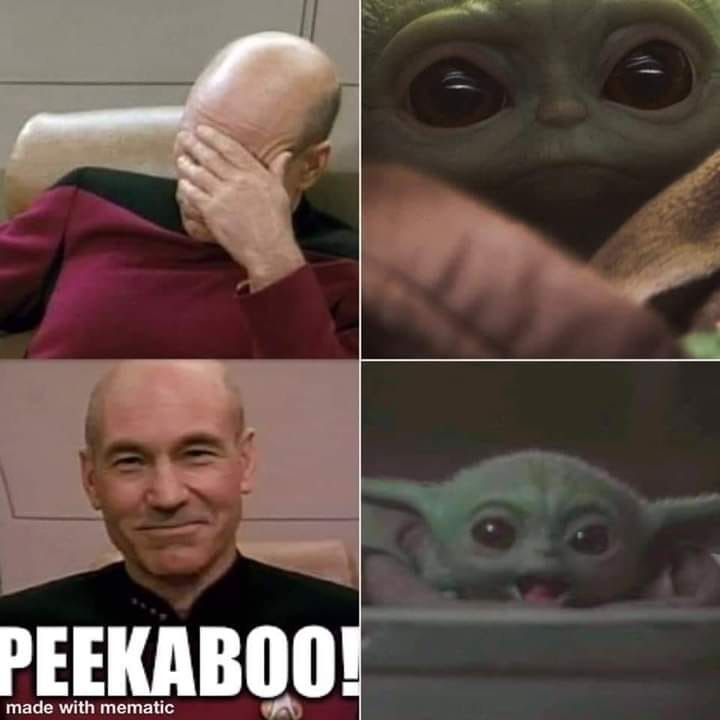
The meme is a four-panel image utilizing a common meme format: pairing contrasting or related images for comedic effect.
- Top Left: Patrick Stewart (known for his roles in Star Trek and other dramatic productions) is pictured seated in a burgundy jacket. He has his hands covering his eyes.
- Top Right: A close-up of Grogu (commonly known as "Baby Yoda" from The Mandalorian) with its eyes closed in a similar pose, as if playing peekaboo.
- Bottom Left: Patrick Stewart smiling with his hands down.
- Bottom Right: Grogu smiling and opening its mouth.
Across the panels, the meme relies on visual parallelism: matching the actions and expressions of Stewart and Grogu to create a humorous juxtaposition. Text is added at the bottom, reading “PEEKABOO!” and a watermark that the meme was “made with mematic.”
Postmodernism
This meme epitomizes several key tenets of postmodern thought:
- Pastiche/Intertextuality: The meme brings together two very different cultural artifacts – a respected dramatic actor and a character from a modern sci-fi series. It playfully combines them in a new context, creating a new meaning through association. This “mixing” of references is a hallmark of postmodern culture.
- Irony/Playfulness: The meme is not intended as a serious commentary, but as a playful recontextualization. The humor comes from the unexpected pairing of a sophisticated actor and a cartoonish, beloved character. This playful approach is characteristic of postmodern aesthetics.
- Deconstruction of Authority: The meme takes a traditionally “high-culture” figure (Stewart) and places him on the same plane as a character designed for entertainment. This disrupts the traditional hierarchy of cultural authority, implying that both forms of expression can be equally valued for their ability to elicit emotional response.
- Simulacra and Simulation: The meme itself is a simulation of a playful interaction, utilizing images to create a feeling that is separate from a genuine moment. The meme does not seek to represent reality, but to create a hyperreality.
Foucauldian Genealogical Discourse Analysis
A Foucauldian analysis would focus on the discourse surrounding Patrick Stewart, Grogu, and the act of playing peekaboo.
- Power/Knowledge: The meme relies on pre-existing power/knowledge formations. We "know" Patrick Stewart as a serious actor, and Grogu as an adorable, often vulnerable character. This pre-existing knowledge is essential to the meme’s humor. The meme momentarily disrupts these expectations, revealing the constructed nature of these "truths."
- Genealogy of Peekaboo: The act of peekaboo, as presented in the meme, can be traced as a power dynamic. The one hiding (Stewart/Grogu) exerts power over the one seeking. The reveal grants the seeker pleasure and a reassertion of control.
- Discipline and Normalization: The meme plays on the normalized idea of playfulness and joy in childhood. Peekaboo is a formative game, teaching object permanence and social interaction. The meme subtly reinforces this “normal” behavior.
- Shifting Discourses: The meme is itself a discourse, contributing to the ongoing conversation around these cultural figures. It reshapes the meaning of their images and actions, potentially influencing how they are perceived in the future.
Critical Theory
A critical theory lens might examine the meme in terms of cultural production and the perpetuation of certain ideologies.
- Cultural Industry: The meme is a product of the "cultural industry" (Adorno & Horkheimer). It commodifies images and emotions for the sake of entertainment and engagement.
- Mass Culture: The meme represents the dilution of cultural meaning in mass culture. While Stewart and Grogu come from distinct contexts, the meme reduces them to easily digestible, viral content.
- Ideology: The meme reinforces the ideology of cuteness and harmless play. By aligning a serious actor with a cute character, it reinforces the idea that these emotions are universal and inherently positive.
- Spectacle: The meme is a form of spectacle (Debord). It offers a fleeting moment of entertainment that distracts from more serious social and political issues.
Other Frameworks
Marxist Conflict Theory: Not very strongly applicable here. While we could examine the production and consumption of the meme as a capitalist enterprise, the core themes and meaning of the meme do not inherently involve class conflict or material struggle.
Queer Feminist Intersectional Analysis: This framework also has limited applicability. While we could analyze the meme for gendered or queer undertones, those are not explicitly present or central to its meaning. The meme's humor and meaning are not significantly dependent on questions of gender, sexuality, or intersectional identity.
Hopefully, this analysis provides a good overview of the meme through various theoretical lenses! Let me know if you'd like any of these points elaborated upon, or if you'd like me to explore another theoretical framework.
simple-description (llama3.2-vision)
The meme is a humorous image featuring a character from the Star Wars franchise, specifically a certain beloved creature known for its adorable and expressive face. The image shows this creature with a surprised and delighted expression, as if it's just seen something amazing. The text "I see children playing with a droid that shoots the blasters too" appears below the image, referencing a scene from the Star Wars franchise.
tesseract-ocr
V7 5 — _/ fe : aad = : ae 27 — | \ o is , PEEKABOO