First Seen
2023-05-10T21:03:41+00:00
simple-description (llama3.2-vision_11b)
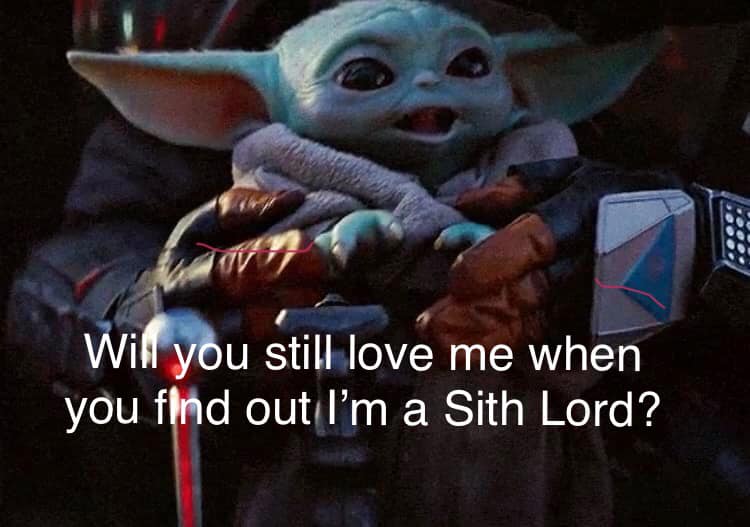
The meme features a screenshot of Baby Yoda from the Star Wars series "The Mandalorian" with the caption "Will you still love me when you find out I'm a Sith Lord?" This meme plays on the idea of a romantic partner's acceptance of a partner's dark side, a common trope in fantasy fiction. The image is likely humorous because it implies that the speaker is a Sith Lord, a villainous character, and is asking their partner to still love them despite their dark nature.
detailed-analysis (gemma3-27b-vision)
Okay, let's analyze the image of "Baby Yoda" (Grogu) with the text "Will you still love me when you find out I'm a Sith Lord?" through a few theoretical lenses.
Visual Description
The image features Grogu, the character popularly known as "Baby Yoda" from The Mandalorian series. He is presented in a close-up, appearing vulnerable and endearing, with large expressive eyes looking directly at the viewer. His skin tone is a characteristic green, and he is dressed in a brown robe-like garment. The background is dark and blurred, suggesting a spaceship interior, potentially The Razor Crest. The overall aesthetic leans into the “cute” and helpless, leveraging the kawaii aesthetic to engender protective feelings in the audience. The image is overlaid with white text in a clear sans-serif font. The placement of the text beneath Grogu subtly directs the viewer to associate the question with his appearance.
Foucauldian Genealogical Discourse Analysis
Foucault's work emphasizes the relationship between power, knowledge, and discourse. Within the Star Wars universe, the concept of the "Sith Lord" is heavily discursively constructed. The Jedi and Sith represent opposing power structures, with the Jedi traditionally framed as benevolent protectors and the Sith as agents of chaos and evil. This dichotomy isn’t natural; it’s a constructed opposition. The image subverts this discourse. By having Grogu, a creature designed to evoke innocence and dependency, pose the question of being a Sith Lord, it disrupts the established power dynamic.
The question itself is an interrogation of this power/knowledge system. It’s not about being evil, but about the conditions under which Grogu’s potential “Sith Lord” identity will affect the love and care he receives. This question forces us to consider: what constitutes "good" or "evil" in Star Wars (and by extension, in our own world)? Is affection conditional upon adherence to a particular moral code? The "discourse" around Sith Lords is one of fear and condemnation. This image throws that discourse into question.
Critical Theory (Specifically, Frankfurt School/Adorno/Horkheimer)
From a critical theory perspective, we could read this image as a commentary on the commodification of innocence and the entertainment industry's tendency towards spectacle. Grogu, as a character, became a hugely popular "meme" and merchandise item, becoming a commodity for consumption. This image plays with that commodification. It presents a traditionally "cute" character, seemingly questioning their own monstrous potential.
The question about being a Sith Lord could be interpreted as a critique of the spectacle of good versus evil. The image implies that even a potentially "evil" being (a Sith Lord) deserves love and acceptance, questioning the simplistic binaries that are often promoted in popular culture. The image deconstructs the spectacle of the Star Wars universe, prompting reflection beyond simple “hero/villain” narratives.
Postmodernism
The image is a quintessential postmodern pastiche. It combines elements of high and low culture (the Star Wars franchise, a meme format), blurs the boundaries between innocence and corruption, and relies on irony and self-referentiality. The question itself is a meta-commentary on the tropes of the Star Wars saga, acknowledging the audience's familiarity with the Sith and Jedi conflict.
The image deconstructs the idea of a stable identity. Grogu is both cute and potentially menacing. It challenges the concept of a unified self, suggesting that identity is fluid and performative. The image also embraces ambiguity – the question is left unanswered, encouraging viewers to project their own interpretations onto the character.
Queer Feminist Intersectional Analysis
While not immediately obvious, a Queer Feminist Intersectional reading can be applied by recognizing that “love” itself is a socially constructed concept often tied to expectations of "good" behavior and conforming to societal norms. Grogu's question challenges the conditional nature of love. It interrogates the expectation that affection is contingent upon adhering to a particular moral code.
Furthermore, the image can be read as a commentary on vulnerability and power dynamics. Grogu’s infantile form presents a position of vulnerability, yet he poses a question that subverts the traditional power dynamic (a potentially dangerous Sith Lord seeking reassurance). This can be interpreted as a critique of patriarchal power structures that often equate strength with dominance and vulnerability with weakness.
The question of “Will you still love me…?” can be understood as a challenge to the expectation of unconditional acceptance, particularly for those who transgress societal norms. In this context, being a "Sith Lord" represents a transgression of the Star Wars universe's moral code, and the question challenges the audience to consider whether love should be extended even to those who are perceived as "evil" or "different."
Let me know if you'd like me to elaborate on any of these analyses, or explore other theoretical frameworks!
simple-description (llama3.2-vision)
This meme is a play on the classic "I love you" declaration, but with a twist. The image features a screenshot from the Star Wars franchise, with the character Darth Vader holding a young Luke Skywalker. The text overlayed on the image reads: "In a galaxy far, far away... I love you" and "But you are no match for the dark side... I am your father".
tesseract-ocr
tae a —- po aie As e he y he i Te, || anf ro | ™~ iW yOu stilllove me when you fiad out\l’m a Sith Lord? t