First Seen
2023-05-24T21:09:26+00:00
simple-description (qwen3.5_2b-q8_0)
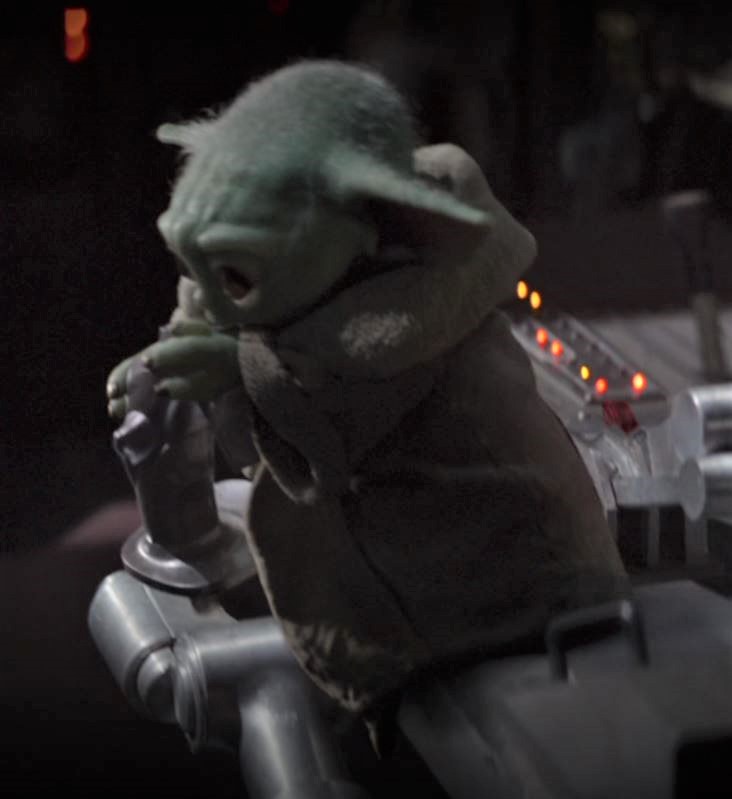
This meme features Baby Yoda (Grogu) from the Baby Yoda Show (The Mandalorian), who is famous for the "Three-Finger Rule." This rule states that Grogu is only allowed to say the word "Yoda" when he holds up exactly three fingers to his face. Visible text in the top left corner of the image reads "GAMERS' MINDSET."
simple-description (llama3.2-vision_11b)
The meme features Baby Yoda, a character from the Star Wars franchise, sitting in a chair, looking unimpressed. The image is captioned "When you're trying to learn to use the Force but your teacher is just making it harder". The meme is a humorous take on the character's struggles with learning to use the Force, poking fun at the challenges of being a young Jedi.
detailed-analysis (gemma3-27b-vision)
Okay, let's analyze the image of Grogu (Baby Yoda) through the lenses you've requested. Given the image’s limited context, certain analyses will be more speculative, but I'll provide as thorough a response as possible, noting when those speculations are being made.
Visual Description
The image depicts Grogu, the character from The Mandalorian, in a close-up, side profile. He appears to be seated in what is likely a spaceship or craft, with metallic, industrial-looking elements surrounding him. The lighting is low-key, emphasizing the dark greens of his skin and the shadows across his face. He is holding what appears to be a silver ball or sphere, possibly a toy or a snack. Grogu’s expression is thoughtful, even melancholic. His large ears are prominently featured, adding to his iconic character design. The background is largely black and indistinct, focusing the viewer's attention solely on Grogu and his immediate surroundings. The small series of red lights in the background suggests advanced technology.
Foucauldian Genealogical Discourse Analysis
A Foucauldian analysis would focus on how Grogu’s depiction contributes to discourses around "childhood," "power," and "otherness." The image presents a constructed view of what a “child” can be – radically different from human conceptions of infancy. Grogu is powerful in the Force, and the image subtly portrays this through his concentration and posture. This challenges the conventional discourse that positions children as inherently powerless and needing protection.
The use of puppetry and CGI constructs Grogu as a specific object of knowledge. We aren’t seeing a "real" infant, but a fabricated representation, and its construction is therefore informed by pre-existing power structures that define what we consider acceptable or desirable in a young being. Grogu’s "cuteness" isn’t innate; it's produced through design choices that leverage human predispositions to nurture. Furthermore, Grogu is clearly othered through his species and his appearance. The discourse surrounding his ‘cuteness’ masks the fact that he is fundamentally different from a human infant, thus reinforcing a desire to control and understand the ‘other’.
Critical Theory (Specifically Frankfurt School)
From a Frankfurt School perspective (Adorno, Horkheimer), the image can be seen as contributing to the “culture industry.” Grogu's widespread popularity and commodification (merchandise, memes, etc.) represent a form of mass-produced entertainment designed to pacify and distract from genuine social and political issues. His "cuteness" functions as an ideological tool, offering a superficial emotional connection that masks deeper structures of power and control within the Star Wars universe and our own. The image, disseminated through popular media, reinforces a consumer culture that prioritizes spectacle and entertainment over critical thought. The emphasis on Grogu’s vulnerability, while seemingly heartwarming, may serve to reinforce the passivity and emotional manipulation inherent in mass media.
Marxist Conflict Theory
Applying a Marxist lens, the image can be read as reflecting class structures within the Star Wars universe. Grogu, as a member of Yoda’s species, is exceptionally powerful in the Force, suggesting a potential for social influence. However, he is also inherently dependent—at first on the Mandalorians, and subsequently reliant on Luke Skywalker— mirroring the power dynamics between the proletariat (those who labor) and the bourgeoisie (those who control the means of production). The ship represents a resource – and the capacity to travel – that is not available to everyone.
The image itself, as a piece of media, can be seen as a commodity produced for profit. The emotional engagement it elicits (adoration, empathy) is exploited for commercial gain, reinforcing capitalist structures of accumulation. The Mandalorian, a bounty hunter with a degree of autonomy, could be seen as representative of a working class seeking to navigate a complex and exploitative system.
Postmodernism
From a postmodern perspective, the image exemplifies the blurring of boundaries between "real" and "simulated." Grogu is a CGI creation, a hyperreal construct that is more visually striking and emotionally affecting than anything found in "reality." The character performs "cuteness," and we respond to this performance as if it were authentic, participating in a simulation of emotional connection. The image also highlights the fragmentation of narrative and the emphasis on spectacle over substance, characteristic of postmodern culture.
The character’s popularity and the endless production of Grogu-themed merchandise represent the hypercommodification of culture, where meaning is increasingly derived from surface aesthetics and branding rather than inherent value. The image lacks a singular, definitive meaning; it is open to multiple interpretations and constantly re-contextualized through memes, fan fiction, and other forms of cultural appropriation.
Queer Feminist Intersectional Analysis
While seemingly less direct, an intersectional queer feminist analysis can illuminate interesting aspects. Grogu's lack of traditional gender markers (he is neither definitively male nor female) challenges conventional notions of gender and sexuality. This androgyny could be interpreted as a form of resistance to binary gender norms. The way in which the Mandalorian acts as a caregiver to Grogu subverts the traditionally gendered role of nurturer, potentially challenging patriarchal structures.
However, it's crucial to acknowledge the potential for infantilization and the power imbalance in this relationship. The Mandalorian, as an adult, wields authority over Grogu, and the representation of this dynamic needs to be critically examined for potential exploitation or objectification. Moreover, the character’s inherent vulnerability, while endearing, could reinforce the marginalization of those deemed dependent or helpless.
Important Disclaimer: These analyses are based on a single image and rely on interpretive frameworks. Contextualizing Grogu within the broader narrative of The Mandalorian and The Book of Boba Fett would yield richer and more nuanced insights.
Let me know if you'd like me to elaborate on any of these analyses or explore other theoretical perspectives!
simple-description (llama3.2-vision)
The meme is a screenshot of the character Baby Yoda from the TV show "The Mandalorian" sitting in a high chair, looking unimpressed and disinterested. The text "When you're trying to learn to fly but you're still working on walking" is overlaid on the image, implying that Baby Yoda is frustrated with his own lack of progress. The meme is a humorous take on the challenges of learning new skills.
tesseract-ocr
y . * 3 a on a | : in . \ 42 ee ; ! -