First Seen
2023-05-10T21:03:42+00:00
simple-description (qwen3.5_2b-q8_0)
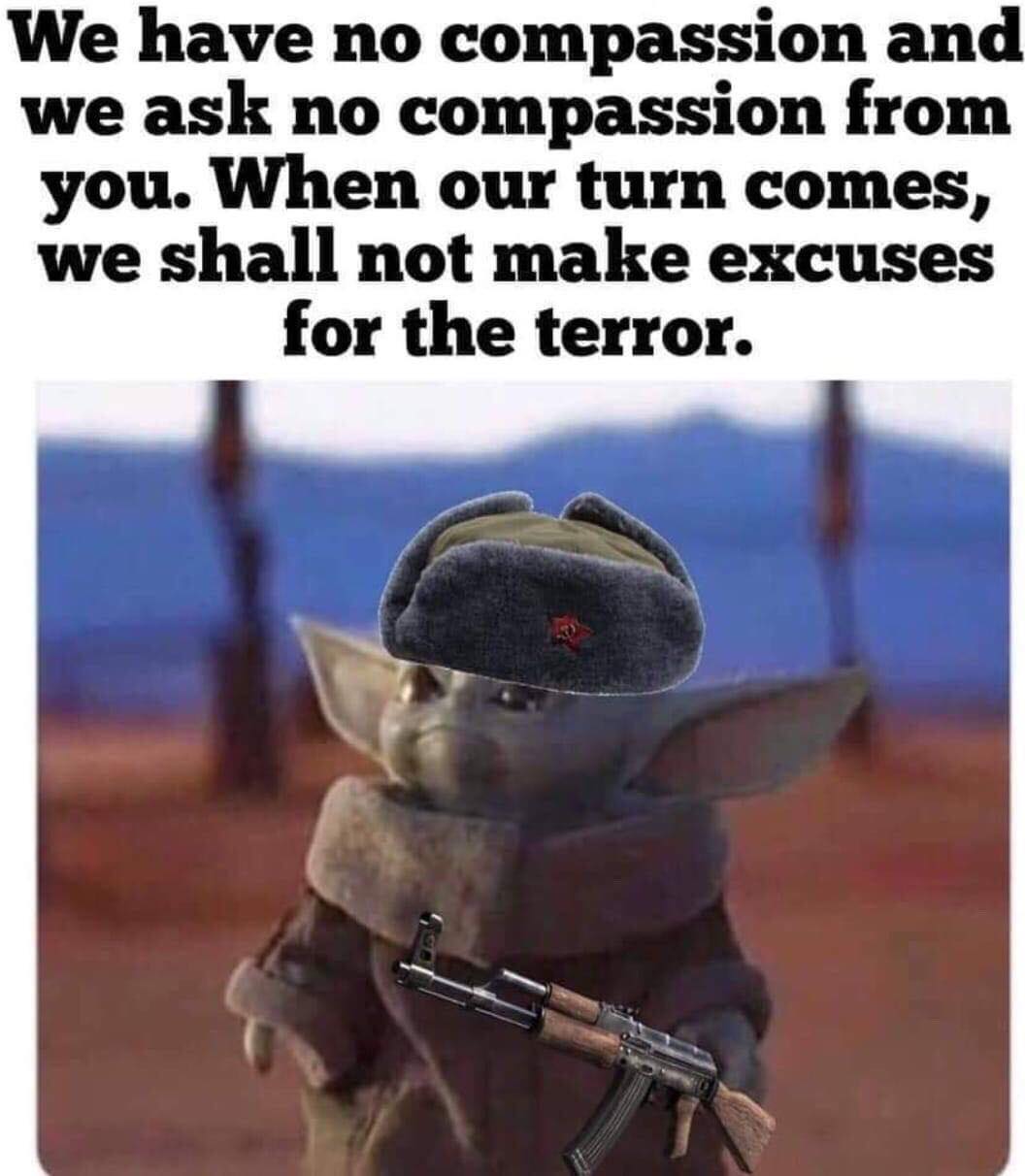
This meme uses the character Baby Yoda from Star Wars to satirize the Russian government. While Baby Yoda is typically portrayed as a gentle, wise being, here he is comically depicted wearing a Soviet-style hat and holding an assault rifle. The text quotes a famous Russian government slogan—"We have no compassion and we ask no compassion from you. When our turn comes, we shall not make excuses for the terror"—but applies it ironically to the innocent character to suggest that Russia has no mercy and won't apologize for its violent actions.
simple-description (llama3.2-vision_11b)
The meme features Baby Yoda from the Star Wars series, dressed in a military uniform and holding a blaster, with the quote "When I find out what's behind the curtain, I'll put a rocket through it" from the movie "The Dark Knight" superimposed over the image. The quote is a humorous and ironic juxtaposition with the image of Baby Yoda, implying that even a young and innocent being like Baby Yoda is capable of intense anger and violence. The meme is likely intended to be humorous and satirical, poking fun at the idea of a young child being capable of such intense emotions.
detailed-analysis (gemma3-27b-vision)
Okay, let's break down this image and its accompanying text through the requested theoretical lenses. It's a complex image, drawing on several layers of symbolism, so a thorough analysis requires multiple approaches.
1. Visual Description
The image depicts Baby Yoda (Grogu) from The Mandalorian digitally altered to appear militarized. The core visual elements are:
- Grogu/Baby Yoda: The central figure, usually associated with innocence, vulnerability, and cuteness.
- Soviet Ushanka Hat: This hat, adorned with a red star, evokes the imagery of the Soviet Union, Communism, and a historical context of state-sponsored violence and ideology.
- AK-47 Rifle: The iconic assault rifle, heavily associated with revolutionary movements, warfare, and violent conflict.
- Setting: A barren, reddish-brown landscape, possibly suggesting a desert or war-torn environment. The fence in the background is simple and could represent confinement or border control.
- Text: "We have no compassion and we ask no compassion from you. When our turn comes, we shall not make excuses for the terror." This is a stark and uncompromising statement.
The overall visual effect is jarring and intentionally unsettling. It juxtaposes an icon of innocence with symbols of violence and ideological extremism, creating a provocative and potentially disturbing image.
2. Foucauldian Genealogical Discourse Analysis
Michel Foucault's genealogical approach focuses on tracing the historical emergence of concepts, power relations, and discourses. In this image, we can analyze:
- The "Terror": The text explicitly references "terror." A Foucauldian reading wouldn’t treat "terror" as a pre-existing, essential concept. Instead, it would analyze how the discourse of terror has been constructed historically – how it's been defined, justified, and deployed as a tool of power. It looks at the historical association of terror with revolutionary movements (e.g., the French Revolution, Soviet Russia) and how it's become a key concept in contemporary political rhetoric (e.g., the "War on Terror").
- Power/Knowledge: The image links the cute image of Baby Yoda to the Soviet symbol of oppression and violence. This is a powerful association that demonstrates how seemingly innocuous images can be used to assert dominance and project an ideology.
- Discipline and Biopower: The image suggests a shift in power dynamics where the normally vulnerable is asserting a capacity for violence. This alludes to the control of populations by utilizing force.
- The Discourse of Compassion/Lack of Compassion: The text inverts the expectation of compassion normally associated with Grogu. This act dismantles the expectation and frames the entity as being beyond empathy.
3. Marxist Conflict Theory
From a Marxist perspective, this image embodies a struggle for power.
- Class Conflict: While the image isn't explicitly about class, the "us vs. them" framing (those who show no compassion vs. those who are denied it) implicitly suggests a conflict between opposing groups. Those who will enact "terror" see themselves as oppressed or marginalized and seek to overturn the existing power structure.
- Revolutionary Violence: The image, with its Soviet symbols and threat of "terror," can be read as a justification of revolutionary violence. The idea is that when the oppressed finally seize power, they will not hesitate to use force to achieve their goals and will not apologize for it.
- Ideology: The image serves as a form of ideological propaganda. The association of Grogu with Soviet iconography attempts to legitimize a particular political worldview and mobilize support for violent action.
4. Postmodernism
A postmodern reading focuses on the breakdown of grand narratives, the blurring of boundaries, and the importance of representation.
- Pastiche & Intertextuality: The image is a clear example of pastiche, mixing elements from different cultural contexts – the cute and innocent world of Star Wars with the harsh realities of Soviet history. It plays with intertextuality, relying on the viewer's recognition of these elements.
- Deconstruction of Meaning: The image deconstructs the conventional meanings associated with Grogu and Soviet symbols. The juxtaposition of these elements disrupts the viewer's expectations and challenges traditional interpretations.
- Simulacra and Simulation: The image can be seen as a simulacrum, a copy without an original. It's a manufactured image that bears no direct relation to reality but operates as a representation of power, ideology, and violence.
5. Queer Feminist Intersectional Analysis
While less directly applicable, an intersectional lens can offer a nuanced interpretation.
- Subversion of Innocence: The image subverts the cultural association of Grogu with innocence and vulnerability. This is often a dynamic that is associated with the exploitation of people.
- Power Dynamics: The imagery suggests a reappropriation of power by those typically marginalized, disrupting traditional power structures. This could be interpreted as a form of resistance.
- Deconstruction of Gender Roles: This is less prominent, but the image challenges traditional notions of cuteness, innocence, and vulnerability which are all often associated with gender norms.
Important Note: This image is highly provocative and potentially offensive. The analysis above is intended to explore the complex theoretical implications of the image and should not be interpreted as an endorsement of violence or extremism.
Let me know if you'd like me to elaborate on any specific aspect or lens of analysis.
simple-description (llama3.2-vision)
The meme features a screenshot from the 1984 film "Red Dawn" where a character says "I'm sorry, I'm sorry, I'm sorry" in a desperate attempt to save his comrades. The image is paired with a photo of the meme character, Baby Yoda from the Star Wars series, wearing a Soviet-style military hat and holding a rifle. The text overlay reads: "I'm sorry, I'm sorry, I'm sorry" and "I don't want to die" in a childlike voice.
tesseract-ocr
We have no compassion and we ask no compassion from you. When our turn comes, we shall not make excuses for the terror. ; ‘ace